Rituals in the Making: a George Washington University research project on memorialization, misinformation, and the consequences of the COVID-19 pandemic

Tag: Memorial

  • Memorialization as Movement Work – Part II: “Synopsis of Events,” and Then… Someone Dies

    Memorialization as Movement Work – Part II: “Synopsis of Events,” and Then… Someone Dies

    By Rituals in the Making

    This story discusses suicide. If you or someone you know needs help, the national suicide and crisis lifeline in the U.S. is available by calling or texting 988. There is also an online chat at 988lifeline.org.


    ICE memos record every step of Brayan Rayo-Garzón’s death in custody — and the fault of no one. Similar deaths have been recorded, documented, and archived by the state. Yet the deaths have not stopped. Between January 20, 2025, and June 4, 2026, 52 people died in Immigration and Customs Enforcement (ICE) custody in the United States. The mortality rate in ICE custody is at its highest level in over a decade (Human Rights Watch and Physicians for Human Rights, 2026).

    The healthcare system, so dependent on immigrant labor, has also seen its staff flee or be detained — most recently Ann Lawani, a nurse and professor.

    All of these deaths and detentions have been recorded as “procedures” and described in official ICE memos as a “synopsis of events.”


    Can an archive of death be more than a “synopsis of events”?

    What does it mean to archive and yet remember nothing?

    What does it mean to name and yet erase those who have been named?


    Brayan Rayo-Garzón was 27 years old. He was in ICE custody at the Phelps County Jail in Rolla, Missouri. Brayan had COVID and wanted to talk to his mom. “She must be worried,” he wrote in Spanish on a piece of paper he passed to one of the guards, hoping they would let him call her. They did not. Brayan died by suicide.

    Photo for NPR by Deisy Garzón.


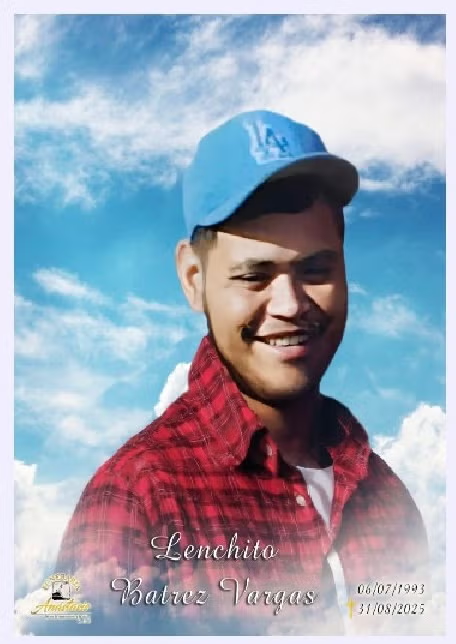
    Lorenzo Antonio Batrez Vargas was 32 years old. He died on August 31, 2025. ICE held him at the Central Arizona Correctional Complex in Florence. About 10 days after he arrived, he tested positive for COVID and was isolated in a medical unit. He received a single dose of acetaminophen. Chest X-rays later showed signs of pneumonia; ICE’s own review said his antibiotics “did not align” with CDC guidelines. After leaving isolation he had trouble breathing. The next day he reported shoulder pain, and no one checked his oxygen levels. Staff later found him dead (The Intercept). ICE listed the cause as unknown, and called claims that he received poor care “FALSE.”

    Photo from Batrez Vargas family personal archive for Human Rights Watch

    José Guadalupe Ramos-Solano was 52 years old. He was from Silao, Guanajuato, and had lived in Los Angeles for 28 years. He died on March 25, 2026, at the GEO Group’s Adelanto ICE Processing Center in California. ICE said he received ongoing care for diabetes and hypertension (Latin Times). Other detainees say they repeatedly tried to alert staff to his worsening condition, and that he got no medical attention until he was already unconscious (Colorado Boulevard). His autopsy, obtained by Scripps News in May 2026, says he had been suffering from COVID for days, with high blood pressure and cardiovascular disease as contributing causes of death.

    Photo by Gloria Ramos for GoFundMe.


    ***

    At Rituals in the Making, we have long asked what it means to name the dead. We have asked about the people who died of COVID, and the silence that closed around them. We have asked about their families, and the cry they raised against denialism. We have asked about unjust death, disposable death, and how the state writes those deaths down.

    Six years after the pandemic began, we want to turn to the archive as well: to what is kept, and what is lost, in the midst of denialism. And we want to follow how COVID’s neglect and dehumanization echo in other forms of violence.

    ***

    It is often assumed that states that produce violence would rather not write it down. The opposite is true. States often do not only produce death, or take part in it; they narrate it, with clinical attention, in official memos. The sequence of events. The number of dead. The setting. This paperwork lends the state legitimacy. It becomes an anchor from which to say how things “really happened,” and a lever for pushing “the real history” — that with a capital H. States memorialize as well.

    However, memorializing, we want to argue, is not just about recording, about documenting. Working with the bereaved, with grassroots organizations, and on civil claims has allowed us to learn that the seeming monumentality of state documentation is matched by the size of its vacuums, its silences, and its reiterations: not only in its insistence on (mis)remembering the 1.2 million people who died of COVID in the United States alone, but in its reproduction of falsehood, violence, and cruelty — in its neglect.

    With this new series of dispatches, which began last week with Sarah Wagner’s article on the memorials for Renee Good and Alex Pretti, we want to insist on other ways of remembering the pandemic dead against the state archive — what Sarah Wagner and Ariel Santikarma call “memorialization as movement work,” one in which “the dead and specifically their memory are animating forces in pushing for political change.”

    “[F]rom the movement of an individual’s hand in tracing the portraits of the deceased to creating a space of memorialization that forges social ties through and beyond life, the living work with the presence of the absent. The dead are thus remembered and transformed as kinful forces, who make the revolution of memory — and its movements toward both a livable present and future — possible.” — Santikarma and Wagner

    To counter-archive is to remember against the grain of state paperwork. It is to ask how an archive might become something living: changeable, amplifiable, made together — a movement at work. For what, for whom, and why?

    If the dead are “animating forces in pushing for political change,” then remembering cannot simply mean documenting them, or listing their names. Remembering has to entail naming them well: remembering with them, and with the social fabric their absence tears. It has to mean reading the archive of death not as a “synopsis of events,” isolated, with no one responsible, but as a record of the policies that go on producing death. It is not enough to name the dead if we do not name their lives. It is not enough if the archive does not give us back their haptics — our willingness, as Tina Campt puts it, to be touched by those in the archive. It is not enough if nothing is done about what killed them in the first place.

    As we ask what an oral history archive of COVID could be, we cannot look away from where COVID still appears, six years after its first case: in political discourse — in the memos, autopsies, and death reports of people held in ICE custody. Brayan, Lorenzo, José, and many others were all sick with COVID in custody.


    Since 2020, human rights organizations have repeatedly warned that immigrant detention centers do not meet the conditions needed to prevent and treat illness in time. “When a government detains a person, it has a heightened obligation to protect their rights, and to this end must provide adequate health care and other protections. In the case of a death in custody, the government should also provide all relevant information to the family, including medical reports and investigations into the death” (PHR, 2026).

    Yet the Department of Homeland Security has stopped listing most detainees with final deportation orders — tens of thousands of people — in ICE’s online detainee locator, as The New York Times reported (and the Associated Press first revealed the change in September). This makes it almost impossible for lawyers to defend them, since no evidence can be gathered and no case built. Physicians for Human Rights also found that in 39 cases it reviewed, “the government did not publicly provide sufficient information about the circumstances of death or about the medical care provided in detention to support a definitive clinical assessment. The available documentation was often scant, but it was nonetheless sufficient to identify serious concerns about the care provided.” Brayan’s death is one of those 39.


    BRAYAN
    A CASE, A NAME, AND YET so MUCH MORE

    On his fourth day alone in a cinderblock cell in Rolla, Missouri, sick with COVID, Brayan Rayo-Garzón slid a note under his door. He wanted to call his mother. He felt in his heart, he wrote in Spanish, that she was very worried. He appealed to the man on the other side of the door: “I know you have family, and you know that they worry about us. God bless you.”

    The guard collected the note. He did not speak Spanish, so he used a colleague’s phone to translate it, and wrote in a report that he planned to follow up. Within an hour, Brayan was found unconscious.

    Refusal 1: The Body

    The Phelps County Jail had been accepting ICE detainees for only a month when Brayan arrived. The sheriff had pitched the partnership to county commissioners as a way to bring revenue into a strained budget — millions of dollars, he told them. ICE pays a fixed sum for each detained body, each day — typically between $70 and $110 for a county jail — so a filled bed is income, and an empty one is a loss. Some counties have expanded their capacity precisely to capture that income. Care, in other words, was a side effect of a financial arrangement.

    ICE promises a medical screening within 12 hours; Brayan’s took 35. He told a nurse he was anxious. He was referred for a “routine” mental health appointment. Days later he tested positive for COVID and was moved into an isolation cell with a camera overhead, framed as protection against spreading the illness. His mental health appointment was scheduled and then canceled twice: once for lack of “mental health clinic time and staff,” and once because of his COVID diagnosis, the AP investigation found.

    Research suggests that COVID can bring on depression through neuroinflammation. The same severe immune response — the cytokine storm — releases signals (interleukin-6 among them) that may reach the brain and disturb the circuits that regulate mood. Neuropsychiatric symptoms are common in the acute phase, and a growing body of research has begun to connect that inflammation to suicidal ideation, in what researchers call the inflammatory hypothesis of suicide. Brayan was in physical distress (shortness of breath, trembling, fever) and, evidently, under psychological stress that was not addressed but instead postponed and neglected.

    Refusal 2: The Language

    The nurse who assessed Brayan did not speak Spanish. She used a handheld translation device, and through it “concluded” that he denied thoughts of suicide and depression. She recommended him for the general population and listed his condition as stable.

    But Brayan had told the staff he was suffering. He was not the only one. At a Pennsylvania facility, Chaofeng Ge, a Chinese detainee, received no mental health treatment, in part because no one there spoke Mandarin (AP); he had already attempted suicide before.


    Every night before bed, Brayan called his mother to share a blessing. “I gave him strength,” his mother, Adriana Garzón, said. Her name was tattooed on his arm. That call was their one ritual, and it was forbidden as a precaution against spreading the illness.

    The only call ICE did place was the one telling her that her son was dying.

    Couple celebrating a 21st birthday with balloons, silver decorations, cake, and party supplies.
    Brayan and Adriana on his 27th birthday. Photo by Adriana for GoFundMe.

    A well-run facility should have no suicides at all, because the moment the state detains a person, as experts told the Associated Press, it takes on the duty to keep that person alive. But even that simple assumption has changed. A new memo from acting ICE director David Venturella has ordered the agency to stop reporting the deaths of newly released detainees.

    Brayan now joins the ranks of those who contracted COVID but did not die of it. Instead, they died of the state’s refusal to recognize, to care, to act. Brayan died alone, as did so many of the COVID victims whose lives and deaths we have studied over the past several years.

    Again, we see the connection. We hear echoes of the victim-blaming public discourse of 2020 (“Wasn’t he overweight?” “Didn’t she have asthma?” “They lived a long life anyway”) in the logic that justifies an ICE detainee’s suffering — his very detention, and even his suicide (“the worst of the worst,” as the administration calls them). With its paperwork and memos, dehumanization starts to look like simple procedure.

    The scholar Saidiya Hartman has asked how we are to mourn when the event has not yet ended. The pandemic never ended for Adriana Garzón. For her, it simply went unwatched.

    The official record calls its account a “synopsis of events,” and a synopsis is exactly what it is: a list of procedures, each supposedly neutral and defensible, that forgets the man passing a piece of paper to a stranger, asking only to hear his mother’s voice one more time.

    “I beg you […] God bless you,” he wrote. And then he waited.


    Coda

    When the state offers no common form for loss, the labor of eulogizing and remembering falls to individuals. Ed Koenig, a longtime friend of Rituals in the Making and an advocate for the COVID-19 impacted, is one of those individuals. Ed lost his partner, Jody, to the pandemic and refuses to stop naming the dead — that is, feeling with those who are named. Over the past weeks, we have been inspired to see how his advocacy extends to standing against all forms of violence, including those beyond or alongside COVID.

    Here is a short interview with Ed about his ongoing activism in New York City.

    Black-and-white photo of memorial posters for Heber Sanchez Dominguez and Jose Guadalupe Ramos-Solano, labeled "Suicide in Ice Camp," attached to a vehicle.
    Black-and-white missing-person poster featuring a portrait of Lorenzo “Lenchito” Antonio Batre Vazquez.
    Black-and-white memorial poster reading “Suicide in ICE custody” with a photo of Brayan Rayo-Garzon.
    Black-and-white protest scene with barricade signs reading “DIED in ICE custody” and a “STOP TRUMP GESTAPO” sign.

    Photos by Ed koenig from the weekly silent vigils at 26 Federal Plaza, Manhattan.

    Rituals in the Making: As someone who lost a loved one to COVID, you’ve been actively involved in shaping movements to remember those who died and to push back against denialism. Has your personal experience with COVID influenced your desire to speak out against other forms of violence, like violence against migrants?

    Ed: I think my involvement in memorializing those lost to COVID-19 goes back to my earlier activities around the HIV/AIDS epidemic of the 1980s and 1990s. During that period, my partner, Jody, and I lost dozens of friends and acquaintances. It was the first time in my adult life that I realized that society in general, and the U.S. government in particular, easily denigrates the marginalized by blaming them for their own circumstances. Here are some examples of what I mean.

    Early in the HIV/AIDS epidemic, gay men were told that their illness and suffering were their own fault because they engaged in “illicit” sexual encounters. Over time, intravenous drug users who became infected were blamed for their own illness because of their addiction and the sharing of hypodermic needles. Even after it was determined that HIV/AIDS was caused by a virus, and members of the so-called “straight” community were also affected, the stigma continued. (As an aside: in 1987, when Jody first showed symptoms of multiple sclerosis and was hospitalized, he “volunteered” that he was gay. As a result, some hospital staff members would not provide him with services because they assumed he was HIV-positive. For example, they would leave his meal tray on the floor at the doorway to his room and refuse to bring it to him. Just a small example of what was going on.) Amazingly, it took five years for the President of the United States, Ronald Reagan, to even say the word “AIDS” in public. The government just didn’t care.

    I believe there have been few, if any, public monuments to those who died of HIV/AIDS. Memorialization was left to friends and loved ones. The primary memorial is the AIDS Memorial Quilt, created by family and friends. The quilt is made up of panels, three feet by six feet, that contain the names, photographs, and various mementos honoring those who died. On October 11, 1987, the quilt was first displayed on the National Mall near the U.S. Capitol. October 1996 was the last time the full quilt was displayed, with 40,000 panels laid out on the National Mall stretching all the way from the Capitol to the Washington Monument. The white flags of the In America display on the National Mall in September 2021, honoring those lost to COVID-19, immediately made me think of the AIDS quilt — memories of loved ones inscribed by those who knew them best.

    So, when COVID-19 arose, I was not surprised that those who became infected were blamed for their own illnesses or deaths. If they weren’t old, if they weren’t diabetic, if they weren’t fat, if they had taken better care of their health, they wouldn’t have gotten sick. Of course, we know that this was not always true. Again, it was the “blame the victim” game all over again. Sadly, those with COVID-19 became a handy foil for a callous and incompetent government hell-bent on retaining power. When Jody died, and as I got to know others who had lost loved ones, I knew it would be important for us to memorialize them ourselves — to let the world know that they had lived and loved, and that they mattered. So, whenever I learn of a COVID-19 memorial being created, I have always made sure Jody is included.

    Since the severity of COVID-19 has waned, immigrants in the United States have become the new marginalized. It’s not surprising to me that this has been spearheaded by the same government officials who mishandled the COVID-19 pandemic. They need a new bogeyman, and immigrants fit the bill. They forget that it was the labor of many immigrants that kept this country running when we were all under lockdown. All this, coupled with my faith tradition, motivates me to stand up for immigrants and ensure that they are respected, as they rightly deserve to be.

    Rituals in the Making: Do you see a connection between how COVID deaths have been dismissed by blaming comorbidities and the dehumanization of migrants?

    Ed: First of all, I would say that the forgetting of the destruction caused by COVID-19 and the treatment of immigrants in detention centers are both symptoms of our society’s nefarious need to have someone to blame for our own personal problems. We forget COVID-19 because it distracted us from our own pursuits — I had to stay home; I couldn’t go to the movies or eat in a restaurant; I had to wear a face mask! — and we don’t want to be reminded of that. The dehumanization of immigrants seems to me to follow from many people’s need to feel superior to someone else. Sadly, for many, seeing someone locked up in a detention center, separated from family and friends, and treated inhumanely gives them the chance to look down on someone else as inferior. I guess I don’t see them as directly related, but they stem from the same societal issues.

    Rituals in the Making: Over all these years of working alongside grassroots organizations and people who lost someone to COVID and are now speaking out against ICE, are there any stories or anecdotes you’d like to share? What have you learned with and from people who, like you, lost someone during the pandemic, or who have now lost someone to ICE violence?

    Ed: What I have learned over the years is that people will step up and care for each other even when society and government are unwilling to. In the era of HIV/AIDS, LGBTQ people came forward to care for those who were sick because no government services were available or willing to do so. The same is true of those impacted by COVID-19. We came together to help each other cope, to share information and experiences, and just to be there to listen on a bad day. It also occurs to me that much of the work AIDS activists did to gain access to treatments and medications for HIV/AIDS paved the way for the rapid development of the mRNA vaccines that helped lessen the impact of COVID-19. Now that I have been working with the immigrant community, the work is the same. Families have needed comfort when detainees have been killed by government agents. They need so many forms of support when a family member — often the only breadwinner — is incarcerated. Just as people reached out to those of us who lost someone to COVID-19, now we pay it forward and reach out to care for our immigrant brothers and sisters.


    CODA OF CODA –

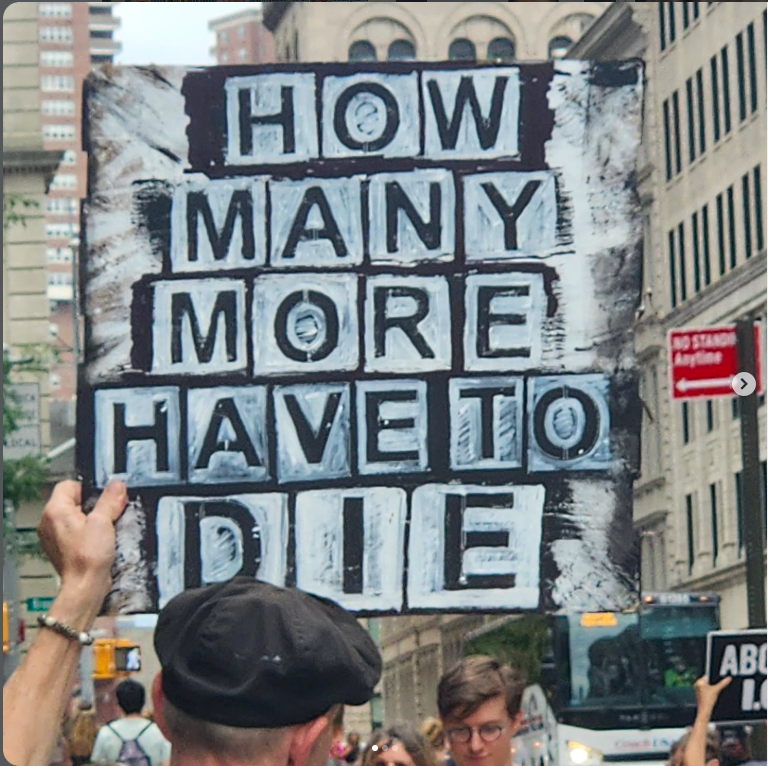
    Protest sign reading “How many more have to die?” held aloft in a city street.
    Thursday. 26 Federal Plaza. Silent Witness. #SayTheirNames #JusticeForImmigrants Photo by Edward Koenig.

    Ed, in a later email: “I find myself looking around at these folks and thinking that in many ways they are the ones who kept the country going in the darkest days of the pandemic and this is how we reward them! This, to me, is another (hidden?) link between the COVID-19 pandemic and its unexpected deaths and the numerous, needless deaths of immigrants in ICE custody. It’s no wonder I often find myself careening between rage and tears.”
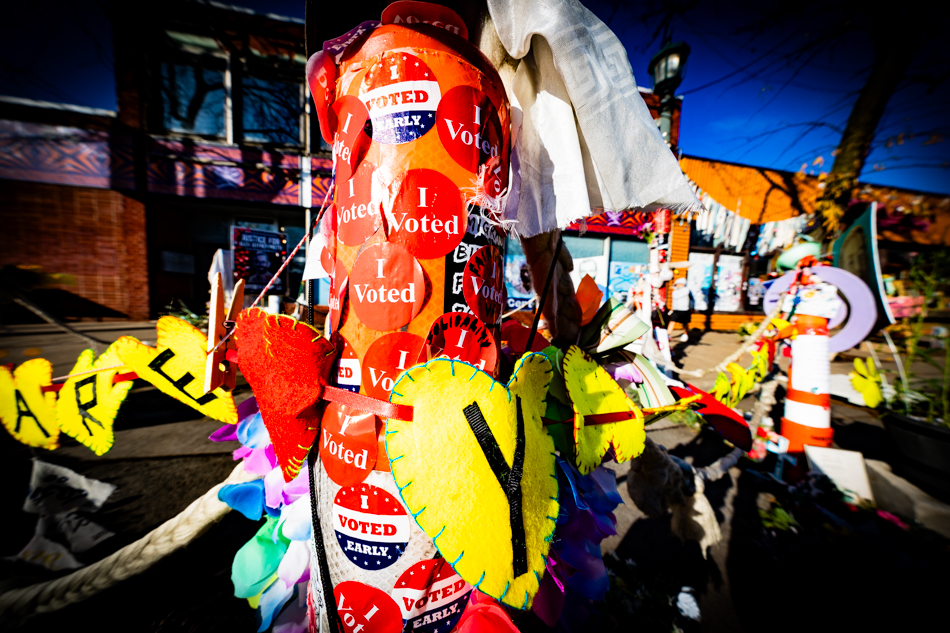
  • Memorialization as Movement Work – Part I: “I VOTED” Stickers, or Memory as a Politics of Love

    Memorialization as Movement Work – Part I: “I VOTED” Stickers, or Memory as a Politics of Love

    By Sarah E. Wagner

    Colorful election-themed outdoor display covered in “I Voted” stickers and handmade decorations
    Photo by Gregory Gilbert (Gregory A. Gilbert Art, www.gregoryagilbert.com)

    Back in 2024, reflecting on the first two years of the pandemic (2020-2021), members of Rituals in the Making team (Ariel Santikarma and Sarah Wagner) published an article in the journal Anthropological Quarterly in which we challenged the public rhetoric characterizing pandemic death in the US as exceptional. Instead, we argued the opposite: “(1) that the politics of interrupted mourning [was] not new; and (2) within the United States, COVID-19 death [was] anything but exceptional when considered within a broader history of precarious and disposable life.”

    We presented a different way of thinking about efforts to memorialize unjust death – that is, “memorialization as movement work,” or the intertwining projects of memory and political transformation. In our definition, the dead and specifically their memory are animating forces in pushing for political change:

    “[F]rom the movement of an individual’s hand in tracing the portraits of the deceased to creating a space of memorialization that forges social ties through and beyond life, the living work with the presence of the absent. The dead are thus remembered and transformed as kinful forces, who make the revolution of memory—and its movements toward both a livable present and future—possible.” – Santikarma and Wagner

    ***

    Over the past days (and weeks and months), we at Rituals in the Making have been struck by parallels and connections between our core research questions about pandemic loss and other forms of memorialization as movement work.

    In the coming days, we will share several separate but linked dispatches that focus on the transformative “movement work” of memorializing unjust death. Lessons from our research on COVID commemoration (like the work of Rami’s Heart, events such as Naming the Lost Memorial’s Día de los Muertos, or Suzanne Brennen Firstenberg’s In America: Remember) inform how we understand the relationship between emotion and action.

    ***

    Street memorial decorated with flowers, signs, and red “I Voted” stickers, including a “Raise Good Girls, Pret Boy” sign.
    Photo by Gregory Gilbert (Gregory A. Gilbert Art, www.gregoryagilbert.com)

    Sarah Wagner: On Friday morning, November 6, my phone pinged. My younger brother had just forwarded a Reddit thread about people in the Twin Cities (in Minnesota, where we both have family) going to the impromptu memorials dedicated to Renee Good and Alex Pretti to add their “I voted” stickers. In the span of three weeks in January 2026, during “Operation Metro Surge,” first Good and then Pretti were gunned down by U.S. Immigration and Customs Enforcement agents in south Minneapolis. In the wake of each killing, people flocked to the two sites to leave flowers, candles, and personal tributes.

    Since October a new item—the “I voted” stickers that people receive after casting their ballot—began appearing at the grassroots memorials.

    As I read through the Reddit thread, I noticed how many of the comments linked emotions to action, namely, the act of voting:

    “I’m never forgetting the frostbite I got and the rage I felt. Fuck these fascists”

    “We’re voting for them. We won’t let their deaths be meaningless, we will fight like hell to protect people
    and put people in power who will do the same.”

    “May they only grow”

    “I just realized Renee Good never got to vote in MN. But she ended with a bunch of people voting in her
    honor.”

    I then reached out to another family member in Minneapolis, who put me in touch with Gregory Gilbert, a hospice chaplain and visual artist based in the Twin Cities. I asked Greg if he had any photos of the memorials from the past few days. From the “I voted” sticker memorialization as movement work. He emailed right back with the pledge that he would visit both sites the following day to document the memorials with their sticker additions.

    Here are the photos he sent, of both Alex Pretti’s memorial and Renee Good’s:

    Outdoor display featuring a portrait covered with red “I Voted” stickers, with a person in a red knit hat nearby.

    (All photos are courtesy of Gregory A. Gilbert Art, www.gregoryagilbert.com.)

    In the months preceding the election, the memorial for Alex Pretti was repeatedly vandalized—raw bacon, raw tuna, human feces were left; it was spray painted, motor oil and truck bed liner dumped on it; someone even tried to burn it.  The attempts to deface the memorial—to deny the violence that snuffed out Alex Pretti’s life—represented a different form of acknowledgment, an admission even. You don’t try to destroy a memorial to something that never happened.

    Its custodians doubled down in their commitment to caring for Pretti’s memory:

    “Whatever happens, we will be there to restore and repair and recover and clean,” said Jadah Green, one
    of the caretakers. “Now I think, ‘Okay, you’re coming with whatever violence you have in your life, and
    you’re inflicting that on the memorial, and the memorial is just going to generate more love.’” – Madison
    McVan, Minnesota Reformer, October 30, 2026

    In his victory speech on November 3, US Senator-elect (D-TX) James Talerico spoke of the transformative politics of love—rather than hate:

    “Love is not passive. Love is not neutral. Love is not weak. Love requires that we stand between the bullies and the bullied. Love requires that we look evil in the eye and not blink. That kind of love has always been a threat to the powers that be. That kind of love is revolutionary. That kind of love is creative.” – James Talerico

    Despite the hatred directed toward Pretti’s memorial, its caretakers insist that it will only “generate more love.” To my anthropological eye, I read both the caretaking and the “I voted” sticker assemblages through the lens of ritual. One of anthropology’s pre-eminent scholars on ritual processes, Victor Turner explained how rituals take place in particular settings through sequenced action to influence forces (such as divine forces or mystical beings) and advance interests (like beliefs). They also depend on symbols. “The ritual symbol becomes a factor in social action, a positive force in an activity field” (Turner, The Forest of Symbols, 1967, p. 20)

    Just as the grassroots memorials to Renee Good and Alex Pretti are made up of the symbols of flowers and candles, portraits and tributes, so too the “I voted” stickers do crucial symbolic work of manifesting a politics of generative, creative love. Sticker by sticker layered upon their surfaces, the memorials become an archive not only of violence and its commemorative rejoinder, but also of a specific form of ritual action: casting one’s ballot.

    And in Minnesota, voting last week exceeded all expectations. As my family member pointed out, “MN also broke records for midterm voting”:

    “SAINT PAUL – Unofficial results show more than 2.8 million Minnesotans cast ballots in the 2026. Statewide General Election. This breaks the previous record for midterm participation set in 2018.

    In addition, Minnesota is projected to have had the highest voter participation rate in the nation, according to preliminary estimates from the University of Florida’s Election Lab.

    ‘Minnesota has once again made history for voter participation,’ said Minnesota Secretary of State Steve Simon. ‘This is a victory for every Minnesotan who showed up during the voting period to take part in our shared democracy.’” – Office of the Minnesota Secretary of State, November 4, 2026

    Colorful street memorial display with flowers, signs, and voting messages outside a building
    Photo by Gregory Gilbert (Gregory A. Gilbert Art, www.gregoryagilbert.com)

    ***

    And to the caretakers of their memory, in the words of Gramps Morgan:

    So keep doing what you do
    Cuz there’s a place up there for people like you

  • Glossed Over: On Attending the Symposium at the Library of Congress

    Glossed Over: On Attending the Symposium at the Library of Congress

    By Ed Koenig

    Edited by Martha Greenwald

    On March 12 and 13, 2026, the American Folklife Center, a part of the Library of Congress, in Washington, DC, presented a symposium entitled “From Lived Experience to Public Memory: Commemorating, Documenting, and Archiving Experiences of the COVID-19 Pandemic.” The event coincided with the sixth anniversary of the declaration by the World Health Organization that COVID-19 had become a global pandemic.

    As one of the over 1.2 million Americans who has lost one or more loved ones to COVID-19 (my partner of 33 years, Jody Settle, died in April 2020,) I was curious to see how the lived experiences of those who were most severely impacted would be represented. Unfortunately, our experiences were either ignored or glossed over during the various presentations.

    The symposium instead looked at various aspects of how we coped and lived our lives during the temporary lockdowns that arose around the world to combat the spread of the SARS-CoV-2 virus and how some of those changes have impacted and continue to influence our daily lives.

    Sour, Dough

    One of the obvious areas that concerned everyone was food, its production, and the related delivery systems. As was sometimes true prior to the lockdowns, comfort food became a source of solace for many who were fearful or, worse, mourning the loss of loved ones to this new virus. I was a bit disillusioned with a reference to a meme that discussed common weight gains during that period as “the COVID nineteen” (much as first year college students are often said to experience a weight gain called the “freshman fifteen.”) Unfortunately, the laughter from the audience that ensued ignored the sentiments of those who were most severely impacted.

    One of the activities that seemed to become rampant during the lockdown period was the baking of sourdough bread. Myriads of families ordered bread making machines so they also could join in this activity. Perhaps, it was their way of feeling connected to others. Someone sent me one in the days after my partner died in April 2020. Looking at the box, I wondered what I was supposed to do with a bread making machine. I couldn’t bake a new partner! Sadly, the box sits unopened in the closet six years later.

    More interesting, there seems to have been an increased rediscovery of old family recipes for favorite meals that had been stored away unused due to the lack of time in our busy society. Now, staying and/or working at home, there was more time to reconsider these foods and the comforts and memories they provided. This, of course, required ingredients that many did not regularly have at hand.

    The food procurement system has been impacted or altered by the pandemic. There was a huge increase in the ordering of groceries on-line which stores then needed to deliver directly to the home. Restaurants, restricted from indoor dining, began relying on services like DoorDash and Grub Hub that came into prominence during this period. People began ordering take-out food from local restaurants if only to support them and help them to survive until the lockdowns were over. The message seemed to be that people wanted to continue enjoying their favorite foods without risk to themselves. Sadly, the risk to those who had to work to survive was only discussed in a passing remark that “comfort for one became discomfort for another.”

    Several other observations were made about the impact on food delivery systems. There has been a notable increase in the number of farmers markets around the country. Researchers presume that people felt that shopping at these open-air concessions was safer with less chance of exposure to the virus.

    A final thought is that there now seems to be an increased understanding of how the corporate industrial food system works. People have finally acknowledged that our food doesn’t miraculously appear on the shelves in our grocery stores. It requires a great number of human resources to grow, produce and ship products and then to stock the shelves – all of which put people at risk during the pandemic. The question left unsaid is whether people continue to care about those who are part of this important supply chain component.

    I would be remiss if I didn’t mention how friends and neighbors stepped up to prepare meals that they shared with me when Jody died. They would call and come over and we would meet outside. Maintaining the recommended social distance, they would place the food nearby and step back. I would then go over and pick it up. After a brief shouted “thank you,’ we would return to our homes. The comfort offered by a homecooked meal and a few minutes of face-to-face contact was not something discussed during this portion of the symposium.  

    Synchrony/Cacophony

    Music and the impact on musicians were the themes of several presentations. Because musicians were unable to perform together in-person, many of them tried to employ new on-line technologies, like Zoom, to continue their collaborations and performances. Because of the nature of internet technology at that time (since improved somewhat,) lags in transmission speeds often made the synchronization of the various musicians difficult, if not, impossible, often leading to cacophony. Musicians experimented, learned and implemented new techniques to overcome these difficulties such as writing compositions and arrangements where one performer’s last notes could be sustained and then the next performer would begin on the same note. Also, visual clues were used for one musician to cue another. These aided the musicians to continue their creative work until they could again work together in-person. An example of these new techniques was shown (performed via Zoom) by the Kronos Quartet performing the musical piece, Marejada (which translates as “surge”) composed during the lockdown.

    Other speakers spoke of the means musicians in small or isolated communities used to continue performing for themselves and others. One presenter discussed a group of blue grass musicians in southern Indiana. As they told her, if they were to live the lives they were used to living, they would have to adapt. And, they did. Single performers would play from their front porches while friends and neighbors would sit in their cars listening to the performance. Later, as restrictions eased, some of the groups would gather to perform outdoor concerts. She even showed videos of them precisely measuring out six-foot social distance circles around each performer. They did the same with the folks that came to listen and enjoy. All this helped them to live during the lockdown.

    Improvisation was the key to survival for many musicians. A project based in some impoverished neighborhoods of Washington, DC, put into service a rickety old van nicknamed the “COVID Van.” The organizer, from American University, and his wife would meet musicians, usually in their late teens or early twenties, who would perform while they, safely inside the van, recorded videos that, once edited, were shared on platforms like YouTube. This allowed these young musicians to continue creating and sharing new music with their fans even when they couldn’t appear in a public setting. Again, new ways of thinking worked and continue to be used now.

    Several researchers who worked in Spanish-speaking Latin American communities discussed the role of music in providing information and solace to people from Mexico to Argentina. One of the interesting things they discovered was that musicians were less concerned about making music during the pandemic, but rather they focused on creating music about the pandemic. As they termed it, the music was about the humanity of surviving.

    Much of this music focused on instructing people on how to stay safe — like washing your hands frequently, wearing a face covering, and maintaining social distance – “be a good citizen and we’ll get through this.” The one quirky thing they recognized in each country was that the music was usually upbeat and the videos created for these songs were almost always full of dancing and hope and smiles. They served as cheerleaders in a time of sorrow.

    The use of folk art provided some further insights. Some art work served to educate people on how to protect themselves and, in doing so, provided continued economic survival for the creators. Of course, some art work served to memorialize people who died from COVID-19.

    A Renaissance of Stitches

    In the early stages of the pandemic when there was a lack of personal protective equipment, ethical questions arose about the creation and sale for profit of face masks while people were dying. This included examples where protective face masks were decorated with distinctive patterns and designs and intended to be sold as art work rather than to be used as protection against the virus.

    Of interest to me was how seamstresses around the world gathered whatever materials they had at hand and produced many millions of masks for their friends and neighbors and others. Their work was so prolific that there was a run on the elastic materials used to keep the masks properly placed on the face. An interesting anecdote was how seamstresses in Cambodia produced and shipped face masks to underprivileged people in the United Kingdom and Australia.

    During the lockdown periods, there was a notable renaissance in the art of quilt making around the world. Many picked up an avocation that they had set aside a long time ago. Many others first came to quilting at that time.

    Over time, often influenced by social media posts that referenced the AIDS Memorial Quilt that was begun to memorialize those who had died during the HIV/AIDS epidemic in the 1980s and 1990s, many tried to reproduce the feelings those quilts invoked in them and moved to sew similar quilts for those lost to COVID-19. Examination of many of the quilts produced reflect the social anxiety the creators were feeling whether from being isolated, having to maintain social distance when interacting with others, and, even the simple task of trying to find toilet paper. One other interesting aspect of this work was the number of quilting bees that arose on the internet via apps like Zoom. The people could sew while talking to others doing the same thing. It provided them a chance to share their feelings and their work. It allowed them to practice a tactile art without the need to touch.

    Say Their Names

    Another use of art serving to memorialize appears in the work of the Naming the Lost Memorial project in New York City. Taking inspiration from the reaction to the murder of George Floyd in Minneapolis in May 2020 and the constant call to “say his name,” this small group formed and reached out to those communities that weren’t able to properly mourn their dead following their own customs and traditions.

    After receiving a grant, the group expanded and joined with local artists and musicians from various immigrant communities in New York City to develop memorial artwork and events that gave honor to their cultural ways of mourning. They scheduled two events per year: one at Brooklyn’s Green-wood Cemetery in the spring and the other celebrating the Day of the Dead (el Día de los Muertos) at the Church of St. Marks-in-the-Bowery in Manhattan. I attended both memorials in 2025 where I recall and experienced how the rituals of mourning in various places such as Mexico, Guyana, and West Africa, among others, were performed to honor the members of those communities who had passed on. While loved ones were lost, we continue to remember and learn from each other.

    The Naming the Lost Memorial project concluded with the most recent Day of the Dead event in November 2025. But the project will never really end as long as we continue to say their names.

    There were other various presentations. Some of them I found interesting. One dealt with the impact of COVID-19 on the Navajo Nation. It was noted that in May 2020, the indigenous peoples of the United States had the highest COVID-19 infection rates. On a brighter note, by February 2021, these same groups had the highest COVID-19 vaccine uptake rates. The primacy of elders in the indigenous populations as repositories of their language, oral and written history, and native learning methods promoted the care of these elders to primary importance in their communities as they struggled against COVID-19. An elderly Navajo woman noted speaking about COVID-19: “I look upon it as a monster that is feeding on us.” The lack of resources for these indigenous communities from the U.S. government (the case before the appearance of COVID-19) accelerated the situation. Sadly, a number of members of the Navajo community were lost.

    Others presentations I found disturbing. These made me wonder why anyone would want to characterize this period of history in this way. One of these compared some of the reactions to COVID-19 pandemic to those of the 1918 Influenza Pandemic dubbed the Spanish Flu even though credible scientific evidence shows it most likely originated at a U.S. Army base in Kansas City.

    In 2020, early on in the pandemic, the use of the internet and social media platforms led to “ideas” and disinformation such as the belief that 5G cell phone technology or the financier George Soros was the source of the pandemic. The somewhat racist depiction, Kung Flu, was an ad lib from Donald Trump in a speech he delivered during the beginning of the pandemic. Other strange ideas also arose at this time like “vegetarians are safe – only meat eaters get COVID” and “gargling with salt water would dislodge the virus from your throat.” Many of the numerous memes that were shared via social media showed a disconnect between the perceived image and actuality. The hurtfulness of many of these memes to those who lost loved ones to or continue to suffer from the impact of COVID-19 was not mentioned or just ignored. There was no discussion of counteracting the misinformation arising from these memes and other postings.

    For me, the most disturbing presentations made during the symposium revolved around the topic of play. One positive presentation in this area of play was an exception. Presented by two young scholar researchers from the United Kingdom who work with young people living with Tourette’s Syndrome. Their organization, Tourette’s Hero, developed several creative projects to help keep these individuals engaged. One they spoke of was named “Digital Heros of Imagination.” Using whatever materials were close at hand, the people worked to create their own superheroes and then to develop backstories surrounding their creations which they told through posters that shared with one another. When the severe lockdowns were lifted, they began a second program called “Journey to a Better World.” Here, they strove to instill and maintain a sense of joy and connection in their clients.

    Other presenters discussed games for children like “Coronavirus Tag” in which a designated player who, in theory, carried the coronavirus would run around and tag another player who would become “infected” and would fall down as if dead. This continued until all the players had been “infected.” The game would restart with a different player designated as the one having coronavirus. Parents seemed to find that this game, and others like it, were inventive and catered to the physical and psychological vulnerabilities of the children while including them as historical witnesses to life during the pandemic. As a person who lost someone to COVID-19, I found the idea of this game offensive, particularly because it was presented as a celebration of creativity. If only my loved one could just get up and live again. In Finland, “Korona” was a board game, much like Monopoly, where players moved along the board trying to infect the world with a virus. Players often exhibited joy in watching the virus spread. I tried to ask the presenters if they had considered the impact of these games on children who had lost a parent, sibling, or caretaker to COVID-19. They were adept at ignoring my question.

    All this leads to one overarching conclusion about these presentations. All of them, in their own way, were too focused on those who had the most privilege, e.g., those who had the ability to flee large urban areas for vacation homes in rural areas. There was very little note given to the financially challenged people who lived crammed together in urban centers and continued, at much personal risk, to venture out to “essential” jobs to serve the needs of those who were able isolate. In the end, I was disappointed. I think many of the presentations failed to consider the people who were most severely impacted by COVID-19, i.e., those who died and those who loved them.

  • We’re Not Done Yet: Taking Stock and Charting a Path Forward

    We’re Not Done Yet: Taking Stock and Charting a Path Forward

    It’s been a little over a year since we learned that the National Science Foundation grant supporting the Rituals in the Making project was “terminated, effective immediately.” As we wrote in a recent essay for Anthropology News, just because we lost our funding doesn’t mean we’ve lost our drive to research and write about the lasting effects of pandemic loss on American society.

    We’ve been busy this past academic year, presenting our findings at the DDD conference and the American Anthropological Association and publishing several books chapters:

    • Rituals in the Making Collective. “Case Study: ‘In America’ COVID Memorial Art Installation on the DC National Mall.” In Practicing Digital Ethnography, edited by Devin Proctor. New York: Routledge, 2026.
    • Vicente da Silva, Andreia, and Sarah Wagner. “Ritualising and Memorialising Unjust Death: The Affective Force of COVID Loss in Brazil and the United States.” In Decolonising Death Studies, edited by Panagiotis Pentaris, Stacey Pitsillides, and Hajar Ghorbani. New York: Routledge, 2026.

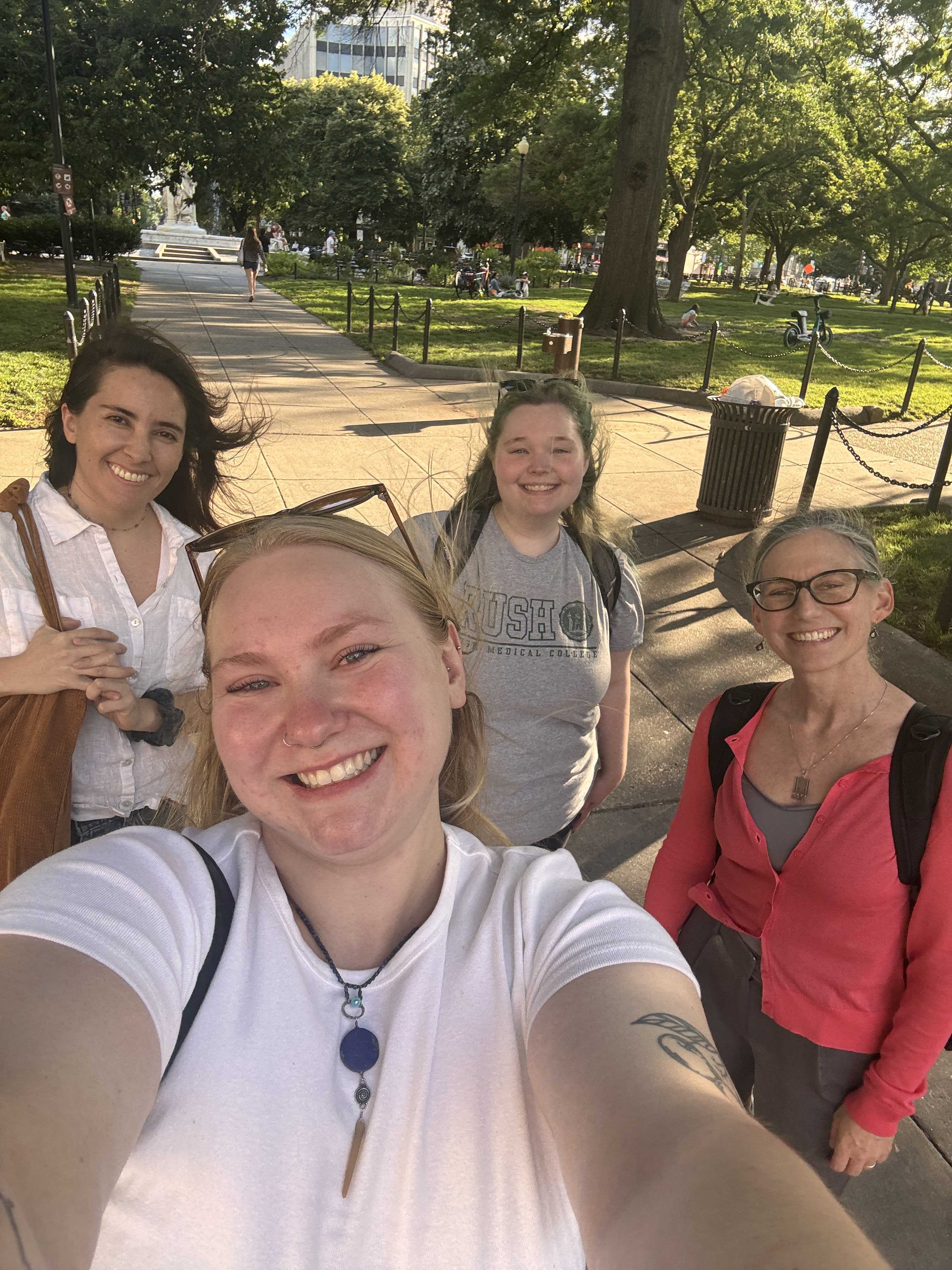
    And so this past month, we gathered (in person and virtually) for a writing retreat—a chance to reflect on our individual and common goals and to reaffirm our commitment to researching and writing together. Though a smaller team, we are still the Rituals in the Making Collective.

    Here are a few scenes from the three-day retreat. We look forward to sharing the fruits of our redoubled efforts in dispatches throughout the summer. And a new website is “in the making” … please stay tuned!


    Three days of setting out goals, writing, reading, playing board games, and just being! Everything a successful retreat could be 🤭


    A smiling woman with long hair wearing a t-shirt that says 'GIRLS JUST WANNA HAVE FUNDING FOR SCIENTIFIC RESEARCH.' She is standing next to a dog wearing a cone collar.

    PS from Sarah W: When I got home on Saturday evening, my block was full of people enjoying the Petworth Porchfest 2026. I spotted my neighbors and was chatting with them when a young woman leaned over to say, “I really like your shirt.” The t-shirt was a gift from my fellow co-editor of the Cambridge Handbook for the Anthropology of Death, Sarah Richardson, also a staunch supporter of Rituals in the Making. It felt like a fitting end to the three days of working together with Martha, Avery, Paige, Maria Jose, and our virtual guest from Brazil, Andreia Vicente.

    GIRLS JUST WANNA HAVE FUNDING FOR SCIENTIFIC RESEARCH. (And Puppy Emmy just wants that cone off!)

  • March 2026 – Steeped in the Yellows of Early Spring: Rami’s Heart COVID-19 Memorial Sixth Annual Lighting Ceremony 

    March 2026 – Steeped in the Yellows of Early Spring: Rami’s Heart COVID-19 Memorial Sixth Annual Lighting Ceremony 

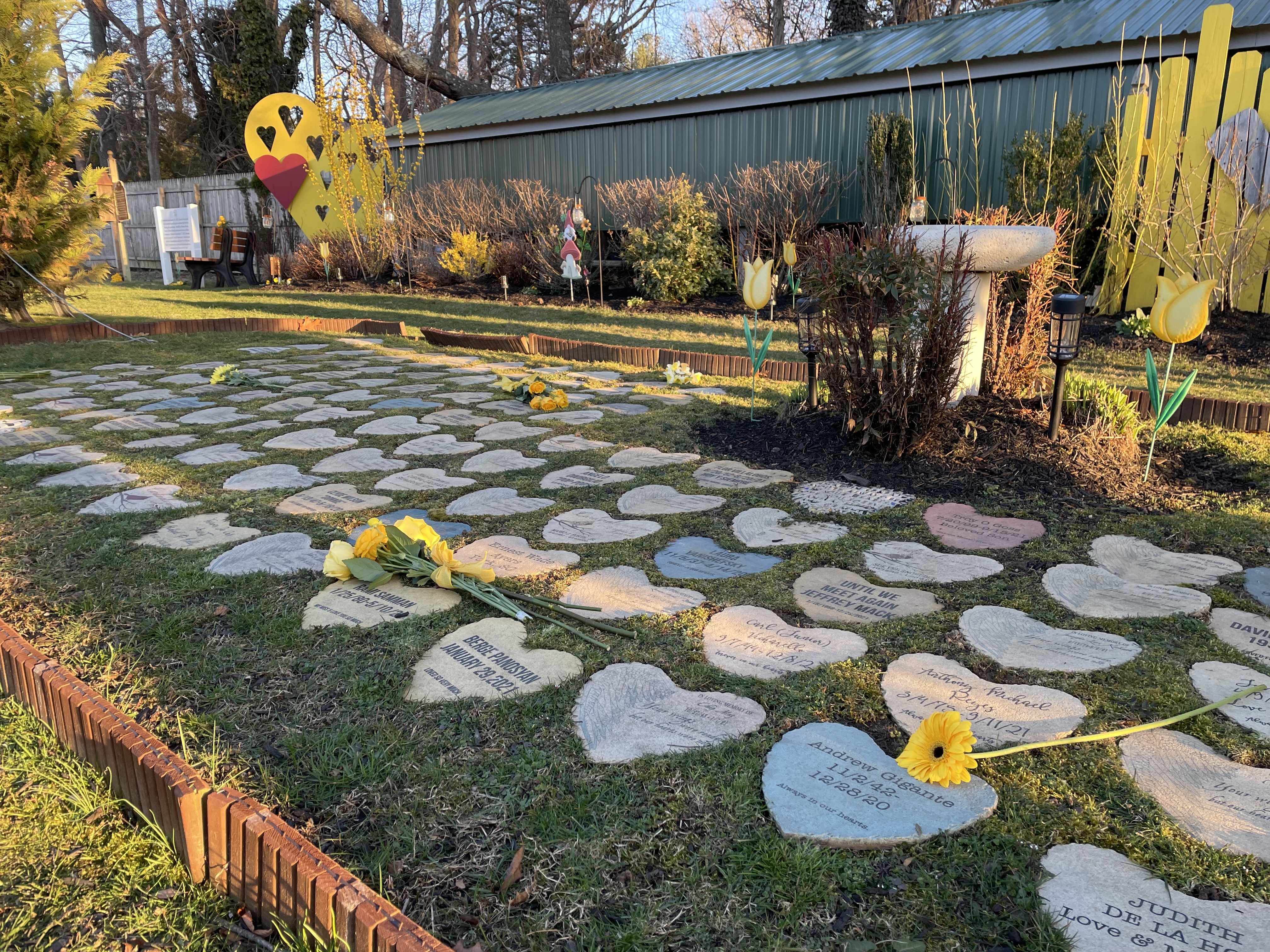
    A memorial garden featuring heart-shaped stones with names and dates, surrounded by greenery and decorative ornaments, including flowers and birdbath.

    By Sarah Wagner

    ***

    “We are talking about how we carry so many people with us wherever we go, how even simple living, these unearned moments, are a tribute to the dead.”

    – Ada Limón, “Forsythia”

    March 28, 2026: In the earnest, warm light of an early spring evening, Rami’s Heart COVID-19 Memorial once again gathered its own to remember their loved ones. Shades of yellow—hearts, shells, stones, candles, ribbons, and flowers—brought the space to life despite (or maybe because of) the setting sun. This year Paige Gavin and I had the honor of joining Rima Samman-Whitaker and the Rami’s Heart community for the occasion, and I write this dispatch with the evening’s sights and sounds still fresh in my mind. The essay combines photos from before and after the ceremony with captions drawn from the different speeches, as well as poetry that I stumbled on in the days since. I’ll start with a collage of photos and two poems that seem especially fitting. 

    ***


    Forsythia et al. 

    For this sixth annual lighting ceremony, Rima urged attendees to bring flowers. And so, gradually, as people arrived, so too did their floral tributes: a vase nested in the dark mulch, its bouquet brimming with shades of bright and pale yellow, pink, and green; clusters of canary-yellow roses tied to a memorial bench; a single stem of gerbera daisy resting atop a heart-shaped stone; florets of golden-yellow ranunculus (Persian Buttercups), tucked between names. 

    And forsythia, at the entrance and exit, just then in brilliant yellow bloom. 

    To my delight, I found that two of my favorite poets have written about forsythia: 

    Billy Collins, “Forsythia” 

    It caught my eye a while ago, lit up 
    against the gloom of the woods 
    in the corner of a wild field, 
    the pulsing color of caution. 

    And now that I have spent a little time 
    on this stone wall watching its fire 
    flare out of the earth 
    I begin to think about the long chronicle of forsythia, 

    how these same flowers have blazed 
    through the centuries, 
    roused from the ground by the churning of spring. 
    I would rather not look around the next 

    corner of the year to see how this will die, 
    its lights going out,  
    its bare, arcing branches 
    waving like whips in the bitter wind. 

    So I sit facing the past, 
    letting my feet dangle over the wall, 
    beating time against stone with my heels 
    as the long gray clouds roll over me. 

    Remember how Arnold by the Channel 
    thought of Sophocles who must have heard 
    the same shore-sounds long ago, 
    walking by the edge of the Aegean? 

    Well, I am holding in the palm of my thoughts 
    all the others who once were stopped, 
    like me, by this brightness, 
    this sulfuric cry for help: 

    women in tunics, women gathered by a well, 
    men in feathers, men swimming by a river, 
    all speaking languages I will never know, 
    saying the different words for its color 

    as I feel the syllables of yellow form in my mouth 
    and hear the sound of yellow fill the morning air. 

    Source: Poetry (April 1995)

    Ada Limón, FORSYTHIA 

    At the cabin in Snug Hollow near McSwain Branch creek, just spring, all the animals are out, and my beloved and I are lying in bed in a soft silence. We are talking about how we carry so many people with us wherever we go, how even simple living, these unearned moments, are a tribute to the dead. We are both expecting to hear an owl as the night deepens. All afternoon, from the porch, we watched an Eastern towhee furiously build her nest in the untamed forsythia with its yellow spilling out into the horizon. I told him that the way I remember the name forsythia is that when my stepmother, Cynthia, was dying, that last week, she said lucidly, but mysteriously, More yellow. And I thought yes, more yellow and nodded because I agreed. Of course, more yellow. And so now in my head, when I see that yellow tangle, I say, For Cynthia, for Cynthia, forsythia, forsythia, more yellow. It is night now. And the owl never comes, only more of night and what repeats in the night.


    *** 

    Scenes from the ceremony: Photo essay

    (The captions and quotations that accompany the images are from the ceremony’s speakers: Teresa Dimezza; Dr. Raynard E. Washington; Joann Burney; Sean Burney; and Rima Samman-Whitaker.)

    “[COVID] brought a lot of loss and disruption and uncertainty and quarantines and homeschooling and all kinds of home projects and just complete chaos in our lives. And while time has moved forward, the impact of that time certainly hasn’t. In New Jersey alone, we lost more than 35,000 residents to this virus, and while that’s a number, each one of those numbers counts to life, a story, a family that’s forever been changed. . . . So tonight is about honoring those individuals, about saying their names in our hearts, holding space for their stories, and recognizing that though they’re not here with us, the love that we share for them still is here.”

    – Dr. Raynard E. Washington, Commissioner of the New Jersey Department of Health

    A memorial display featuring black stones inscribed with names, arranged on wooden shelves. Below, yellow flowers and candles are arranged on the ground, creating a somber atmosphere.
    “Every candle we light represents a name, a life, a story and a love that continues to shape us.” – Teresa Dimezza 

    A crowd of people sitting on folding chairs and standing on grass during sunset, with trees in the background and buildings visible.
    “We [Allaire Community Farm] are a nonprofit that we are honored to host Rami’s Heart, and Rima and Travis have become an extended family to us, and I just want to thank them for all their hard work. I know you all appreciate them very much. They put their heart and soul into this, and without them, it wouldn’t be as beautiful as it is.”  – Joann Burney, Allaire Community Farm 
    Interior view of a path with visitors in winter clothing, lined with candles and flowers, under string lights, as they engage with a display or memorial.
    “I would like to also thank Don Corson. Don’s 91 now, and it was a little too cold for him to be here tonight, but he’s the one who, immediately after seeing the shadow boxes, saw that memorial in his head and put it together, and we had the materials. It was up in less than a week.” – Sean Burney, Allaire Community Farm 

    To the families I remember with you all this evening, to those that we lost, I honor you all this evening and to all gathered here, may we leave this place, not just with heavy hearts and remembrance of those that have been lost, but with a renewed sense of purpose to continue to act to make health possible for all of our neighbors here in New Jersey.” – Dr. Washington 

    ***

    “We also gather in a moment when there are voices who would rather we forget, who would have us move on without reflection and replace our very real, lived experiences with misinformation. But we can’t, and New Jersey won’t. Public health is based depends on trust and on truth and our willingness to learn from what we’ve endured together as communities. Remembering is not about looking backwards. It’s about honoring lives by doing better as we move forward.” – Dr. Washington 

    Three individuals standing outdoors, smiling for the camera with a clear blue sky and an American flag in the background.

    ***

    “But in the six years, each and every year, something happens, something brings us hope, something shows us that there’s still good things out there, like Sean and Joan who gave us the space, like Governor Mikie Sherrill and Dr. Washington for recognizing our grief, the board members that meet with us every month and help us plan everything out, and we all do it on our own time.” – Rima Samman-Whitaker, Founder of Rami’s Heart COVID-19 Memorial

    “So it’s another year that we go on grieving as the world moves on. The reality is we’ll never move on from our grief, but we’ll ever, will forever carry their love and their light. So tonight, when we light those candles, just know that we carry their light. And although grief may not be a great thing, it is a part of us. It is a part of who we are now, and it is up to us to keep them in our memory and our lives.”

    – Rima Samman-Whitaker, sister of Rami Samman

    A heart-shaped memorial stone with the name Rami Samman, birth and death dates, and the phrase 'We miss & love you so much,' accompanied by a bouquet of yellow roses tied with a ribbon, set on grass.

  • At Naming the Lost Memorial, St. Mark’s in the Bowery

    At Naming the Lost Memorial, St. Mark’s in the Bowery


    By Ed Koenig

    Curated and edited by Martha Greenwald

    ***

    On November 2, 2025, a beautiful autumn afternoon in New York City, I attended the annual Día de Muertos ceremony sponsored by Mano o Mano, a New York City based Mexican cultural association. As part of this event, the COVID remembrance project, Naming the Lost Memorial, held its final presentation honoring the more than 46,000 New York City residents who have died from COVID-19. This concluded five years of work, throughout the five boroughs, putting names and faces to those who have been lost.

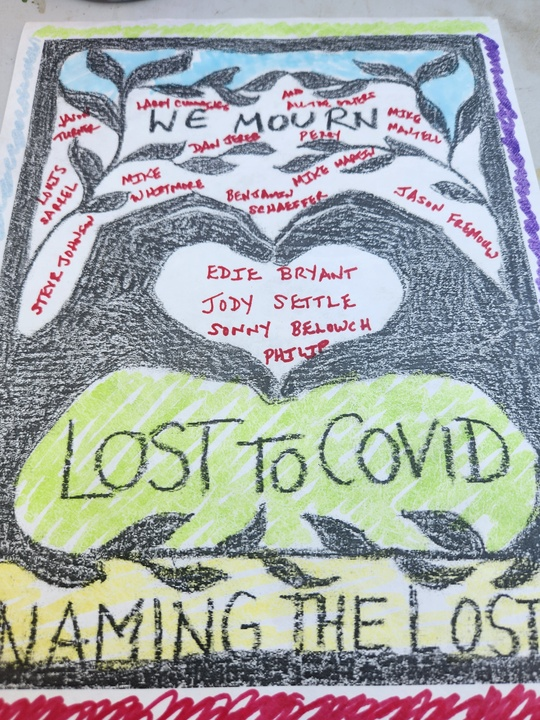
    A colored memorial drawing with the words 'WE MOURN' at the top and names of individuals lost to COVID-19, including 'Jody Settle' and 'Edie Bryant,' surrounded by artistic embellishments. The bottom section reads 'LOST TO COVID' and 'NAMING THE LOST.'
    Photo by: Ed Koening

    I first encountered the work of NTLM in the spring of 2021 when they created a memorial at the Morris-Jumel Mansion, one of the oldest buildings in Northern Manhattan, dating back to 1765. That time, the memorial consisted simply of long, multicolored ribbons, each inscribed with the name of a loved one who had passed. This was the first time I added the name of my partner of thirty-three years, Jody Settle, to a COVID memorial. Jody succumbed to COVID-19 in April 2020. I attended other NTLM events, most recently this past spring at The Green-Wood Cemetery in Brooklyn.

    I arrived early and strolled along the fences that surround the church, St. Mark’s in the Bowery. Numerous memorial panels hung on the fence, all created by the survivors of these cherished victims. Reflecting the diversity of New York City, the displays were inscribed with thoughts in English, Spanish, and Mandarin Chinese. Some were just words of love. Many were hand-drawn portraits of loved ones. One of the larger displays was created by a young man who had been incarcerated in prison during the time of the pandemic. His work tries to show some of the people who were unable to “flee” when the city was overrun with fear and uncertainty. His message is that no one should be excluded from our memorials just because they were serving time in jail.

    I continued my walk and soon turned into the courtyard in front of the church. The people from NTLM had set up tables where passersby could create simple remembrances for their loved ones. They provided me with some sample templates I could use to create my own drawing. I chose the butterfly template and sat down with colored pens and markers and got to work.

    I have been a member of a small group of men and women who lost a spouse or partner to COVID. Formed during the early days of the pandemic to comfort and support each other, five years later, our group is still in almost daily contact, friends with a common reason for connection. I decided to include the names of all our spouses on my display. So, I started. I wrote the names all over the template and finished it with a rainbow of background shadows encompassing all of them.

    While I was working on my memorial, four or five others were seated nearby doing the same. We all chatted about our works in progress, but, more importantly, we shared the stories of those we were memorializing. As I write this, it seems to me that our sharing was more joyous than mournful. We have had over five years to heal the scars of our devastating losses and can now remember their lives more than their deaths. Our drawings completed, they were added to the display along the fence—more names to remind those going by that our losses were real.

    The NTLM ceremony was very simple. The people assembled formed a line, and we marched around the border of the church grounds. As we passed the numerous banners hanging on the fences, a pungent, but sweet, incense was passed over the banners, calling to mind, I guess, the spirits of those remembered there. At several of the displays, we stopped for a few minutes so that the creators could talk about their work.


    Eventually, the crowd of 50 to 60 returned to the courtyard of the church. All of us were given an orange marigold to hold in honor of our loved one. Led by Kay Turner, one of the founders of the Naming the Lost Memorial project, we were all encouraged to speak aloud the names of those we had lost. Everyone responded chanting: “naming the lost.” This continued for quite a while until the sound of names quietly dissipated. I looked around as the names were spoken. The faces of many still showed the pain of their loss. A young couple standing near me hugged each other while tears poured down their cheeks. I could only wonder who they mourn now and forever.

    The event ended with a charge that, even though the official NTLM project was coming to its conclusion, we must all go forth and continue to name the lost. 

  • On Obscurity: Pandemic Memory Work and the National COVID Memorial Wall (UK)

    On Obscurity: Pandemic Memory Work and the National COVID Memorial Wall (UK)

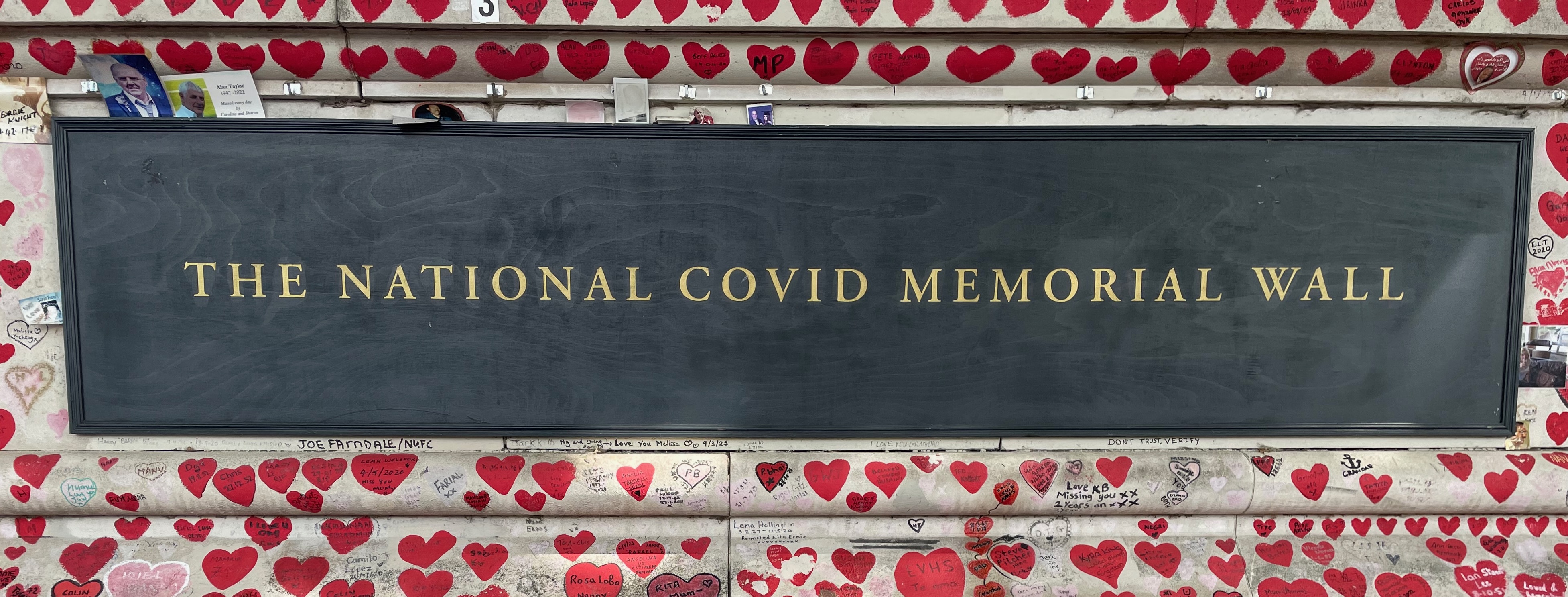
    The National COVID Memorial Wall in London, UK, May 31, 2025.

    By Sarah Wagner

    ***

    Years ago, I was driving with Hajra Ćatić, my mentor and friend, along a back road in eastern Bosnia and Herzegovina, not far from the city of Bratunac. I don’t recall the exact purpose of the trip, but I can still envision the scene—a late summer day, open fields to the left and right, a row of beech trees that shaded our route. Probably we were visiting a member of Hajra’s association, Žene Srebrenice (Women of Srebrenica), who had decided to return to her prewar home in the years after the 1992-1995 war that decimated much of the country.  Likely, she was a survivor of the Srebrenica genocide of July 1995 that claimed the lives of more than 8,000 Bosnian Muslim men and boys. We must have been unsure of the address because at Hajra’s direction I slowed the car and drew alongside a woman walking on the gravel shoulder. I remember Hajra rolling down her window and hailing the woman. They spoke briefly, and then the woman’s expression changed. Tilting her head, narrowing her eyes, she asked where she knew Hajra from. Almost as soon as she had uttered the words, she remembered. “I’ve seen you on television.” She thanked Hajra profusely for her work on behalf of the Srebrenica families. (Hajra Ćatić was the president of the Women of Srebrenica from 1996 until her death in 2021. She was a quiet warrior, an incredibly determined leader who sought accountability, “truth and justice” (instina i pravda) for the surviving kin of the Srebrenica missing. She lost her husband and her younger son, Nino, to the genocide. She died before she could bury Nino; his remains have yet to be recovered and identified.)

    What I remember very distinctly from that afternoon was Hajra’s response. In a gentle but firm voice she said, “I wish you didn’t know me.” She wished that all the things that had thrust her into the limelight—on television, in newspapers and magazines, into her position as the head of her organization—would never have happened. She would have given anything to not be recognizable. To remain obscure. For Hajra, obscurity would mean that she hadn’t lost her family, her home, and her former life in Srebrenica.


    Historian Jay Winter writes about this idea of obscurity and remembrance. In describing how individuals and groups, “mostly obscure,” gathered together in the aftermath of World War I, he explains how they sought to craft “the story of their war, in its local, particular, parochial, familial forms,” so that it could be “told and retold.”[1] I understand obscurity here to intimate a groundedness in community and an intimacy with loss that propelled mourners to express their sorrow publicly. In his description, I recognize the choices and leadership of Hajra Ćatić as she moved from relative obscurity to celebrity—or at least recognizability among strangers who shared the bond of mourning the genocide’s victims and atrocities. I also see echoes of that transformation in the work of remembrance forged by “memory agents” like Rima Samman-Whitaker of Rami’s Heart COVID-19 Memorial, Jennifer Sullivan, creator and host of the podcast, “For Those We Lost,”[2] and someone I met earlier this summer, Lorelei King, one of the ten volunteers of the association, Friends of the Wall, the caretakers of the National COVID Memorial Wall in London, UK.

    In this dispatch, prompted by Winter’s language, I explore the idea of obscurity and its corollary among relatives turned activists—prominence, exposure, even notoriety. That is, what happens when the bereaved are forced to live through their grief, the tangle of emotions that gathers with death, in unwantedly public terms.

    nel mezzo del cammino

    Let’s begin with the word itself:

    ob·​scure, a. [ME.; OFr. obscur; L. obscurus, dark, dusky, indistinct]

    1. dark; destitute of light; dim; gloomy.
    2. living in darkness; as, the obscure bird.
    3. not easily understood; not obviously intelligible; vague; ambiguous; as, an obscure passage in a writing.
    4. in an inconspicuous position; hidden; retired; remote from observation; as, an obscure retreat.
    5. not famous; unknown; humble; as, an obscure person.
    6. not clear or distinct; as, an obscure idea.
    7. not easily perceived or felt.

    obscure rays; the nonluminous heat rays of the solar spectrum.

    Syn.––dark, indistinct, abstruse, intricate, unknown, humble.

    The term can describe the physical conditions of dimness and darkness, as well as something more figurative—an indistinct, imperceptible state, a lack of clarity and perhaps the uncertainty that accompanies it. This notion of obscure as hidden or remote from observation reminds me of an interview I did in October 2020 with a woman who had lost her brother to the pandemic. Her family was divided in their responses, and their disagreements about whether to name the virus ricocheted through her own grief. She resented how the politics—the threat of being mocked for talking about COVID, for acknowledging it as the cause of her brother’s death—took away the possibility of mourning in obscurity: “We can’t grieve privately right now because we’re competing with everybody knowing.” And so, she turned to online support groups where she could join others “grieving in [virtual] public.”

    In thinking about the disorienting and confusing darkness of grief, and the tension around the obscurity/notoriety of surviving kin’s mourning, I’m reminded of a different text altogether—the opening lines of Dante’s Inferno:

    Nel mezzo del cammin di nostra vita
     mi ritrovai per una selva oscura,
     ché la diritta via era smarrita.

    [Midway upon the journey of our life
      I found myself within a forest dark,
      For the straightforward pathway had been lost.][3]

    Here, the metaphor of the selva oscura—the dark or shadowed forest—is meant to capture the sense of spiritual disorientation that Dante, the protagonist, faces at this “midway” point of his life. The poem is not about grief, per se. And yet that image of being enveloped in the darkness of loss, of trying to feel one’s way around its shadows, resonates with bereaved. Years ago, a friend of a friend, a young man in the prime of his life, died suddenly. I remember his mother describing how, in an instant, all the color of her world drained away. Nothing but the pall of grey remained.

    If obscurity is in part about darkness—or the absence of light, clarity, and direction—then color might be its antidote or its refusal.[4]  Perhaps it’s not surprising then that the National COVID Memorial Wall in London is a space flush with cherry-red hearts. I visited it for the first time in May 2025.

    “There was a discussion around different colored hearts, … but, collectively, we thought, really, if we focus on the red heart as a symbol of love, that really gets to the, you know, the essence of what this memorial’s about.” – Wall of Grief and Love, The Podcast, Episode 1

    ***

    “Half a kilometer of painted red hearts that runs from Westminster Bridge to Lambeth Bridge on the South Bank in London, commemorating those who have lost their lives to COVID in the UK.” – Wall of Grief and Love, The Podcast, Episode 1

    From across the Westminster Bridge, the memorial is barely visible. It’s only as you approach that its colors and symbols take shape: 500 meters of red hearts stretch along the raised embankment of the River Thames. Begun on March 29, 20121, the National COVID Memorial Wall is arguably the most well-known and most photographed of the COVID memorials worldwide. Understandably so—it’s stunning to behold. At Rituals in the Making, we knew of it from our resident British research consultant, Dr. Ruth Toulson, an anthropologist at the Maryland Institute College of Art, who visited the site while in London during the summer of 2024.[5] We also knew of the memorial’s central role in the UK’s fifth anniversary events, “COVID-19 Day of Reflection,” held on March 9, 2025. Thus, when the opportunity arose, I reached out to the organization (covidmemorialwall@gmail.com) to see if anyone might be able to show me around the memorial and tell me its story. That’s how I met Lorelei King.

    Lorelei King, one of the ten members of the Friends of the Wall. Photo by fellow volunteer, Anne Grange.

    On Saturday morning, May 31, I walked to the memorial from my hotel near Regent’s Park to get a better feel for its location—smack in the center of British politics (right across the Thames from Parliament) and home to several popular tourist spots (e.g., Westminster Abbey and the London Tower are nearby attractions). En route, I listened to the first two podcasts produced by the collective that explored the memorial’s origins, how it developed, the cadre of volunteers who painted the hearts back in March 2021, and their continued work.

    “It is a reminder to the politicians, not just to the Johnson government but to all the politicians who would later scrutinize how the government performed during the pandemic.” – Wall of Grief and Love, The Podcast, Episode 1

    Lorelei had invited me to meet her at a bench in front of “panel 8.” There are 25 panels in total, and each panel, corresponding to a section demarcated by an architectural break/feature of the wall, contains hundreds of hearts of various sizes and differing hues. Designed around the simple ethos of one heart for each person who has died of COVID in the UK, the memorial contains over 249,000 hearts.[6] The color variation—from the predominant bright red to occasional faded pink hearts and sporadic white brushstrokes added to cover graffiti—tells the memorial’s story as a site of determined remembrance as well as alternately innocuous and intentional overwriting. Because the memorial sits in the heart of London, it’s open around the clock to visitors. Some come to remember (and for some, like Lorelei, that work of remembrance is both a calling and demanding commitment); some stumble upon it and get drawn in, their curiosity piqued; some don’t realized that it’s a COVID memorial and instead add names or initials to the hearts (like one might carve a lover’s name into a tree trunk); some use the space as a platform for unrelated messages of protest.

    Among the hearts is one for Lorelei’s husband, Vincent Marzello. Both are Americans but lived and worked in the UK for years, as actors in movies, television, and radio. Vincent died in March 2020, having contracted COVID while in care home for dementia. As was the case for many of the bereaved we’ve spoken with in the United States, pandemic restrictions placed on long-term care homes meant that the only way Lorelei could see her husband was through FaceTime. At a June 2023 protest organized against the UK’s former health secretary, Matt Hancock, Lorelei explained, “Care homes became charnel houses because there was no testing, there was insufficient PPE, but most disastrously, it’s because they discharged people from hospitals without testing them.” Her selva oscura of grief and anger led her to the wall and to the comradery of her fellow mourners, the nine others who for the past four years have spent hundreds of hours adding and replacing hearts, educating the public, advocating for political recognition, and providing support to their fellow travelers in sorrow.[7]

    ***

    We sat on the bench by the river for almost two hours, Lorelei explaining the memorial and her team’s work, the two of us comparing notes about our respective governments’ responses to the pandemic, the gradual forgetting we each have witnessed in the UK and the US. There, among the cool shade of the trees, I was struck by what a peaceful place the memorial is. A somber oasis from the crush of traffic and tourists. A vibrant, dynamic space of remembrance. At times, I was reminded of In America: Remember and the labors of geolocating, then cleaning and storing and transcribing the flags, or Rami’s Heart with its painted shells and handwritten names. Grief made public because private mourning was neither possible nor palatable.

    And yet later, as we walked along the wall examining various examples of tributes and transgressions, I caught glimpses of a different kind of obscurity—a trace of the adjective’s meanings as “not easily understood; not obviously intelligible; vague; ambiguous” and “not easily perceived or felt.” I watched as a little boy ran his hand along the concrete wall, skimming over the hearts nonchalantly as he passed them by. Lorelei and I paused to take note of certain hearts—some with more elaborate decoration, others a collage of the recently refreshed and the gradually faded. Occasionally, I’d spot a heart with initials inscribed. VAL + NiC printed in bold blue. I took a photo, trying to capture in the same frame the more humble, obscure tributes: Nicky Arnold (upper left) and JLK My love 2021 (lower right).

    A couple of times, Lorelei approached people who were about to write on a heart. Had they lost a loved one to COVID in the UK? The memorial is meant to recognize UK deaths, and she and the other Friends of the Wall volunteers navigate fine line between making space for grief and maintaining the site’s integrity. On Friday of each week, they return to the wall to touch up red hearts whose outlines and color have begun to fade. And they add new dedications, inscribing the names onto (already existing) hearts, as requests come in from the bereaved. People still find solace in public sites of observation and commemoration.

    This memorial, like so many others, has to struggle against the erosion of time and attention. In repainting hearts and retracing names, over and over, Lorelei and the Friends of the Wall volunteers keep pushing for awareness, understanding, and empathy about a global pandemic that killed over 7 million people.

    These days, pandemic memory work is not for the fainthearted.


    [1] Winter, Jay. “Forms of Kinship and Remembrance in the Aftermath of the Great War.” Chapter. In War and Remembrance in the Twentieth Century, edited by Jay Winter and Emmanuel Sivan, Cambridge University Press, 1999, p. 40.

    [2]  Jennifer has recently published a book about her mother, who suffered from Alzheimer’s and died of COVID, When the Window Closes: What I Learned Caring for My Mom while She Was Alive and Dying (2025).

    [3] The English translation is by Henry Wadsworth Longfellow. The full text of the Divine Comedy, along with translations and commentaries, can be found at Dartmouth College’s Dante Lab Reader: http://dantelab.dartmouth.edu/reader?reader%5Bpanel_count%5D=4.

    [4] Since this dispatch is full of free associations, when thinking of color and its absence, I’m reminded of Toni Morrison’s image in her novel Beloved of Baby Sugg’s quilt that “made the absent shout” and of its two solitary strips of color: “In that sober field, two patches of orange looked wild—like life in the raw.” Toni Morrison, Beloved, Vintage, 2004, p. 46.

    [5] Ruth herself just published a book: The Necropolitics of the Ordinary: Death and Grieving in Contemporary Singapore(Washington University Press, 2025).

    [6] As Lorelei explained to me, the official banner, which lists the number of UK deaths, is typically changed once every week or two, but they are currently awaiting a new one. When they last changed the banner, at the end of May, the total figure was 248,956 deaths. Sadly, it will soon be closing in on a quarter of a million, as people continue to die from the virus.

    [7] The Friends of the Wall began restoring the memorial in August of 2021.

  • The Fabulous Fifth Floor

    The Fabulous Fifth Floor

    Guest Dispatch by Amaia Catan

    Edited by Richard Grinker

    ***

    All kids who grow up in DC are united by a shared experience: being dragged to every museum the city has to offer. Long before Covid, I remember spending days inside the National Building Museum. It was rarely crowded, had lots of exhibits for kids, and—most importantly to my six-year-old self—the gift shop was beautiful.

    When I sat down to interview Dene Garbow, I was surprised to discover that she had started the building museum gift shop in the 1980s. Dene has been living in a newly renovated apartment at Ingleside, a retirement community in northwest Washington, DC, since early 2020. My job was to interview her about her experience during the COVID-19 pandemic.

    Before my conversation with Dene, I had preconceived ideas about people’s experiences during the pandemic. I expected her to discuss feeling isolated and afraid during such a destabilizing time, and, to some extent, she did talk about loneliness and fear. “You already feel vulnerable getting older, and then of course you felt vulnerable during Covid too,” she said

    When the pandemic started, Dene was also caring for her spouse, whose health was quickly declining. She explained: “I was aware that my husband was going to be transferred from a hospital to rehab, and I stood outside, I saw him on a stretcher, and I kissed him. He knew who I was, and that was two minutes.” It was the last time she saw her husband.

    As painful as this time was for Dene, what struck me the most about our conversation was how resilient and close-knit she and the other residents at Ingleside became, especially those on the fifth floor. “Everyone calls us the fabulous fifth floor,” she told me with a small smile. “Sometimes the whole floor would meet by the elevator to sit and talk. We all became very close friends, which was a big support.”

    My conversation with Dene left me deeply impressed by her resilience and by the community at Ingleside. When I once again visited the Building Museum a few weeks ago, I couldn’t help but notice the gift shop and think about the person who made it.

  • A Visit to the “Naming the Lost Memorial” on Opening Night 5/8/25

    A Visit to the “Naming the Lost Memorial” on Opening Night 5/8/25

    A Guest Dispatch by Ed Koenig
    Curated and edited by Martha Greenwald

    ***


    Ed Koenig lives in New York City. Retired from a career in information systems, he is exploring writing and music. His partner of 33 years, Jody Settle, died during the first wave of the COVID-19 pandemic in April 2020.  He has found solace in sharing stories on the WhoWeLost website and supporting and participating in other memorial organizations. He’s travelled to Rituals in the Making activities in D.C. several times and participated in the In America: Remember remembrance event, with the Rituals team, in September 2024.

    The evening of May 8, 2025, overcast and threatening showers, found me approaching the main entrance of historic Green-Wood Cemetery in Sunset Park, Brooklyn. This was the gathering place for the spring opening night of the “Naming the Lost Memorial,” which runs through June 8, 2025.

    “Naming the Lost Memorial” began in May 2020 with a twenty-four hour online vigil where participants could recall the names of family and friends who had died during the first wave of the COVID-19 pandemic. It grew into a public art project offering a space for collective grief with displays appearing throughout the five boroughs of New York City twice each year: in the spring and at the time of El día de los muertos (The Day of the Dead) at the end of October. This year, 2025, is planned to be the last year for this project.

    Looking to the left and the right, the cemetery fences were cloaked with very colorful banners created in memory of those who had been lost to the COVID-19 pandemic. Among those lost is my partner of 33 years, Jody Settle, who passed in the first wave of the pandemic in April 2020. I had twenty minutes before the start of the ceremony, so I decided to stroll along the fences to look at as many banners as I could to honor the dead.

    Photo by Ed Koenig

    I immediately noticed two things that were common to all these artistic remembrances — they were all colorful and full of life. The creators of these banners chose to focus on the life of the loved ones they had lost rather than on how they had died. Five years after the death of my partner, I understood very well their motivations — we choose to remember the lives they led and how they contributed to their families, friends, and community.

    Strolling along, I became cognizant that these personal memorials were reflective of the diversity of the people gathered for the memorial. The banners represented people of all races, of various religious and spiritual traditions, drawn from nearly every continent, all who were intertwined together in the great conglomeration called New York City.

    All of them reflected the cultural diversity of their creators. Several depicted the simple rituals of daily life like a walk over the Brooklyn Bridge or grandparents sitting on a park bench with their grandchildren.

    Photo by Ed Koenig

    I was touched to see a large sheet, painted in the colors of the rainbow, that resembled a graffiti tagging, that was made by some young people to honor their friend’s place in the world of hip hop. Their grief led them to create an object of beauty that told the world here is the story of someone who mattered.

    Another, created by immigrants from Guyana, was simpler. The country name appeared at the top with five vertical bars of color – red, black, white, yellow, and green – representing the values of their culture.

    To my eyes, the most intricate was a depiction of a large compass filled with concentric circles. These were full of names hand sewn into the fabric by the designer. She was nearby and I stopped to inquire about her display. She shared that she hoped to represent that, even as these people are no longer with us physically, they are still important parts of the circles of our lives. 

    As I walked along, I felt connected to so many more people. One thing I’ve learned over the course of the pandemic is that those who have been impacted by such tragic loss are bound together as one in remembering our loved ones while simultaneously caring for and lifting up one another. I was happy to see that there was a place where I could include my Jody in this memorial. I quickly added his name to a cut-out butterfly, available on a nearby table, and pinned it to the fence, adding him to this pantheon of heroes.

    Soon, we gathered at the entrance, ready to walk to the site where the memorial service would take place. A few drops of rain fell — tears from heaven, I suppose — but quickly evaporated. Before proceeding into the cemetery, in a Mexican tradition, incense was burned and sounds were intoned on a conch to call upon the souls of all our ancestors.

    We started our serpentine move into the cemetery led by a jazz band consisting of brass instruments. Their song, St. James Infirmary Blues, was doleful and fit the situation perfectly. Several of us remarked that it felt like a funeral procession in New Orleans. Many danced to the melancholy sound of the music in celebration of the lives of our loved ones. I couldn’t help but imaging Jody swaying to the music as we moved forward. We soon reached the entryway to the historic chapel at Green-Wood and molded ourselves into a circle of gathering.

    After some opening remarks by the organizers and local political leaders, the program of rituals began. The various presentations came forth from multiple ethnic and religious traditions. The first was a “sound bridge” by Nate Speare. It consists of many sounds that all seemed to come from the depths of his soul. Some were joyous; some filled with mourning; all reflective of the love for those who had passed and the pain of losing them.

    A Guyanese tradition followed. As bowls filled with seeds – corn, peas, and other vegetables were passed around for each person to take a handful – the presenter, Winston “Jeggae” Hoppie explained the tradition of sowing seeds in the ground to bring about new life in memory of lost loved ones. All present spread their seeds along the grass in front of the chapel in their honor.

    A Mexican purification ritual was next presented by Lucia Ce-Malinalli. As burning incense filled the air, she had us face in different directions: north, south, east, west, toward the ground, and toward the sky. The ritual called upon the sun, the moon, the air, and the water to protect the dead – to look over them by day and night; to help them breathe and be refreshed. The earth was called upon to hold their remains and the sky was implored to accept their souls. After each invocation, there was a beating of drums, shaking of maracas, and the mournful sounding of a conch calling out to our ancestors and loved ones.

    This was followed by an explanation and history of the Jewish tradition of laying a rock on the headstone to remember and honor the deceased. The presenter, Sarah Chandler traced the practice back to the story of Cain and Abel, intermingling her commentary with singing the Kaddish prayer. It was a somber moment that left many in tears.

    A final speaker was a former prisoner who had been in an upstate New York jail during the pandemic. Willie Kearse, now free and working in creative arts, related the story of how inmates survived and cared for one another in those days. Most troubling to me was that, while given blue surgical masks to wear, they were forced by prison regulations (nothing blue could be worn) to put them on inside out, making them essentially useless. Here was a new level of suffering and neglect that I had never imagined.

    Photo by Ed Koenig

    The planned rituals completed, it was time to honor the dead. A ceremony of reciting names began. The organizers would pronounce a name and everyone shouted in reply presente! calling them into our presence. The recitation continued with more names spoken a little more quickly each time. The response continued presente! presente! presente! Everyone was asked to recite the names of their loved ones. Of course, I shouted out Jody’s name. I didn’t stop there. I shouted out the names of dozens of others, the loved ones of those who have become my dear friends in grief. The list of names and responses became almost cacophonous, whirling about like a dervish. I couldn’t help but be reminded of the chaos we experienced in those early days of the pandemic.

    Feeling overcome with emotion I felt the need to step away. I made my way back to the entrance way. It was dark now. All the banners displayed on the cemetery gates were illuminated with strings of white lights – 46,955 of them, the “official” count of New York City residents who died from COVID-19. As I gazed along the pathway, I couldn’t help but feel sorry that Jody, and all the others were no longer here. But I took consolation in knowing he is among these 46,955 souls beaming down on us.