A guest post by Rebekka Loeffler, Department Operations Manager (GW Anthropology)
Rebekka joined the department in April 2024. One of the first things she encountered when she began setting up her office space was a curious artifact left over from the pandemic—something no one had touched in the four years in between the campus shutting down and her arrival. She reflects here on the artifact and what it means to her to this day.
***
I found this calendar in the office of Anthropology. They are as ephemeral as one can get—blocks meant to be changed daily with a sticky note meant to be a temporary addition in an office filled with strangers. On the surface, it is a tongue-in-cheek memorialization, a lighthearted imitation of a museum artifact. However, as a historian of the 20th century, I find this little artifact to be profoundly moving.
What does a wooden cube calendar and sticky note tell me about one of the largest pandemics since the 1918 Flu?
Given the nature of a pandemic, I am assuming this lighthearted memorial actually masked the deep grief felt by this event and the need to make sense of this disruption.
It tells me that this event was hugely disruptive in people’s everyday lived experience, because it completely stopped the use of an everyday object followed by a person feeling the need to explain why. It tells me that there was a need to mark an event of historical significance and that this need was not met by institutions. It tells me that this was deeply personal, because personal shrines are usually for joy (like a wedding) or for grief. Given the nature of a pandemic, I am assuming this lighthearted memorial actually masked the deep grief felt by this event and the need to make sense of this disruption. And it tells me that institutions or leadership failed to stop this feeling of disruption. They failed to craft a narrative making sense of what happened to people and failed to give them a way to grief and move forward. This is the main function of memorials. Memorials are meaning-makers for the aftermath of a huge shift in space and time or as we like to call it “history.” If institutions fail to craft an authentic narrative, people will craft their own, with their own memorials.
So here we have that rare self-aware artifact – an everyday object transformed by everyday users into a memorial attempting to capture the Zeitgeist, the exact point in time where the space we occupied irrevocably and forever changed. We often spend millions on impressive statues and gardens in order to create exactly what four little wooden cubes and a sticky note managed to capture so clearly: This was real. All of the personal and societal costs of the pandemic mattered. We mattered. This was History and we were her unwilling participants.
“We’re literally the first permanent national memorial, which I can’t believe we’ve accomplished that because back then [in January 2021] we were so deep in our grief that we didn’t even realize what we were doing. So the fact that we did it and we continue to maintain it is really amazing.”
– Rima Samman-Whitaker in a video interview for Asbury Park Press, March 13, 2025
“There was and still is just a profound sense of emptiness, regret, blame, and longing. It’s drowning over and over again without ever catching your breath.”
– Michelle Digangi, mother of Jonathan Digangi, who died of COVID at the age of 26.
Members of the RIM team drove from Washington, DC, to the Allaire Community Farm in Wall, NJ, on March 15, 2025, to join Rami’s Heart, its community of mourners and supporters, in their efforts to mark five years since the start of the pandemic. This year’s fifth annual lighting ceremony began slightly later than in the past, at 6:00 pm, just as dusk was starting to settle over the farm and the memorial. Those who arrived early were immediately drawn toward a series of memorial signs (“In loving remembrance”) placed on either side of the stretch of lawn that leads to the covered memorial space of Rami’s Heart. Some lingered to study the faces; others took photographs of their loved one’s sign.
The memorial itself also had a new feature: a printed directory at the entrance that allowed visitors to look up individual names and locate the memorial stone in the corresponding “”heart”—the display case that houses one of the twelve clamshell-bordered hearts.
Visitors took their time walking through the memorial illuminated by lights strung above and lines of mason jars filled with tea lights below. Gestures of tender recollection, fingertips kissed and traced over names; cameras zoomed into focus; words shared in hushed tones—all combined to reinforce an aura of sacral remembrance. Shells, stones, memories, and the people who treasure them.
Alongside these images and descriptions of memorial, its attendees, and the atmosphere of the day, in this dispatch we want to give space to a tribute of mourning shared by one of the ceremony’s speakers, Michelle Digangi, mother of Jonathan Digangi. Her words brought us, the audience, to tears, both in recounting the loss of her son and how the knowledge of his suffering and pain of his absence have forever changed her and her family:
“Just over four years ago we lost our son Jonathan on January 3, 2021 after he fought relentlessly for 18 long days by himself with no one by his side. During those 18 days, he never allowed me or his father to know how sick he really was. It wasn’t till the day before he left us that we realized when he texted us both saying he was in too much pain he couldn’t fight anymore and he asked to be put on a ventilator. His words to his ICU nurse was just “Tell my mom I will be ok.”
The hospital would not allow us to be by him even when they knew he was never coming home. There were no last goodbyes, no ‘I love you so much and I am proud to be your mom.‘
There was and still is just a profound sense of emptiness, regret, blame, and longing. It’s drowning over and over again without ever catching your breath.
As a family, we not only lost a son and brother, we lost our futures together. We have three boys and all their lives we did everything together, even as they became adults. We embodied a true sense of family in every way. From celebrating all holidays, birthdays and special events with each other. So to say we only lost a son would be a lie; we lost our family. There are no more happy holidays decorating the tree or dying Easter eggs. No longer do we look forward to our annual apple picking and hayrides. Where there was once so much love, happiness and joy, what has been left behind is sadness, and loss so profound the devil himself would be brought to his knees. We all lost so much the day JonJon was taken from us. The world lost a light so bright even the stars themselves would be jealous of him.
Living without a child rips at not only [your] heart but your soul. It changes you in ways that you don’t even recognize yourself most days. It puts a stain on all your relationships because the person you were before is truly not the person you are today. Hell, somedays I don’t even like myself. I’ve lost the me that I was and do not know how to cope with the person I was forced to become.
Our two other boys have been our reason to continue on. They are our life and without them not sure where we would be today. I wish I had some words to tell you it gets better or easier, but I would be lying to you all. For me the pain and longing are just as bad today as the day Jonathan left us. Nothing makes that broken shattered piece of your heart and soul stop aching and hoping that each morning you will wake up and it was all just a nightmare.
I am grateful to Rami’s Heart for being a driving force in memorializing our loved ones because whether it’s a son, daughter, mother, father or any person you love, they all deserve to be remembered, loved, and honored for as long as we live.
Thank you for taking the time to listen about the loss of our son Jonathan Digangi, forever 26.”
In our own remarks, presented by RIM team member Paige Gavin, we sought to recognize the lasting imprint of losses such as Michelle’s, alongside the powerful, enduring work of Rami’s Heart Memorial. Paige explained:
“We’ve learned that the work of remembrance happens through grand acts and small gestures. It’s with that in mind and on an occasion like today, that we as researchers can say to you, this vast but tightly knit community of mourners, that what you do will live on – for years and decades to come. Your memories will be this nation’s memories. Maybe they don’t know it yet, but the bright yellow shells and hand-painted rocks are laying the cornerstones of collective memory that no attempts at pandemic revisionism or social forgetting can brush away.”
To Rima and Trav, to Michelle Digangi, her husband and her two other boys, to all of the Rami’s Heart community: thank you for allowing us to stand with you in this beautiful event of remembrance and solidarity.
Written by: Paige Gavin, Avery Nennmann, and Sarah Wagner
“The holidays can be incredibly difficult for those who are grieving,” said Rima Samman-Whitaker, Co-founder of Rami’s Heart. “Being surrounded by others who understand and have suffered similar losses offers a unique comfort and reminds us that we are not alone in our grief. This event is our way of providing hope and solidarity as we enter the holiday season.”
For this holiday season, on Saturday, November 23, 2024, RIM researchers Avery Nennmann, Paige Gavin, and Sarah Wagner ventured back up to New Jersey for the fourth annual Rami’s Heart COVID Memorial Holiday Bazaar. It was our third trip to NJ this year to attend and support events hosted by Rami’s Heart. (We traveled to Wall, NJ for the fourth annual lighting ceremony in March and again to Belmar Beach for the fourth annual “Walk to Remember” in April.)
But this was our first time attending Rami’s Heart’s holiday bazaar.
Fueled with coffee and snacks, RIM team heads north to St John Vianney High School in Holmdel, NY. Photo by Avery Nennmann.
As we know, the holiday season is an important time of year for anniversaries, remembrances, and rituals, and so we volunteered to help with the holiday bazaar by making gift baskets for the raffle and serving food to the public attendees.
After much deliberation on the theme of our gift baskets, we chose science education for the children, ages 4-7 years old. In these baskets were plush animals, science games and toys, candy, and books on wildlife. This theme we hoped would inspire young children to be interested in science and to be curious about the world around them.
Paige prepares RIM’s four “science education-themed” gift baskets. Photo by Sarah Wagner
There were over 120 gift baskets donated for this event, and they varied in their theme and composition. Of particular interest to us were the baskets designed and assembled in the spirit of a loved one lost to COVID-19. Daughters, sons, sisters, brothers, and friends all donated pieces of their memory of a loved one to be bundled in a basket that would then be passed along to another person for their enjoyment and remembrance.
These well-designed gift baskets are material representations of the memory of a loved one, much in the likeness of the AIDS Quilt, where objects and symbols composed of fabric and string were sewn together to echo a loved one’s spirit.
What is intriguing about these baskets—what stands apart from other forms of memorialization—is that they break away from the default process of necronominalism, in which the names of the deceased are the principal object and conduit of memory-making.
“… a proliferation of the names of the dead or, more precisely, a moral imperative to hold on to them in public settings: to read them from books and lists; to inscribe them in stone or steel; to trace them on paper; to treat them as if they were actual remains. Ours is the age of necronominalism…”
– Thomas Laqueur, The Work of the Dead, p. 414.
Yet, these baskets have become a necromemoria, in which the personality, traits, and hobbies of a person have been represented into a material bundle of items.
Among these baskets of curated mementos and signifiers meant to pass into new hands, we’re reminded of Joshua Bell’s writing on “bundles,” a term he applies to collections of museum artifacts. He explains that “individual objects are composed of materials, knowledge, and social relationships. Every object is the product of various scales of collecting materials, and processes of making, whether conceived of as a bundle of semiotic properties (Keane 2005), networks (Latour 2005), relations (Strathern 1999), an assemblage (Bennett 2010, Deleuze & Guattari 2004), or meshwork (Ingold 2011, 2012).”
Placed beside each basket in the high school gymnasium, descriptions penned by their donors lovingly recalled the materials, knowledge, and social relations that represent the absent:
“Rami loved all things, Snoopy, his family, and Cracker Barrel, especially around the holiday.”
“Andrew was a hard-working business owner, and he also believed in giving back to his community.”
“Barbara loved to be all together around the table for the Holidays. She would plan weeks before the menu with everyone’s favorites. . . . Her turkey soup, second to none!”
We were honored to take part in the day and glimpse the communitas of this community, born from grief as well as laughter, humor, kindness, warmth, and, above all, a common sense of purpose—to support one another through yet another holiday without their loved ones.
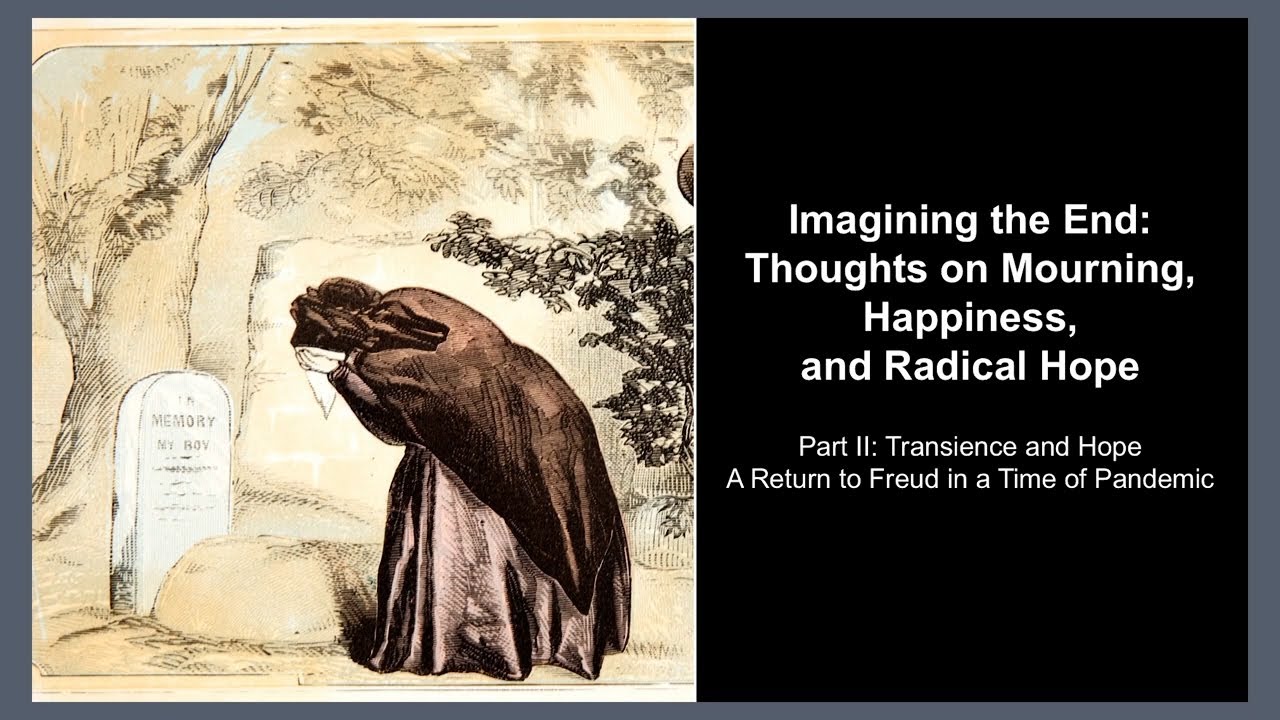
“All beginnings contain an element of recollection.” When the late British anthropologist Paul Connerton wrote these words (1989: 6), he had in mind a specific kind of memory: social memory that generates and is revitalized in commemorative practices (like rituals, holidays, and parades) as well as in material culture (like monuments, museums, and sacred texts). But there is an even more general point to be made: when we remember, and perhaps especially when the memories cause us pain, we try to find meaning in the pain; and when we search for meaning, we are engaged in creative and imaginative acts.
To illustrate our capacity for creativity, one need only look at two of the subjects covered in our dispatches: “In America: Remember” and “Rami’s Heart.” Both efforts came from mourning losses to COVID-19 – “In America: Remember” from artist Suzanne Brennan Firstenberg’s desire to mourn and honor the enormous number of people in the US who died from the virus, and “Rami’s Heart” from Rima Samman-Whitaker’s desire to mourn and honor her brother, and to invite us to join her and extend that honor to others. Importantly, the projects continue to grow, even in a divisive political climate in which many in the US deny the realities of the pandemic and urge us to forget. As we will see below, when Freud wrote during WWI about the positive effects of mourning, he was so critical of those who reacted to loss with apathy and dejection rather than with a therapeutic grieving process that he suggested they were engaged in a “revolt” against mourning. To the extent that Firstenberg and Samman-Whitaker’s projects seek to embrace rather than to revolt against mourning, they are counter-revolutionary.
I recently came across a fascinating short article by the philosopher and psychoanalyst Jonathan Lear, “Transience and Hope: A Return to Freud in a Time of Pandemic” (2021), that might help us understand the value of mourning we see in phenomena like “In America: Remember” and “Rami’s Heart.” I also bring it up for a simple academic reason: it is a relatively unknown work that may be of interest to many scholars who, if they are anything like me, had never even heard of it.
Given the title of his essay, I assumed Lear’s article would be about Freud’s 1917 “Mourning and Melancholia,” since so many scholarly works on the COVID-19 pandemic draw on this classic. Writers in numerous academic disciplines have argued that the pandemic and the restrictions on social interaction that followed (including mortuary rites) complicated the experience of loss, making it hard for survivors to move from what Freud considered pathological grief or melancholia (the unconscious experience of loss as grief of a part of one’s self) to “normal” mourning (the conscious experience of grief as the loss of someone outside of ourselves).
But Lear surprises us. Instead, he discusses Freud’s little-known 1916 piece “On Transience,” a short 2 ½ page reflection. The seeds of “Mourning and Melancholia” are there, but they are symbolized, as in a dream or a parable.
In “On Transience,” Freud reflects on a vacation in 1913, just one year before the onset of WWI, when war, in his words, “robbed us of very much that we had loved, and showed us how ephemeral were many things that we had regarded as changeless” (1957 [1916]: 307). He recounts a summer walk in the countryside (likely the Dolomite mountains in northeastern Italy) – with an unnamed “taciturn friend” and an unnamed “famous poet.” We learn almost nothing about the views of the taciturn friend, who remained taciturn; other than that, he did not enjoy the walk. The poet, however, expresses his displeasure. He becomes despondent when he considers that the beauty around him and indeed “all human beauty” will one day disappear. Freud cannot argue with the fact that many beautiful things perish; but he does dispute the idea that transience should get in the way of enjoying what is currently in front of us. In fact, transience should make that which is beautiful even more beautiful. As Freud puts it, “A flower that blossoms only for a single night does not seem to us on that account less lovely” (1957 [1916]: 306). Why, then, was the friend unhappy and the poet so disturbed?
Freud writes, “What spoilt their enjoyment of beauty must have been a revolt against mourning,” and more specifically the pain of mourning, even if they were unaware of the reason for their melancholy. For Freud, mourning is therapeutic; unlike melancholia, personified by his companions, mourning allows us to appreciate what we love, even if it perishes, while at the same time, it liberates us to attach ourselves to other new objects of love. Mourning doesn’t eliminate the loss—in fact, it transforms the natural phenomenon of death into an experienced loss, an absence in our lives to which we give a psychological meaning, and in so doing provides us with relief. This is the point Lear wishes to make: melancholia fixes us in one place; it is unproductive and can lead to depression, while mourning is creative. What’s more, the pain of mourning—at least one’s socially recognized withdrawal or the impairments in one’s everyday life—eventually wanes.
Lear tells us that he read “On Transience” differently before and during the pandemic. Before the pandemic, he considered it merely a poignant meditation on ephemeral beauty, and the imagined losses of the impending war. After the pandemic, he read it as an allegory of Freud’s own process of mourning. Despite Freud’s insistence that he is different from the poet, having worked through the problem of how to sustain an appreciation of beauty in a chaotic and ephemeral world, there is evidence that Freud on the walk in the Dolomites is also melancholic, grieving a part of himself. Freud writes almost apocalyptically. He says that the war “tarnished the lofty impartiality of our science,” “let loose the evil spirits within us,” “made our country small again,” and “shattered our pride in the achievements of our civilization, our admiration for many philosophers and artists and our hopes of a final triumph over the differences between nations and races” (307). The losses of pride, admiration, faith in science, the nation, etc. are pieces of Freud, losses of his ideals. He does not sound like someone in “normal” mourning; he sounds like someone who needs to mourn.
Lear is thus convinced that the essay, read as a whole, is an allegory for Freud’s own mourning process. “On Transience,” Lear concludes, is “a performance of psychic repair in the midst of world catastrophe” (2021: 13, emphasis in original). First, Lear suspects no such trip or conversation ever took place. The event is likely a fictional attempt to make a philosophical and psychological argument, and to illustrate a journey into mourning. Second, the two companions are part of Freud’s own mind, as he debates valuing and despairing that which is transient, an internal debate Lear considers to be both something personal for Freud, as well as a general, human, psychological process. By identifying melancholia in his fellow travelers and mourning in his own “working through” of transience, I even wondered if there was some attempt here to symbolize the taciturn traveler as the self-centered Id, the poet as the guilt-ridden superego, and Freud himself as the mediating ego. What’s more, the three individuals may also represent Freud’s reading audience, living in war and ambivalent about the future.
Even those who did not lose friends or family from COVID-19 suffered, as Freud did in WWI, as we witnessed the loss of faith in science, the loss of pride in our leaders, the loss of national unity in the face of a tragedy that, under different historical conditions, might have brought us together. If readers, Lear says, “can use [Freud’s] essay to make a similar journey” it might help them deal with the pain of their losses.
Even within the war, Freud remained optimistic about the possibilities of mourning. He writes that mourning is itself transient, and perhaps even evil is transient: “Once the mourning is over, it will be found that our high opinion of the riches of civilization has lost nothing from our discover of their fragility. We shall build up again all that war has destroyed, and perhaps on firmer ground and more lastingly than before.”
References Cited
Connerton, Paul. 1989. How Societies Remember. Cambridge: Cambridge University Press.
Freud, Sigmund. 1957 [1916]. “On Transience.” The Standard Edition of the Complete Psychological Works of Sigmund Freud. James Strachey, trans. London: Hogarth.
Lear, Jonathan. 2021. “Transience and Hope: A Return to Freud in a Time of Pandemic.” International Journal of Psychoanalysis, 102 (1): 3-15.
Lear, Jonathan. 2022. Imagining the End: Mourning and Ethical Life. Cambridge, MA and London: Belknap Press of Harvard University Press.
Acknowledgments: Many thanks to Paige Gavin for comments on a draft of this dispatch.
Suzanne Brennan Firstenberg’s In America Remember Three Years On
By: Roy R. Grinker
To highlight the complexity of memorial art and politics, the renowned scholar of memory James Young occasionally invokes the German artist Horst Hoheisel, who conjured up an idea for a kind of anti-memorial. Instead of building something new to memorialize the dead, he proposed, why not remove a physical object. The vacant space itself would then evoke loss and absence. Hoheisel wrote that a vacant space might be “…an invitation to passersby who stand upon it to search for the memorial in their own heads. For only there is the memorial to be found.”
For Hoheisel, a physical memorial is a cop-out; it relieves the burden of memory because the memorial does the work for us.
Most scholars and artists would likely disagree with Hoheisel’s position, arguing instead that the preservation of memory is always enhanced when scaffolded by something material. But I empathized with Hoheisel as I sat on the national mall on September 21 and 22, 2024, contemplating the absence of something monumental that had materialized and then was gone: the 701,113 flags that for two weeks in 2021 carpeted the national mall in Washington, D.C. in honor of those who died from COVID-19. The social action artist Suzanne Brennan Firstenberg conceived and installed the memorial. Between September 17 and October 3, countless visitors came to look, remember, and reflect, alone and with others, and compose written messages on flags they planted on the grounds adjacent to the Washington Memorial.
Now, three years after the installation was dismantled, Suzanne and her team of volunteers returned to the Mall for two days (September 21 and 22) to write down their memories of the installation and record oral histories.
The first thing I did when I got to the mall was to look at photographs of the installation on my phone. I needed to remind myself of what it looked like. It seemed easy to remember by looking at photographs, but only the shape of memory, not memory itself or the depth of feeling I experienced. The harder part was transporting myself back to those actual lived moments in September 2021.
First, I returned to the environment: the sun beating down, somewhat hot for late September, the thousands of flags flapping loudly in strong, warm winds. The impressive sound accentuated the size and gravity of what the installation was about and overshadowed any other sounds, paradoxically creating its own kind of solemn silence.
Next was the feeling of loss. There were my own losses. My entire family of origin – my mother, father, and sister – died during the pandemic, and though they did not die from COVID-19, the installation spoke to me more generally about grief.
I have walked or jogged through the National Mall dozens of times in the three years since the installation ended, but while the installation always comes to mind, this visit was different. We were there again to think about In America.
Suzanne and I spoke to a park ranger who was embarrassed because, he said, he had forgotten about her. But it came back now. He recalled looking out from the top of the Washington Monument, five hundred feet above ground, and seeing how the reflections of the sun made the white flags look as if they were silver. He said, “It’s so consoling to have somebody to sit and think about the lives that were lost, and then what is being done in place of those who have been lost. That was so consoling to me. That’s how I felt.”
Returning to the present, he added, “And you know what, that I feel bad that I forgot about you, but you know what, meeting you again, it’s just like, just like I said, it’s so consoling, you understand.”
For the ranger, the installation commemorated the collective; for many others, however, like the thousands of people who wrote and planted flags, the losses it denoted were both collective and individual.
A former volunteer named Jennifer came to the mall to write and talk about In America, but also to remember her “baby brother” John-John, who died of COVID-19 at the age of 30. John-John had Down Syndrome. He was non-speaking and had significant intellectual disabilities. She said, “I like it when I get the opportunity to talk about [John-John]. I have no fear about being forgotten, but for whatever reason, I have this fear of him being forgotten, and so I will talk about him as much as I possibly can.”
After John-John passed, Jennifer found support online from other mourners, and several came together in person to volunteer at In America and to participate in other forms of advocacy, such as fundraising and making gift baskets for front-line healthcare workers. John-John’s disability, she said, predisposed her to be an advocate, to fight to make things better in the world. Being a sister to John-John, she said, “made me kind.” “And I felt like him passing away, like I almost felt like that kindness was gone. It took a bit for me to find it again.”
Being at the site of the installation helped her to reflect on her own suffering. “I feel like it’s completely like, you know, just, I feel like I’ve broken into multiple pieces.”
She added that even when she drives near the Washington Monument she is reminded of her brother, and those memories are not only painful but comforting. The comfort is in keeping the memory of John-John alive. She does not seek a resolution. Indeed, she is critical of those who think one can move on beyond loss and stop talking about it.
Speaking about loss, she said, “[Many people] pretend like it’s not going to happen, and then one day it happens, and then we’re, you know, trying to put it all the pieces together, to try to, you know, bury this individual that we care about. And then after that, it’s like, oh, how are you doing? I’m so sorry for your loss. And then no one asks about them anymore, which is why I have every intention to talk about my brother.”
Jennifer echoes the wise words of the writer Pauline Boss, for whom closure is a myth and grief is an ongoing process. For Boss, there is no “getting over” grief. Instead, people learn to live with grief, whether by incorporating their deceased loved ones in their daily lives, as Jennifer does through advocacy and volunteer work, or by believing that their relationship to them transcends the living world, in that they are never truly “gone.”
As we sat on the mall talking about John-John, Jennifer acknowledged her own special grief, that the loss of a sibling for whom she would have been the primary caretaker in the future, was a double loss: the loss of a brother, and the loss of the caretaking responsibility she embraced. Those losses are perhaps the two pieces of herself she refers to when she says “I’ve lost some of those pieces [of myself], and I don’t know how to put them all back together.”
***
We will never know if Jennifer would have articulated her special pain in the same way in another location. But she came to the mall intending to grieve. She wants to grieve and will continue to do so, whether the flags for the multitudes who died are planted in the ground or not, or whether the names of the dead are written in permanent marker or etched in stone. When she sees the National Mall, she sees her brother. And on September 21 and 22, we saw him too.
“’A Walk to Remember’ is more than just a physical journey; it’s a step towards healing, a tribute to resilience, and a celebration of the memories that forever bind us to our loved ones.”
– Rima Samman-Whitaker
By Sarah Wagner
On April 13, 2024, I drove back up to New Jersey to take part in Rami’s Heart Memorial 4th Annual “Walk to Remember” along the boardwalk at Belmar Beach. Joined by my husband and a close friend from high school, we arrived in time to register, get our pinnies, and catch the opening ceremony.
It was a surprisingly chilly day for mid-April, with gusty winds and an overcast sky. But nothing to deter the organizers and participants, most of whom came prepared, dressed in layers and ready to move. Travis Whitaker (co-founder along with Rima Samman Whitaker) made his way through the crowd offering Dunkin Donuts—“you’ll walk it off.”
Just stone’s throw from the original site of the memorial, the event formally began at a small staging area off the boardwalk where the crowd of approximately 50 people, ranging in age from little children to seniors, gathered together for opening remarks. In the center was a wire cage with a flouncy yellow bow holding two snow-white doves.
The mayor of Belmar, Jerry Buccafusco, welcomed the participants, paying tribute to Rima’s drive and dedication and explaining that there would be an unveiling of a memorial plaque marking the original site of Rami’s Heart Memorial, a few weeks later on May 11. He spoke with ease and without a script, comfortable among this gathering and yet careful with his words. He knows their story and their grief.
Then came the releasing of the doves—five in total, two in the cage and three in a nearby crate. A woman in a bright yellow jacket handed the birds over one by one with instructions to the participating family members to hold them tightly around their wings. There was a moment of uncertainty when one of the doves flapped, tufts of feathers sent airborne. The handler explained they would need to give them a push, release them with a thrust upward, because otherwise they would fall to the ground. An unrehearsed moment around a symbolic script (of peace, love, remembrance), there was no explicit ceremonial explanation of the meaning of the doves and their release. Once freed, the birds took flight and were gone in an instant.
Rima then gave her own brief remarks, shorter and less formal than the lighting ceremony we attended earlier in March. Just as she had described to me beforehand, this event felt more grounded in the local community and less somber. It was a chance for people to socialize together while also remembering.
The ceremonial part complete, we began the walk itself along the boardwalk. People proceeded in informal groupings, presumably as they came to the event. The waves were quite high and so as we walked along the beach we saw scores of surfers—must have been ideal conditions—in wetsuits, riding the waves, the surf crashing against a large outcropping of black rocks.
As we neared the finish line, we caught up with Trav and I asked him about the evolution of the hearts, how many and how they grew. He explained that the first day there were about fifty. Rima posted images on social media and the next day 200 people had responded, some asking for her to add a name. The first heart was the largest, he explained, with about 300 stones contained within it. Two months later they had expanded into six hearts. Media attention—coverage from a local newspaper and then an ABC report—meant that, as they walked by the site, people knew what they were seeing. Sometimes they offered encouraging words, “It’s so good, so important what you’re doing.” Others thanked them for including their loved one’s name.
After having visited twice the Allaire Community Farm, where the permanent memorial now stands, it was powerful to hear these stories, to take in the sight of the beach, to imagine the stone-filled hearts in their original form, and to see Rami’s Heart—its leaders and dedicated members—gathered in ritual, in motion, and in remembrance.
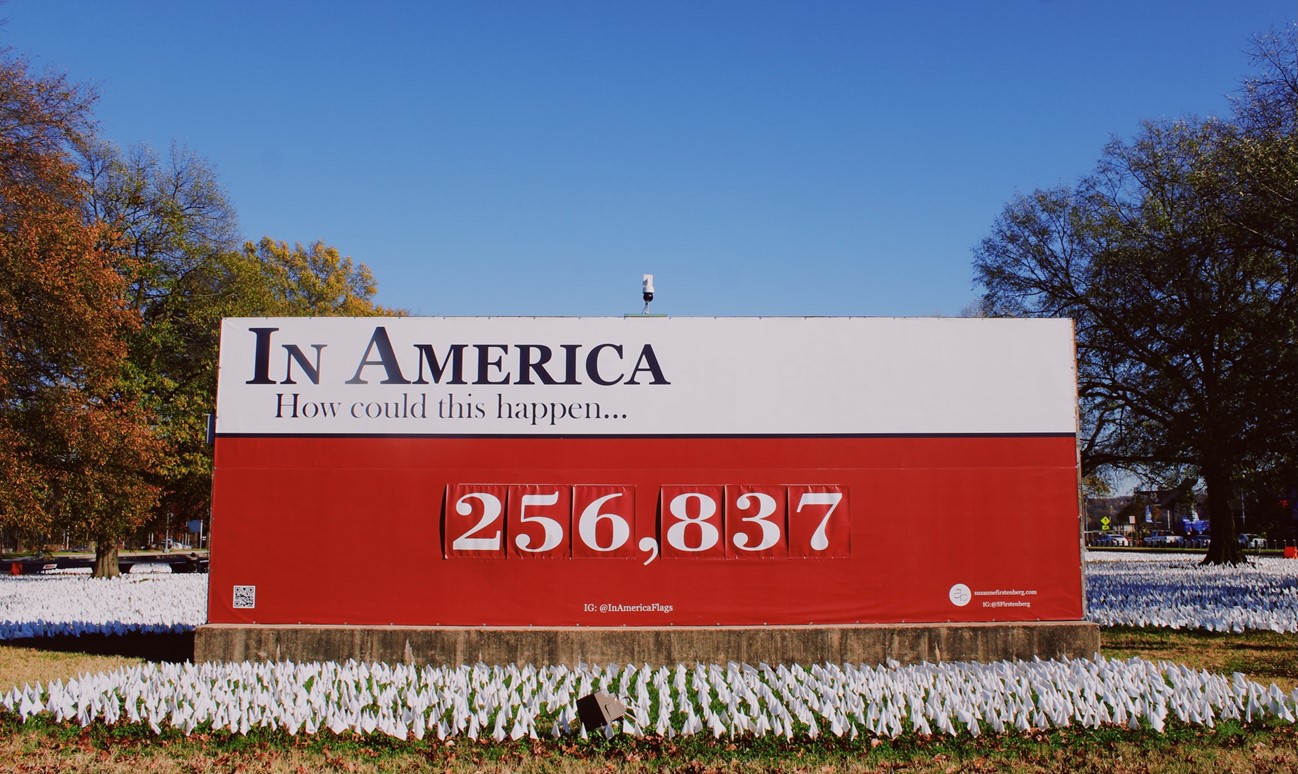
On November 23, 2020, I attended the In America installation by artist Suzanne Firstenberg. At a park in front of the RFK Memorial Stadium and the DC National Guard Armory, Suzanne and a team of volunteers had planted one white flag for each victim of the COVID-19 pandemic in the United States. At the installation’s entrance stood a large sign with the title of the piece and large numbers counting the number of victims and, thus, how many flags. At the time of my visit, the number was 256,837.
One of my first observations was the installation’s specific location. It stood at the end of East Capitol Street and, while it couldn’t be seen over the hills, the sign counting the rising death toll directly faced the US Capitol. Additionally, the installation is located in front of RFK Stadium, a memorial site of its own. The DC National Guard Armory was a few feet away. As Suzanne explained to me, it served as a base from which the National Guard mobilized during the Black Lives Matter protests over the summer.
The flags and their positioning invoked the image of the white gravestones of Arlington National Cemetery. The white also gave people the opportunity to write short epitaphs, either in person or by sending a request to Suzanne. Most are names, some stylized after formal gravestones with dates, while others include brief obituaries with phrases such as we will miss you and thank you. Other messages strive to communicate more collective sentiments: rest in peace everyone. Most but certainly not all are written in English.
A pair of signs bookmark the two ends of the installation. One is an advertisement for the National Guard, the other an insurance ad. In a way, these two signs create a moment of ironic condemnation. These are two institutions toward which many Americans look for safety and yet suspended between them is a representation of a quarter-million deceased citizens.
An insurance advertisement.A DC National Guard advertisement.