Rituals in the Making: a George Washington University research project on memorialization, misinformation, and the consequences of the COVID-19 pandemic

Tag: Healthcare

  • “All of Us Were Willing to Run into the Fire”  

    “All of Us Were Willing to Run into the Fire”  

    By: Avery Nennmann 


    An interview with Dr. Ashwin Shankar on Forging Community Bonds and Pediatric Healthcare during the COVID-19 Pandemic   

    ***

    On October 17, 2024, researchers Avery Nennmann and Dr. Sarah Wagner interviewed pediatric and adult allergist and immunologist Dr. Ashwin Shankar regarding his experiences during the beginning months of the COVID-19 pandemic. 

    Dr. Shankar grew up in Houston, Texas, and went on to study opera performance and music composition alongside nutrition for his Bachelor’s degree. During that time, he burned the wick at both ends by DJing at clubs, getting up to tutor calculus at 8 am, and, for a little fun, joining a breakdancing team. His interest and devotion to medicine took shape when his mother’s health declined in college. He said he “wanted to empower people through medicine” and thus pursued this calling that later landed him in residency in Detroit, MI, at the Children’s Hospital just as the pandemic hit. 

    Dr. Shankar shared that during his time in medical school and residency, he was drawn to allergy and immunology, especially in the pediatrics unit, where he appreciated seeing children’s resilience and joy as a part of their recovery. In March 2020, Dr. Shankar was working the night shift. At the time, hospital staff noticed patients coming in with unusual symptoms, such as healthy children suddenly going into heart failure, and other more serious conditions. “We didn’t know what was going on… There were some rumblings that there was something kind of going around out[side] of the country, but we didn’t really think much of it. We thought maybe this is something that we just haven’t seen before.”  

    As the rumblings grew into concern, clinics shut down, and medical professionals began scrambling to determine how to act and what to do. The problem, however, was that no one had the answers. Dr. Shankar reflected on the silence for the first few months after March as they waited for cases to come in. “We knew we’re going to be having long nights… actually we didn’t know when would be the last time we’d see any family members or friends, and so we were all kind of prepared, and then the pandemic hit.” 

    Date Posted: Feb 2, 2025. 

An interview with Dr. Ashwin Shankar on Forging Community Bonds and Pediatric Healthcare during the COVID-19 Pandemic  
    Dr. Shankar treating ICU patients on the general inpatient floor wearing a 3D printed face shield from a colleague due to limited PPE. 

    May brought chaos to the hospital, and the ER was soon overflowing with COVID cases. Dr. Shankar had colleagues whose patients passed away while waiting in the hallways before they were even able to be checked in. Prevented from assisting because of liability concerns, those working in pediatrics “felt like we were useless… even though we were in the medical field.” “All of us were willing to run into the fire, … and so we were trying to figure out what are ways that we can help connect the community and help connect people.” 

    Dr. Shankar channeled that feeling of helplessness into action and became the chair of an organization called Pediatrics Educating and Advocating for Community Health, or PEACH. The group created Zoom meetings and outdoor activities for kids and their parents to be able to connect and mingle in a safe manner. A lot of what drew Dr. Shankar to this community effort was seeing an increase in Adverse Childhood Experiences (ACEs) from the compounding trauma of the pandemic. As he continued his efforts to heal through community, pediatric cases kept coming into the hospital. In June and July 2020, once again the ER was flooded, as kid after kid arrived with possible COVID-related breathing difficulties, heart palpitations, and fatigue. “Every single inflammatory marker was out of whack.”  

    As the pandemic raged on and the volume of patients increased, colleagues—healthcare workers themselves—began to get sick. Dr. Shankar’s concerns and efforts spread beyond the hospital to those being affected socially, especially within the population of children. He explained how isolation often compounded people’s fear of sickness: “You know, if they [children] ended up getting sick, a family member or a friend getting sick… even in the beginning when schools were closed, some of my patients had lost a parent/caregiver already because of COVID and they didn’t know how to react, they didn’t know what to do, and then on top of that, you know, you’re telling people, okay, you have to seek out your support group, but how can you seek out your support group if you’re supposed to isolate?” 

    When vaccines finally arrived, Dr. Shankar and his colleagues had a new challenge to contend with: distrust and skepticism. Through Zoom meetings and open forums, they sought to reach people where they were, to address their fears and answer their questions. People in the community began to respond. “You could hear the pep in their voice.” They began following up with their prescribed therapy and their checkups. For him, it was a crucial learning opportunity. 


    Towards the end of the interview, we asked Dr. Shankar about his proudest and hardest moments from the pandemic. The hard part for him, he explained, was being away from family—they were in Texas while he was in Michigan. The way through the isolation for him was connecting with community and becoming close with his residency family. He said, “That second layer that was very difficult was having patients pass away on me. Whether it was in the pediatric ICU or the neonatal ICU… these are people who didn’t even have a full life.” Dr. Shankar’s proudest moment emerged once the pandemic was in full swing and vaccines were passed out. The tipping point he recalled was when patients saw him and his colleagues get vaccinated; they did too. This 180-degree turn in trust gave him hope for community care and mutual respect for physician authority. “Seeing families and kids bounce back, like getting gurneyed into a room, and then walking out of that room with balloons and a smile. The numerous patients that happened to, and continuing to be at the hospital because of vaccinations, because they saw their doctor do it. That was probably one of the most exciting things.” 

    Dr. Shankar voiced his concern about the relationship between doctors and patients, which is doubly complicated in pediatrics since the parents/family of the patient are inextricably involved in their care, adding another potential layer of politically influenced strife in addition to the standard stress of having a seriously ill child in the hospital. The national increase in distrust of the medical community was also a factor in Dr. Shankar’s experience, especially in places like Texas and Michigan with the release of the COVID vaccine. Dr. Shankar explained that trust is as important in vaccine distribution as it is when treating a patient. He would ask, “Do you trust me? And they say, Yes, I trust you, Dr. Shankar. I said, Okay, would I ever stray you? Like, would I ever, you know, make you think something that’s not correct or not true? And they said, no. I said, okay, let me lay out all the facts for you. And so, my goal was that any decision we make, we have to make this together.” 

     Dr. Shankar holding his Covid vaccination card as one of the first rescue responders to receive the vaccine in December 2020. 

    Among the many lessons of the pandemic, Dr. Shankar stressed the importance of caring for oneself in order to care for others. “You kind of have to make sure your cup is full and you’re taking care [of yourself] before you can kind of give back and serve people.” 

    “Sometimes,” he explained, “when you’re hitting a roadblock every single day, it can be really hard. And it can be really easy to give up. But I think the reason why, like, myself and a lot of my colleagues didn’t give up was because … we were surrounding ourselves with the right people. We knew none of us had all the answers.” 

  • “People want perfect healthcare; not good, perfect”

    “People want perfect healthcare; not good, perfect”

    BY: Hanaan Khabir

    On October 8, 2024, Avery Nennmann and Hanaan Khabir interviewed Dr. Bill Morris on his experiences during the early months of the pandemic for the More than a Healthcare Hero Initiative. While Dr. Morris, did not work directly with COVID patients nor was he on the front lines, his position within hospital administration and his role as a medical authority within his community and among former patients allows him to contribute a unique insight into this project.


     Dr. Morris has spent the vast majority of his life working as a physician in Kerrville, Texas. The child of an internist, Morris began as an orderly in his early teens. He has dedicated 47 years to internal medicine at Peterson Hospital – spending almost 30 of those years on-call – before closing his practice in 2007 and transitioning to a physician advisor and hospital administrator. When the pandemic began in early 2020, Morris was working as a consultant on the verge of retirement. He – like much of the medical community at that time – first heard of the virus in 2020 – but it was initially viewed as a simple outbreak of pneumonia central to the Asian subcontinent; however, that soon proved to not be the case, and he would eventually be forced to continue his work from home as – given his age – it was deemed unsafe for him to work directly within the hospital environment. 

    Morris spent much of his interview touching on the concepts of misinformation, public health, and medical authority. He mentions how early perceptions of COVID-19 – fueled by political discourse – viewed the virus as a simple cash grab for medical professionals; he corrected this perception, mentioning how hospitals did not profit from COVID-19 patients “unless they died quickly.” Due to the time and beds they took up, taking in/treating COVID patients resulted in a loss of money for hospitals, Outpatient services are where hospitals make their money – and this was especially true during the pandemic. He also touched on public health – specifically within the context of isolation protocols and vaccine initiatives. Morris mentions his role as a community leader, promoting vaccine initiatives despite resistance in the form of distrust in medical authority fueled by political discourse. He even highlights instances of attempts to undermine these [vaccination] efforts, he specifically mentioned “rich people” threatening to stop hospital donations if they didn’t get vaccinated first – regardless of vaccines slowly opening up to certain ages and demographics. 

    Dr. Morris expressed deep disappointment in political figures, particularly the Lt. Governor of  Texas who undervalued the lives of seniors in the context of vaccine administration. Interestingly, while touching on the concept of medical authority, Dr. Morris mentions that members of the older generation, 80-90 years old, were actually trusting in medical authority as compared to their younger counterparts – something he equates to medical professionals getting these individuals to this age in the first place. On the other hand, he notes that the biggest contributors to the anti-COVID/anti-vaccine campaigns were individuals in the 20-50 age range, he simply equates this to the accessibility of medical information. People want perfect healthcare; not good, perfect, and any mistake highlights these imperfections and increases the distrust these individuals hold concerning medicine and the people within the field. This distrust has been continuously exacerbated by sensational media coverage and the continued depersonalization of healthcare. People do not understand the complexities of medicine, he notes that Dr. Fauci and the CDC’s changing perspectives were normal in the context of medicine as scientific information is constantly changing; however, the general public viewed this changing information as a lack of confidence and evidence of incompetence. 

    Dr. Morris ended the interview with a warning, “There will be a next one.” This warning, while foreboding, also underscores the need for improved public health infrastructure and community resilience.

    Dr. Morris’ interview provides valuable insight into the complex issues and challenges faced by healthcare providers during the pandemic and highlights the broader social implications of distrust in medical authority and the continuous need for community health initiatives.

  • “It Was the Most Stressful Year of My Career. Hands Down.”

    “It Was the Most Stressful Year of My Career. Hands Down.”

    An Interview with Dr. Eileen Gavin on Serving Native Communities During the COVID-19 Pandemic.

    By: Avery Nennmann 


    On June 19, 2024, Avery Nennmann, Paige Gavin, Daria Dzen, and Martha Greenwald interviewed Dr. Eileen Gavin on her experiences during 2020-2021 of the pandemic for the More Than a Healthcare Hero Initiative. Dr. Gavin currently works as a travel doctor, going where the people need her, with short stints throughout the year in various indigenous reservations across the Upper Midwest. During the first year of the pandemic in 2020, Dr. Gavin was working on the Bad River Reservation in the northernmost part of Wisconsin on Lake Superior. The reservation had one clinic that serviced the entire tribal territory causing most tribal members to travel 30-40 minutes from their residence to receive any sort of medical care. The closest tertiary care hospital was in Duluth, MN, a car ride an hour and forty minutes away. 

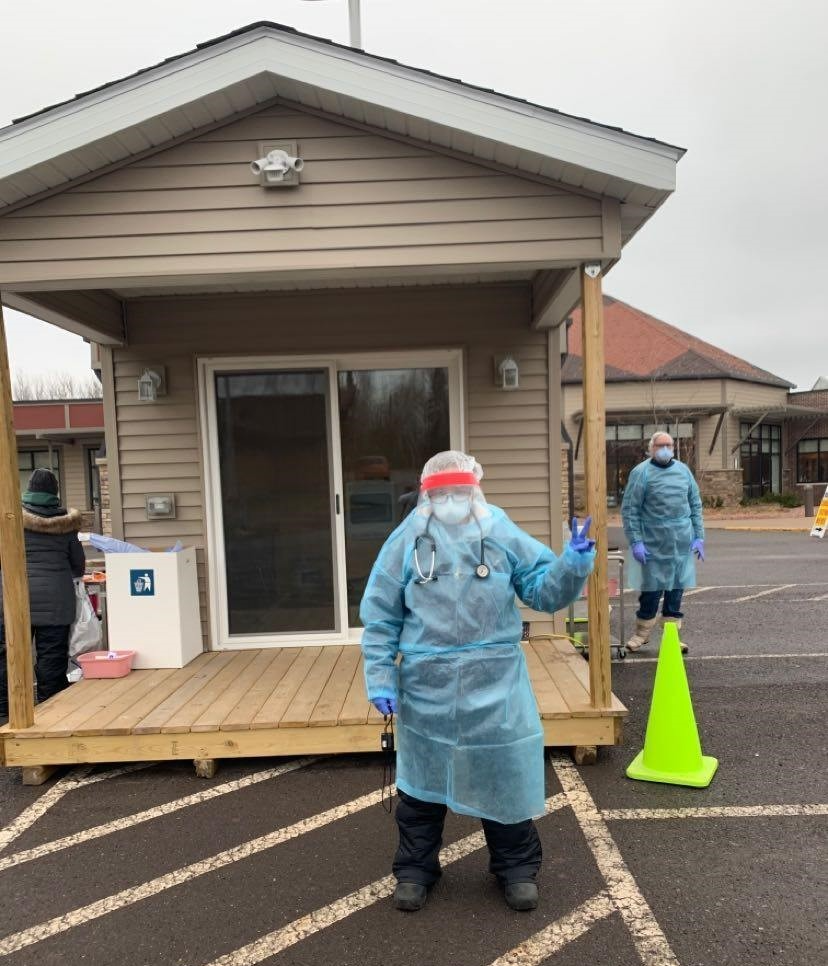
    Dr. Gavin flashing a peace sign in full PPE gear outside of a drive-through clinic on the Bad River Reservation, November 2020.  

    Dr. Gavin, an outsider to the Bad River Tribe, relied heavily on building doctor/patient relationships with community members who were suspicious of Western medicine. To do this she acknowledged traditional medicine as a healing tool alongside her Western approach to medicine. She contended that she didn’t “have anything [better] to offer them and [was] not going to argue with a 1000+ year practice” during a time filled with such uncertainty and fear. Dr. Gavin also noted that no one was well prepared to deal with a pandemic, especially when it came to tribal governments that are often the last to receive care and feel the effects of policy changes from the federal government. She waited for the Centers for Disease Control and Prevention and the federal government to step in and bring resources, but nothing came. With no one but herself and one other nurse practitioner, Dr. Gavin resolved to creating a system of care to mitigate the weight of the pandemic felt by the community. She anticipated what was coming early in February of 2020 and took it upon herself as an independent contractor to tell the clinic director to close the casino. She began holding meetings to brace for the imminent pandemic. At first, everyone thought she was blowing circumstances out of proportions, but her fail safes became safety rafts in the months to come.  

    Dr. Gavin likened the initial year of the pandemic as “kind of like being a firefighter” with her gear and respirator on for protection – she saw the fire coming but only had a fire hose to put it out. She stated her “biggest concern was the feeling of helplessness. There was nothing to do, there were no treatments, there was no vaccines, there was just supportive care, even if we hospitalized them.” Since COVID-19 was a novel virus, Dr. Gavin had no idea how it worked or mutated but thankfully Indian Health Services kept the clinic stocked on the necessary PPE to stave off the disease as much as they could. The Native community wanted to protect their elders by keeping them separated and prioritizing their care – a difficult feat as many households were multigenerational.  

    Alongside the Nurse Practitioner, Dr. Gavin treated all sick patients outdoors, with one day of the week dedicated to only seeing respiratory patients to screen them for COVID or other infectious diseases and diagnose treatment. During the interview, Dr. Gavin mentioned multiple times how overwhelmed and hopeless she was throughout that first year. She was working four-five days a week, with ten-twelve-hour days, and an additional two-three-hour commute from home and loved ones. Despite the medical necessity of the pandemic, Dr. Gavin continued to care for everyday health matters as “we still had to practice medicine. People still got pregnant, people still got pneumonia, people still had diabetes.” 

    Dr. Gavin disclosed that at the beginning of the pandemic, it was “a lot easier for me to manage it mentally, physically, spiritually, psychologically because I just had that education and pandemics and how they work, and knowing that lots of people are going to die. And I was much more comfortable with that, than a lot of most of the other people that I worked with. Having worked in hospice and palliative medicine, I mean, that’s what you do all day long is death and dying, and you just become used to it just as a natural state of life ending and not as a horrific event, it’s not a failure.” Despite this sentiment, Dr. Gavin was not immune to infection or her own impending burnout.  


    As the pandemic wore on, she became more depleted and fatigued as the commute and futility of care took its toll on her body and mind. As she dedicated her life to her oath of care, she was not able to be with her aging parents, nor her husband and daughters, which made it more difficult to persevere through the initial year of the pandemic. She said she wished she would have known we would have gotten the vaccine so quickly because she would have had more hope and wouldn’t have been in such a panic during that time. Dr. Gavin reiterated that it “was the most stressful year of my career. Hands down. I can’t stress that enough.” In December of 2020, COVID caught up to Dr. Gavin despite her precautions, leading her to take a year-long break from medicine. Dr. Gavins’s story is reminiscent of the moral injury and fatigue faced by physicians with little resources and an inability to save everyone from a devastating disease.  

  • “Our Day Was Just Trying to Get Through”

    “Our Day Was Just Trying to Get Through”

    An Interview with Pulmonologist Corrine Moreland, NP on Caring for the First COVID Patients in Texas.

    By: Paige Gavin


    On June 5, 2024, researcher assistants Avery Nennmann and Paige Gavin conducted an
    interview for the More Than a Healthcare Hero interview initiative. They interviewed Corrine
    Moreland, a pulmonary critical care nurse practitioner, who worked directly with COVID
    patients during the pandemic. Moreland worked in an ICU in Fort Worth, Texas, and saw
    between 20-30 patients per day with about 80% of them having COVID. At the beginning of the
    pandemic (2020-2021), the team of doctors and nurses she was working with tried their best to
    get FDA approval to use different therapies and drug methods to help treat COVID patients, yet,
    “in 2020 nothing helped the patient – they either survived or didn’t.”

    In America: Remember. National Mall, Washington, DC.

    Despite the misinformation spreading online about how only the old and those with comorbidities were
    getting/got COVID, Moreland saw people of all ages and fitness levels become severely ill. It
    was a scary time at the beginning of the pandemic for our healthcare workers, not only because
    of the uncertainty and lack of knowledge surrounding COVID-19, but also because there were
    few if any lines of defense against the virus. Moreland states that for nurses and doctors
    working in the hospital, “our day was just trying to get through – see the patients as much as
    you could and try to literally just keep them alive. There was no time to eat or go to the
    bathroom – you just kind of dealt with it.”


    Moreland mentions how saddening it was to see family not being allowed into the hospital or
    other facilities to say goodbye to their loved ones. It was hard to convey over the phone to
    family that their loved one may or may not survive being placed on a ventilator. The hospital
    had a palliative care team trying to reach everyone who was dying, but patients were dying too
    quickly for them to keep up. The nurses themselves would use their own phones to FaceTime
    the family. The use of FaceTime eventually became the day-to-day routine for nurses.
    One critical aspect of this interview was that Moreland had the first COVID-diagnosed patient in
    Texas:


    “The patient had been traveling – went to North Carolina for a work conference and came
    back sick. He had respiratory symptoms, cough, fever, chills, fatigue, all this stuff. Well, just
    the day before, the CDC had sent out email to us and to all the other main pulmonology
    providers to say this is what [COVID virus] looks like on the CT. There’s a certain pattern that
    the CT has that is indicative of COVID infection. So, it has a very specific look for the
    pneumonia, that is what makes people so sick…. well, we did a CT scan on this patient and I
    pulled up the email and I’m like, I think the same pattern that they said to look for. And so, I
    called my attending Doctor, and we completely put that patient on quarantine and then
    ended up having to get a first COVID test through the Fort Worth Health Department that
    took three days to come back. And it turns out he did in fact have COVID. He actually did
    okay, but was sick for like weeks in the hospital….”


    As the pandemic wore on, Moreland encountered patients who came in thinking that they were
    “vaccine experts,” who read things online and acted as though they knew more than the
    nurses. She tried her best to give evidence-based education on the topic of COVID to the
    patients she saw and kept families informed as much as possible.


    “And sometimes you get through to somebody… or you get through to a family member, you
    know, or you waited long enough, and they might be affected by it. That’s the other thing,
    because, you know, they come in and spout all this misinformation. And then six months
    later, they come back and say, you know, I had a family member die from COVID. It’s sad,
    because you don’t want to say I told you so – you just want to say ‘Well I’m really sorry that
    happened.’ And that sometimes that is what it sadly took to change some of these people’s
    minds.”


    “And I told patients, I’m not recommending anything that I haven’t done myself. And
    sometimes that helps, sometimes it didn’t, but I think it was just more people thought they
    knew better, which was just odd, considering nothing else in healthcare has ever stemmed
    such debates to the degree that I’ve seen…”


    Moreland explained to us that she feels that a lot of COVID discourse surrounding
    misinformation is related to the election year. Coming out of the height of the pandemic,
    Moreland notes that her work and personal life feel more manageable, since not many patients
    are getting deathly ill, and we have better treatments to combat the virus. She sees the COVID
    virus becoming like the flu, in the sense that it will be with us for a long time, and we will need
    to get vaccines yearly for it.


    “I think some people think that life just went back to completely normal, but I mean, it’s just
    like a new normal but COVID, it’s going to be there. It’s not going away…Four years in and it’s
    still pretty common.”