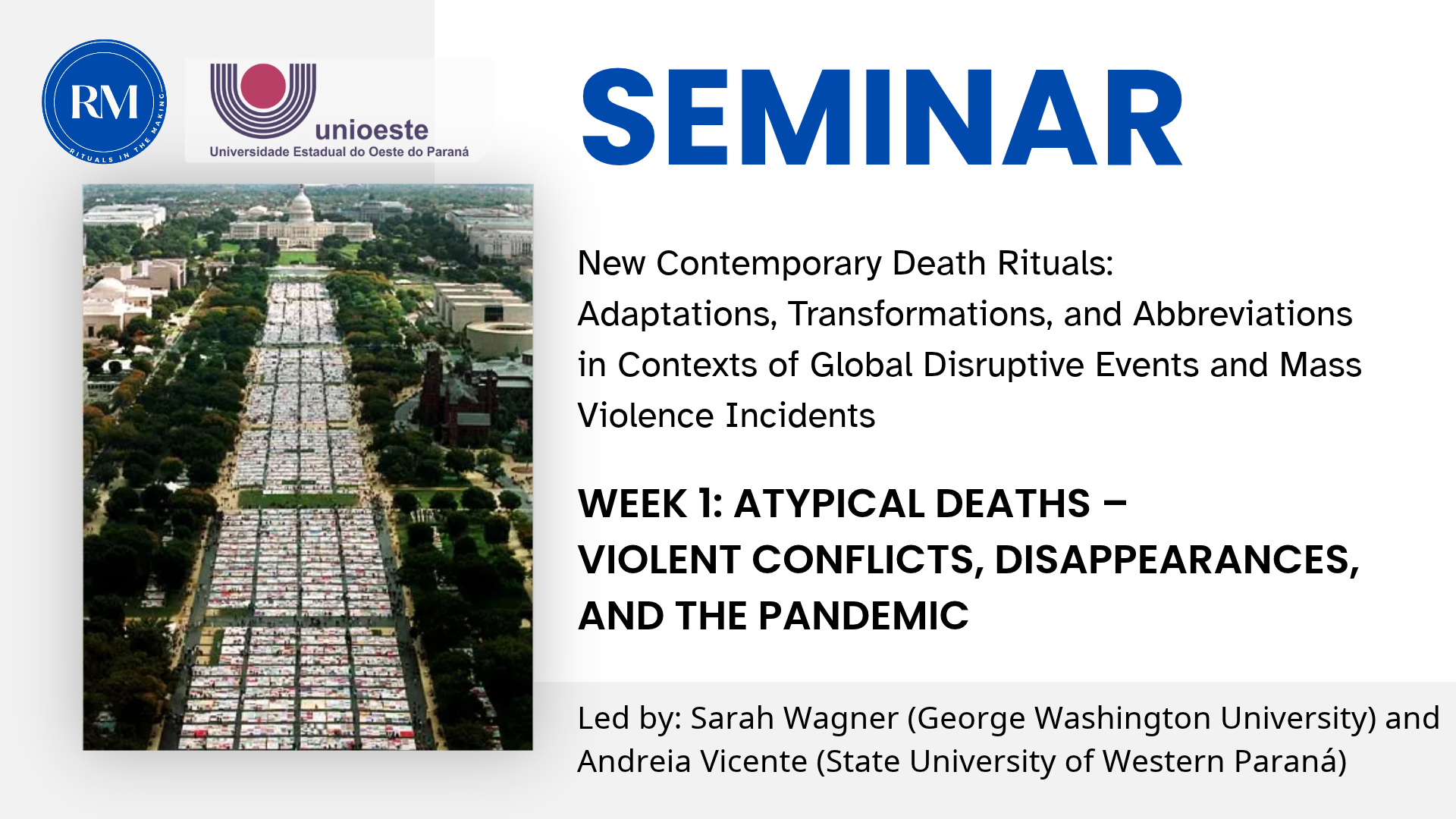

From September to October, 2026, Rituals in the Making teamed up with our longtime colleague, Brazilian anthropologist Andreia Vicente (Universidade Estadual do Oeste do Paraná (UNIOESTE)/State University of Western Paraná) to host one of the most generative spaces of learning and exchange around COVID death, mourning, and memorialization that we’ve been a part of over the past several years—the virtual seminar, “New Contemporary Death Rituals: Adaptations, Transformations, and Abbreviations in Contexts of Global Disruptive Events and Mass Violence Incidents.”
The seminar’s principal goal was sought to convene students, faculty, artists, advocates, and, especially important, the bereaved to discuss death rituals and remembrance and reflect on the impacts of contemporary disruptive events on experiences of finitude. As seminar organizers, we also sought to:
- Relate classical and contemporary concepts of death rituals.
- Debate the relationship between contemporary death rituals and contexts of violence and rupture.
- Reflect on the emotional impacts of new death rituals performed in disruptive situations.
- Present recent research conducted in various countries.
- Provide students with an experience of global and multicultural ritual diversity.
Held virtually from September 4 to October 23, 2026, the seminar explored the themes of death ritual and remembrance over five sessions:
Week 1: Atypical Deaths: Violent conflicts, disappearances, and the pandemic (led by Andreia Vicente and Sarah Wagner)
In this introductory session, we sought to frame the seminar’s more tailored discussion of COVID with broad themes such as “good” versus “bad” death; the importance of death ritual; ruptures introduced by atypical deaths.
From time to time, as presenters would do throughout the seminar sessions, we posed questions for consideration and debate, such as: Even as everyday death can be traumatic, what constitutes an “unjust” death? Is there a hierarchy of unjust death? Is this a universal or a culturally specific delineation?
Andreia explained a concept she has written about extensively, “cut-off rituals”:

Week 2: “They Are More Than Heroes” — COVID-19 pandemic and the deaths of healthcare professionals (led by Rachel Aisengart and RIM’s Avery Nennmann and Paige Gavin)
On the topic of unjust and traumatic deaths, this second session focused on the experiences of healthcare workers during the height of the pandemic in both Brazil and the United States. Healthcare workers from all backgrounds were faced with an overwhelming and atypical volume of death. Patients were dying rapidly from the virus, conditions compounded by a severe lack of PPE, ventilators, and institutional support.
Brazil and the US experienced a “syndemic” (termed by medical anthropologist Merrill Singer), in which the virus was not only understood as biological, but interacted in association with social, economic, and cultural issues that arose during the pandemic. Not only were healthcare professionals dealing with the virus, they were also battling the spread of misinformation relating to the virus, propelled by the presidential leaders Trump (US) and Bolsonaro (Brazil). Because of the circulation of misinformation on social media and from government officials, healthcare workers in Brazil and the United States endured emotional and physical violence from “anti-vaxxers” and COVID denialists – even leading to injuries and deaths amongst healthcare workers. The rise of mistrust in science and COVID conspiracy theories caused many healthcare workers to leave the field of medicine entirely.


Week 3: COVID-19 Pandemic, New Religiosities, and Emotions (led by Andreia Vicente and Teresa Ordorika)
Session #3 examined ritual practice (interrupted and improvised) and affective registers shaping how mourners in Brazil and Mexico responded to pandemic death. In the session’s first half, Andreia Vicente provided an in-depth look at the Evangelical communities she worked with during the pandemic. Canvassing a range of restricted ritual practice (e.g., family members forced to identify their deceased through a photo on a tablet; coffins lowered with mourners at a distance; burials without hymns), she analyzed the emotions flowing from such disruption: sadness, indignation, abandonment, frustration, among others. She highlighted the recurrence of what she terms as “angry grief“:
Tassia said: “I could not even touch my father’s coffin. I felt rage, not only sadness. Rage against the hospital, rage against the government, rage against the virus itself.”

Teresa Ordorika led the second half of the seminar in which she explored the themes of “mprovised farewells and the repair of ritual in Mexico’s COVID-19 bereavements.” She emphasized both the ritual calendar (events) interrupted by pandemic death and its attendant restrictions, as well as what she defined as the four “Four repertoires of improvisation”:
- Rites on screens: Zoom novenarios, Facebook Live, hybrid rosaries, masses by video, phones
- Material supports for memory: objects that allow memory to be produced: the voice, the shirts, the bracelet
- Ashes in the homes: the urn that never left, and the altar that never came down
- Rewritten calendars: rescheduled ceremonies
As an example of a “material support,” an uncle (Jorge) described the powerful emotive force of a teddy bear made of his nephew’s shirt:
“Everyone was given one [a bear made of] a T-shirt with a design that made them feel connected to [my nephew]…
I think my brother kept the cowboy T-shirt. I got the Batman one. Oh, and also, the bear’s name on its paw is what you used to call [my nephew]… So my bear’s name is Loco.”
“At first it was awful, wasn’t it? Because it smelled like my nephew […].”

Week 4: Remembering Pandemic Deaths – Part 1: virtual remembrance rites (led by Sarah Wagner and RIM’s Martha Greenwald, with a cameo by Ed Koenig)


Session four began the seminar’s concluding focus on pandemic commemoration. In it, we introduced and explore key analytics such as collective memory (Maurice Halbwachs), the work of remembrance (Jay Winter), and micro-eulogies, a concept developed by Greenwald et al.:
… condensed acts of remembrance and honoring that, though quotidian, are no less formal or sacred for the mourner. Such micro-acts of grief or mourning, contrary to conventional public speech eulogies, can be done in silence, in the repetition of care . . . .
The concept of micro-eulogies also sheds light on what goes unsaid—the work of omission and silence—and how efforts to memorialize through these smaller-scale, compact rituals and words of remembrance confront the absence of public commemoration and the refusals of pandemic deniers and revisionists. . . .”
Finally, they have a “dual character”: “These acts of remembrance are not simply confrontational or reactive . . . they are also the small, systematized speech acts of ritualized refusal. Naming the dead—necronominalism, as Thomas Laqueur describes (2015)—means refusing to let society “move on,” which implies challenging the devaluation of life and existing alongside the larger macro practices of erasure.“
– Greenwald, Pelaez, and Wagner, “Locating Grief: Pandemic Memory, Mourning, and the Politics of Where,” in The Cambridge Handbook for the Anthropology of Death
Martha led the second half of the session, presenting on her website, WhoWeLost.org, detailing how it came to be, her choices from aesthetic to ethical, and contributions of late. She noted:
“Submissions in 2021 and 2022 were centered on immediate loss, disbelief, grief, and guilt/sadness about the tragedy of loved ones dying alone in a hospital.
Submissions from 2023 until now often focus on potent memories that are triggered by typical grief milestones like birthdays, seasonal change, holidays, anniversaries, etc.
Since Trump’s second presidency began, there have been more stories submitted that express anger and disillusionment. Writers feel no one cares about the 1.3 million lost.
Covid has become the catch all scapegoat, blamed for everything from learning deficits to the economy to the declining birth rate. The virus has become further politicized since the appointment of Robert F. Kennedy, Jr. The controversial debates about vaccines and communicable diseases ignite resentment and anger in many of the survivors who participate in WhoWeLost.”


Finally, in this same session, colleagues from Brazil drew our attention to this online memorial: Memorial das Vítimas do Coronavírus no Brasil:
https://www.facebook.com/memorialcoronabrasil
Week 5: Remembering Pandemic Deaths – Part 2: art as commemoration (led by Sarah Wagner and Alice Kelly)

Our aim during this final session was to foster a comparative discussion of how pandemic loss has been memorialized – from grassroots efforts to official sites. Focused on examples from the US and UK, we were joined by several COVID memory activists:
Rami’s Heart COVID-19 Memorial (presented by Rima Samman-Whitaker):
Website: https://www.ramisheartcovidmemorial.org/
Facebook: www.facebook.com/Covid19MemorialRamisheart/


Kentucky COVID Memorial (presented by Martha Greewald, on behalf of sculptor Amanda Matthews):


https://covidmemorial.ky.gov/Pages/index.aspx
In America: Remember (presented by Suzanne Brennan Firstenberg):
https://www.suzannefirstenberg.com/in-america-remember


Naming the Lost Memorial (presented by Ed Koenig): https://ntlm.org/


National COVID Memorial Wall (presented by Lorelei King)
https://www.nationalcovidmemorialwall.org


For more on the Wall, the hearts, and Lorelei and the other volunteers’ hard work in maintaining and protecting the site, see our dispatch from May 2025.
At the conclusion of the final session, we thanked our attendees … and pledged to keep the dialogue going.