Rituals in the Making: a George Washington University research project on memorialization, misinformation, and the consequences of the COVID-19 pandemic

Tag: COVID

  • Memorialization as Movement Work – Part II: “Synopsis of Events,” and Then… Someone Dies

    Memorialization as Movement Work – Part II: “Synopsis of Events,” and Then… Someone Dies

    By Rituals in the Making

    This story discusses suicide. If you or someone you know needs help, the national suicide and crisis lifeline in the U.S. is available by calling or texting 988. There is also an online chat at 988lifeline.org.


    ICE memos record every step of Brayan Rayo-Garzón’s death in custody — and the fault of no one. Similar deaths have been recorded, documented, and archived by the state. Yet the deaths have not stopped. Between January 20, 2025, and June 4, 2026, 52 people died in Immigration and Customs Enforcement (ICE) custody in the United States. The mortality rate in ICE custody is at its highest level in over a decade (Human Rights Watch and Physicians for Human Rights, 2026).

    The healthcare system, so dependent on immigrant labor, has also seen its staff flee or be detained — most recently Ann Lawani, a nurse and professor.

    All of these deaths and detentions have been recorded as “procedures” and described in official ICE memos as a “synopsis of events.”


    Can an archive of death be more than a “synopsis of events”?

    What does it mean to archive and yet remember nothing?

    What does it mean to name and yet erase those who have been named?


    Brayan Rayo-Garzón was 27 years old. He was in ICE custody at the Phelps County Jail in Rolla, Missouri. Brayan had COVID and wanted to talk to his mom. “She must be worried,” he wrote in Spanish on a piece of paper he passed to one of the guards, hoping they would let him call her. They did not. Brayan died by suicide.

    Photo for NPR by Deisy Garzón.


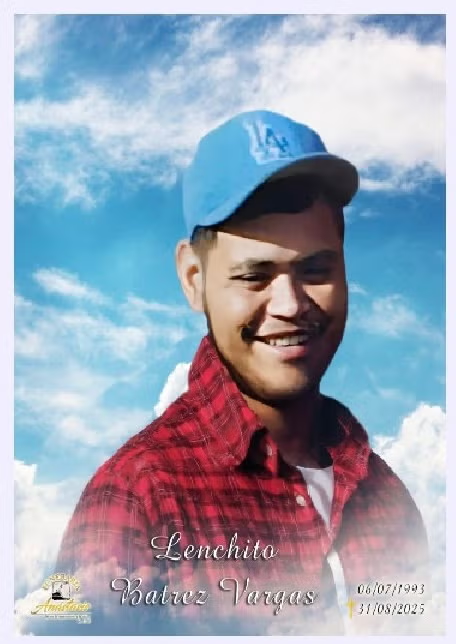
    Lorenzo Antonio Batrez Vargas was 32 years old. He died on August 31, 2025. ICE held him at the Central Arizona Correctional Complex in Florence. About 10 days after he arrived, he tested positive for COVID and was isolated in a medical unit. He received a single dose of acetaminophen. Chest X-rays later showed signs of pneumonia; ICE’s own review said his antibiotics “did not align” with CDC guidelines. After leaving isolation he had trouble breathing. The next day he reported shoulder pain, and no one checked his oxygen levels. Staff later found him dead (The Intercept). ICE listed the cause as unknown, and called claims that he received poor care “FALSE.”

    Photo from Batrez Vargas family personal archive for Human Rights Watch

    José Guadalupe Ramos-Solano was 52 years old. He was from Silao, Guanajuato, and had lived in Los Angeles for 28 years. He died on March 25, 2026, at the GEO Group’s Adelanto ICE Processing Center in California. ICE said he received ongoing care for diabetes and hypertension (Latin Times). Other detainees say they repeatedly tried to alert staff to his worsening condition, and that he got no medical attention until he was already unconscious (Colorado Boulevard). His autopsy, obtained by Scripps News in May 2026, says he had been suffering from COVID for days, with high blood pressure and cardiovascular disease as contributing causes of death.

    Photo by Gloria Ramos for GoFundMe.


    ***

    At Rituals in the Making, we have long asked what it means to name the dead. We have asked about the people who died of COVID, and the silence that closed around them. We have asked about their families, and the cry they raised against denialism. We have asked about unjust death, disposable death, and how the state writes those deaths down.

    Six years after the pandemic began, we want to turn to the archive as well: to what is kept, and what is lost, in the midst of denialism. And we want to follow how COVID’s neglect and dehumanization echo in other forms of violence.

    ***

    It is often assumed that states that produce violence would rather not write it down. The opposite is true. States often do not only produce death, or take part in it; they narrate it, with clinical attention, in official memos. The sequence of events. The number of dead. The setting. This paperwork lends the state legitimacy. It becomes an anchor from which to say how things “really happened,” and a lever for pushing “the real history” — that with a capital H. States memorialize as well.

    However, memorializing, we want to argue, is not just about recording, about documenting. Working with the bereaved, with grassroots organizations, and on civil claims has allowed us to learn that the seeming monumentality of state documentation is matched by the size of its vacuums, its silences, and its reiterations: not only in its insistence on (mis)remembering the 1.2 million people who died of COVID in the United States alone, but in its reproduction of falsehood, violence, and cruelty — in its neglect.

    With this new series of dispatches, which began last week with Sarah Wagner’s article on the memorials for Renee Good and Alex Pretti, we want to insist on other ways of remembering the pandemic dead against the state archive — what Sarah Wagner and Ariel Santikarma call “memorialization as movement work,” one in which “the dead and specifically their memory are animating forces in pushing for political change.”

    “[F]rom the movement of an individual’s hand in tracing the portraits of the deceased to creating a space of memorialization that forges social ties through and beyond life, the living work with the presence of the absent. The dead are thus remembered and transformed as kinful forces, who make the revolution of memory — and its movements toward both a livable present and future — possible.” — Santikarma and Wagner

    To counter-archive is to remember against the grain of state paperwork. It is to ask how an archive might become something living: changeable, amplifiable, made together — a movement at work. For what, for whom, and why?

    If the dead are “animating forces in pushing for political change,” then remembering cannot simply mean documenting them, or listing their names. Remembering has to entail naming them well: remembering with them, and with the social fabric their absence tears. It has to mean reading the archive of death not as a “synopsis of events,” isolated, with no one responsible, but as a record of the policies that go on producing death. It is not enough to name the dead if we do not name their lives. It is not enough if the archive does not give us back their haptics — our willingness, as Tina Campt puts it, to be touched by those in the archive. It is not enough if nothing is done about what killed them in the first place.

    As we ask what an oral history archive of COVID could be, we cannot look away from where COVID still appears, six years after its first case: in political discourse — in the memos, autopsies, and death reports of people held in ICE custody. Brayan, Lorenzo, José, and many others were all sick with COVID in custody.


    Since 2020, human rights organizations have repeatedly warned that immigrant detention centers do not meet the conditions needed to prevent and treat illness in time. “When a government detains a person, it has a heightened obligation to protect their rights, and to this end must provide adequate health care and other protections. In the case of a death in custody, the government should also provide all relevant information to the family, including medical reports and investigations into the death” (PHR, 2026).

    Yet the Department of Homeland Security has stopped listing most detainees with final deportation orders — tens of thousands of people — in ICE’s online detainee locator, as The New York Times reported (and the Associated Press first revealed the change in September). This makes it almost impossible for lawyers to defend them, since no evidence can be gathered and no case built. Physicians for Human Rights also found that in 39 cases it reviewed, “the government did not publicly provide sufficient information about the circumstances of death or about the medical care provided in detention to support a definitive clinical assessment. The available documentation was often scant, but it was nonetheless sufficient to identify serious concerns about the care provided.” Brayan’s death is one of those 39.


    BRAYAN
    A CASE, A NAME, AND YET so MUCH MORE

    On his fourth day alone in a cinderblock cell in Rolla, Missouri, sick with COVID, Brayan Rayo-Garzón slid a note under his door. He wanted to call his mother. He felt in his heart, he wrote in Spanish, that she was very worried. He appealed to the man on the other side of the door: “I know you have family, and you know that they worry about us. God bless you.”

    The guard collected the note. He did not speak Spanish, so he used a colleague’s phone to translate it, and wrote in a report that he planned to follow up. Within an hour, Brayan was found unconscious.

    Refusal 1: The Body

    The Phelps County Jail had been accepting ICE detainees for only a month when Brayan arrived. The sheriff had pitched the partnership to county commissioners as a way to bring revenue into a strained budget — millions of dollars, he told them. ICE pays a fixed sum for each detained body, each day — typically between $70 and $110 for a county jail — so a filled bed is income, and an empty one is a loss. Some counties have expanded their capacity precisely to capture that income. Care, in other words, was a side effect of a financial arrangement.

    ICE promises a medical screening within 12 hours; Brayan’s took 35. He told a nurse he was anxious. He was referred for a “routine” mental health appointment. Days later he tested positive for COVID and was moved into an isolation cell with a camera overhead, framed as protection against spreading the illness. His mental health appointment was scheduled and then canceled twice: once for lack of “mental health clinic time and staff,” and once because of his COVID diagnosis, the AP investigation found.

    Research suggests that COVID can bring on depression through neuroinflammation. The same severe immune response — the cytokine storm — releases signals (interleukin-6 among them) that may reach the brain and disturb the circuits that regulate mood. Neuropsychiatric symptoms are common in the acute phase, and a growing body of research has begun to connect that inflammation to suicidal ideation, in what researchers call the inflammatory hypothesis of suicide. Brayan was in physical distress (shortness of breath, trembling, fever) and, evidently, under psychological stress that was not addressed but instead postponed and neglected.

    Refusal 2: The Language

    The nurse who assessed Brayan did not speak Spanish. She used a handheld translation device, and through it “concluded” that he denied thoughts of suicide and depression. She recommended him for the general population and listed his condition as stable.

    But Brayan had told the staff he was suffering. He was not the only one. At a Pennsylvania facility, Chaofeng Ge, a Chinese detainee, received no mental health treatment, in part because no one there spoke Mandarin (AP); he had already attempted suicide before.


    Every night before bed, Brayan called his mother to share a blessing. “I gave him strength,” his mother, Adriana Garzón, said. Her name was tattooed on his arm. That call was their one ritual, and it was forbidden as a precaution against spreading the illness.

    The only call ICE did place was the one telling her that her son was dying.

    Couple celebrating a 21st birthday with balloons, silver decorations, cake, and party supplies.
    Brayan and Adriana on his 27th birthday. Photo by Adriana for GoFundMe.

    A well-run facility should have no suicides at all, because the moment the state detains a person, as experts told the Associated Press, it takes on the duty to keep that person alive. But even that simple assumption has changed. A new memo from acting ICE director David Venturella has ordered the agency to stop reporting the deaths of newly released detainees.

    Brayan now joins the ranks of those who contracted COVID but did not die of it. Instead, they died of the state’s refusal to recognize, to care, to act. Brayan died alone, as did so many of the COVID victims whose lives and deaths we have studied over the past several years.

    Again, we see the connection. We hear echoes of the victim-blaming public discourse of 2020 (“Wasn’t he overweight?” “Didn’t she have asthma?” “They lived a long life anyway”) in the logic that justifies an ICE detainee’s suffering — his very detention, and even his suicide (“the worst of the worst,” as the administration calls them). With its paperwork and memos, dehumanization starts to look like simple procedure.

    The scholar Saidiya Hartman has asked how we are to mourn when the event has not yet ended. The pandemic never ended for Adriana Garzón. For her, it simply went unwatched.

    The official record calls its account a “synopsis of events,” and a synopsis is exactly what it is: a list of procedures, each supposedly neutral and defensible, that forgets the man passing a piece of paper to a stranger, asking only to hear his mother’s voice one more time.

    “I beg you […] God bless you,” he wrote. And then he waited.


    Coda

    When the state offers no common form for loss, the labor of eulogizing and remembering falls to individuals. Ed Koenig, a longtime friend of Rituals in the Making and an advocate for the COVID-19 impacted, is one of those individuals. Ed lost his partner, Jody, to the pandemic and refuses to stop naming the dead — that is, feeling with those who are named. Over the past weeks, we have been inspired to see how his advocacy extends to standing against all forms of violence, including those beyond or alongside COVID.

    Here is a short interview with Ed about his ongoing activism in New York City.

    Black-and-white photo of memorial posters for Heber Sanchez Dominguez and Jose Guadalupe Ramos-Solano, labeled "Suicide in Ice Camp," attached to a vehicle.
    Black-and-white missing-person poster featuring a portrait of Lorenzo “Lenchito” Antonio Batre Vazquez.
    Black-and-white memorial poster reading “Suicide in ICE custody” with a photo of Brayan Rayo-Garzon.
    Black-and-white protest scene with barricade signs reading “DIED in ICE custody” and a “STOP TRUMP GESTAPO” sign.

    Photos by Ed koenig from the weekly silent vigils at 26 Federal Plaza, Manhattan.

    Rituals in the Making: As someone who lost a loved one to COVID, you’ve been actively involved in shaping movements to remember those who died and to push back against denialism. Has your personal experience with COVID influenced your desire to speak out against other forms of violence, like violence against migrants?

    Ed: I think my involvement in memorializing those lost to COVID-19 goes back to my earlier activities around the HIV/AIDS epidemic of the 1980s and 1990s. During that period, my partner, Jody, and I lost dozens of friends and acquaintances. It was the first time in my adult life that I realized that society in general, and the U.S. government in particular, easily denigrates the marginalized by blaming them for their own circumstances. Here are some examples of what I mean.

    Early in the HIV/AIDS epidemic, gay men were told that their illness and suffering were their own fault because they engaged in “illicit” sexual encounters. Over time, intravenous drug users who became infected were blamed for their own illness because of their addiction and the sharing of hypodermic needles. Even after it was determined that HIV/AIDS was caused by a virus, and members of the so-called “straight” community were also affected, the stigma continued. (As an aside: in 1987, when Jody first showed symptoms of multiple sclerosis and was hospitalized, he “volunteered” that he was gay. As a result, some hospital staff members would not provide him with services because they assumed he was HIV-positive. For example, they would leave his meal tray on the floor at the doorway to his room and refuse to bring it to him. Just a small example of what was going on.) Amazingly, it took five years for the President of the United States, Ronald Reagan, to even say the word “AIDS” in public. The government just didn’t care.

    I believe there have been few, if any, public monuments to those who died of HIV/AIDS. Memorialization was left to friends and loved ones. The primary memorial is the AIDS Memorial Quilt, created by family and friends. The quilt is made up of panels, three feet by six feet, that contain the names, photographs, and various mementos honoring those who died. On October 11, 1987, the quilt was first displayed on the National Mall near the U.S. Capitol. October 1996 was the last time the full quilt was displayed, with 40,000 panels laid out on the National Mall stretching all the way from the Capitol to the Washington Monument. The white flags of the In America display on the National Mall in September 2021, honoring those lost to COVID-19, immediately made me think of the AIDS quilt — memories of loved ones inscribed by those who knew them best.

    So, when COVID-19 arose, I was not surprised that those who became infected were blamed for their own illnesses or deaths. If they weren’t old, if they weren’t diabetic, if they weren’t fat, if they had taken better care of their health, they wouldn’t have gotten sick. Of course, we know that this was not always true. Again, it was the “blame the victim” game all over again. Sadly, those with COVID-19 became a handy foil for a callous and incompetent government hell-bent on retaining power. When Jody died, and as I got to know others who had lost loved ones, I knew it would be important for us to memorialize them ourselves — to let the world know that they had lived and loved, and that they mattered. So, whenever I learn of a COVID-19 memorial being created, I have always made sure Jody is included.

    Since the severity of COVID-19 has waned, immigrants in the United States have become the new marginalized. It’s not surprising to me that this has been spearheaded by the same government officials who mishandled the COVID-19 pandemic. They need a new bogeyman, and immigrants fit the bill. They forget that it was the labor of many immigrants that kept this country running when we were all under lockdown. All this, coupled with my faith tradition, motivates me to stand up for immigrants and ensure that they are respected, as they rightly deserve to be.

    Rituals in the Making: Do you see a connection between how COVID deaths have been dismissed by blaming comorbidities and the dehumanization of migrants?

    Ed: First of all, I would say that the forgetting of the destruction caused by COVID-19 and the treatment of immigrants in detention centers are both symptoms of our society’s nefarious need to have someone to blame for our own personal problems. We forget COVID-19 because it distracted us from our own pursuits — I had to stay home; I couldn’t go to the movies or eat in a restaurant; I had to wear a face mask! — and we don’t want to be reminded of that. The dehumanization of immigrants seems to me to follow from many people’s need to feel superior to someone else. Sadly, for many, seeing someone locked up in a detention center, separated from family and friends, and treated inhumanely gives them the chance to look down on someone else as inferior. I guess I don’t see them as directly related, but they stem from the same societal issues.

    Rituals in the Making: Over all these years of working alongside grassroots organizations and people who lost someone to COVID and are now speaking out against ICE, are there any stories or anecdotes you’d like to share? What have you learned with and from people who, like you, lost someone during the pandemic, or who have now lost someone to ICE violence?

    Ed: What I have learned over the years is that people will step up and care for each other even when society and government are unwilling to. In the era of HIV/AIDS, LGBTQ people came forward to care for those who were sick because no government services were available or willing to do so. The same is true of those impacted by COVID-19. We came together to help each other cope, to share information and experiences, and just to be there to listen on a bad day. It also occurs to me that much of the work AIDS activists did to gain access to treatments and medications for HIV/AIDS paved the way for the rapid development of the mRNA vaccines that helped lessen the impact of COVID-19. Now that I have been working with the immigrant community, the work is the same. Families have needed comfort when detainees have been killed by government agents. They need so many forms of support when a family member — often the only breadwinner — is incarcerated. Just as people reached out to those of us who lost someone to COVID-19, now we pay it forward and reach out to care for our immigrant brothers and sisters.


    CODA OF CODA –

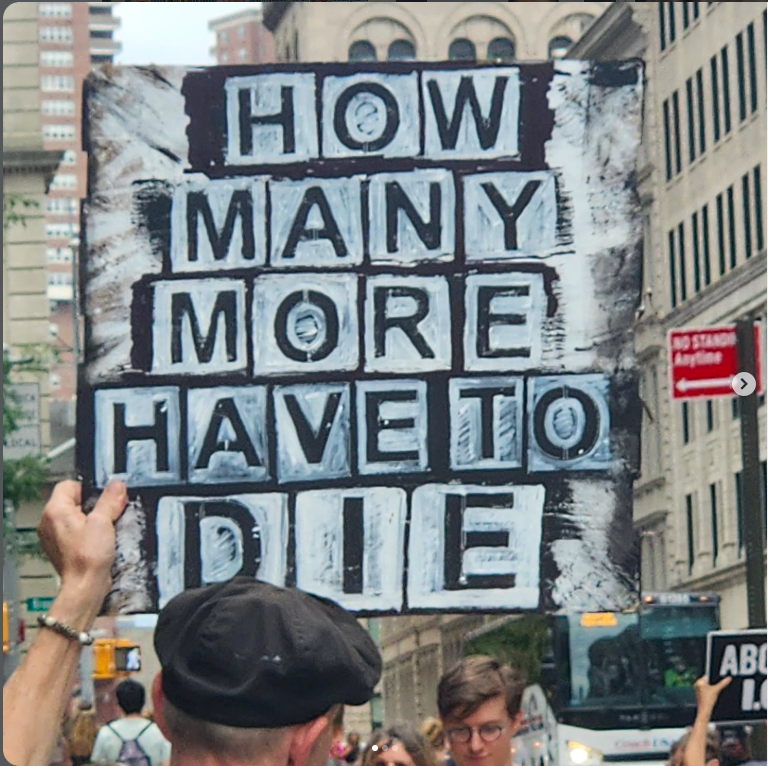
    Protest sign reading “How many more have to die?” held aloft in a city street.
    Thursday. 26 Federal Plaza. Silent Witness. #SayTheirNames #JusticeForImmigrants Photo by Edward Koenig.

    Ed, in a later email: “I find myself looking around at these folks and thinking that in many ways they are the ones who kept the country going in the darkest days of the pandemic and this is how we reward them! This, to me, is another (hidden?) link between the COVID-19 pandemic and its unexpected deaths and the numerous, needless deaths of immigrants in ICE custody. It’s no wonder I often find myself careening between rage and tears.”
  • It’s a Wrap!: “New Contemporary Death Rituals: Adaptations, Transformations, and Abbreviations in Contexts of Global Disruptive Events and Mass Violence Incidents”

    It’s a Wrap!: “New Contemporary Death Rituals: Adaptations, Transformations, and Abbreviations in Contexts of Global Disruptive Events and Mass Violence Incidents”

    By Sarah E. Wagner

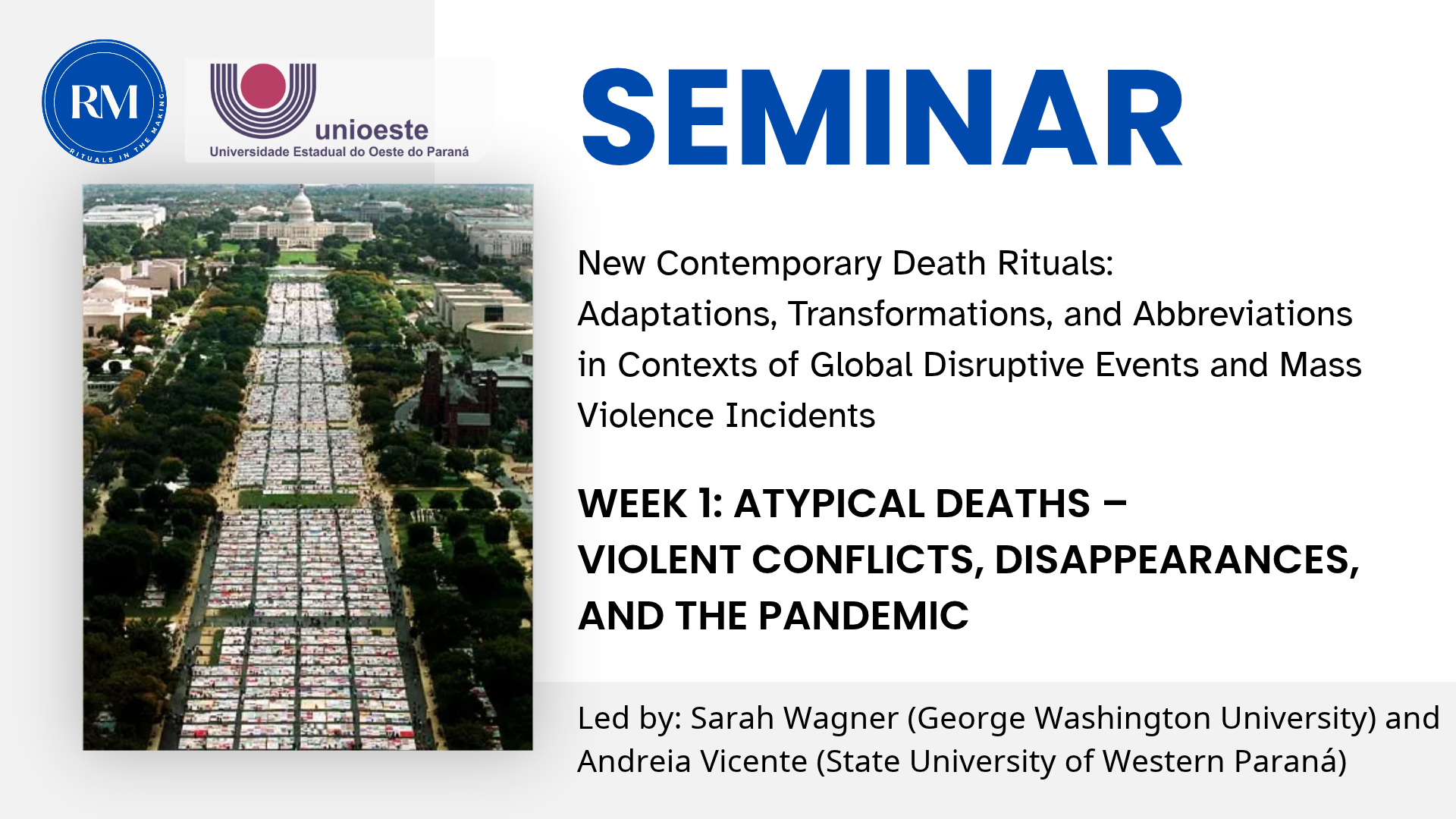
    Aerial view of a large gathering or memorial with numerous white markers on a green landscape, accompanied by text about a seminar on contemporary death rituals, including details on leadership and topics covered.

    From September to October, 2026, Rituals in the Making teamed up with our longtime colleague, Brazilian anthropologist Andreia Vicente (Universidade Estadual do Oeste do Paraná (UNIOESTE)/State University of Western Paraná) to host one of the most generative spaces of learning and exchange around COVID death, mourning, and memorialization that we’ve been a part of over the past several years—the virtual seminar, “New Contemporary Death Rituals: Adaptations, Transformations, and Abbreviations in Contexts of Global Disruptive Events and Mass Violence Incidents.”

    The seminar’s principal goal was sought to convene students, faculty, artists, advocates, and, especially important, the bereaved to discuss death rituals and remembrance and reflect on the impacts of contemporary disruptive events on experiences of finitude. As seminar organizers, we also sought to:

    • Relate classical and contemporary concepts of death rituals.
    • Debate the relationship between contemporary death rituals and contexts of violence and rupture.
    • Reflect on the emotional impacts of new death rituals performed in disruptive situations.
    • Present recent research conducted in various countries.
    • Provide students with an experience of global and multicultural ritual diversity.

    Held virtually from September 4 to October 23, 2026, the seminar explored the themes of death ritual and remembrance over five sessions:

    Week 1: Atypical Deaths: Violent conflicts, disappearances, and the pandemic (led by Andreia Vicente and Sarah Wagner)

    In this introductory session, we sought to frame the seminar’s more tailored discussion of COVID with broad themes such as “good” versus “bad” death; the importance of death ritual; ruptures introduced by atypical deaths.

    From time to time, as presenters would do throughout the seminar sessions, we posed questions for consideration and debate, such as: Even as everyday death can be traumatic, what constitutes an “unjust” death? Is there a hierarchy of unjust death? Is this a universal or a culturally specific delineation?

    Andreia explained a concept she has written about extensively, “cut-off rituals”:

    A group of people in protective gear carrying a wooden coffin at night, illustrating the impact of COVID-19 on traditional burial rituals.

    Week 2: “They Are More Than Heroes” — COVID-19 pandemic and the deaths of healthcare professionals (led by Rachel Aisengart and RIM’s Avery Nennmann and Paige Gavin)

    On the topic of unjust and traumatic deaths, this second session focused on the experiences of healthcare workers during the height of the pandemic in both Brazil and the United States. Healthcare workers from all backgrounds were faced with an overwhelming and atypical volume of death. Patients were dying rapidly from the virus, conditions compounded by a severe lack of PPE, ventilators, and institutional support.

    Brazil and the US experienced a “syndemic” (termed by medical anthropologist Merrill Singer), in which the virus was not only understood as biological, but interacted in association with social, economic, and cultural issues that arose during the pandemic. Not only were healthcare professionals dealing with the virus, they were also battling the spread of misinformation relating to the virus, propelled by the presidential leaders Trump (US) and Bolsonaro (Brazil). Because of the circulation of misinformation on social media and from government officials, healthcare workers in Brazil and the United States endured emotional and physical violence from “anti-vaxxers” and COVID denialists – even leading to injuries and deaths amongst healthcare workers. The rise of mistrust in science and COVID conspiracy theories caused many healthcare workers to leave the field of medicine entirely.

    A promotional graphic for a webinar titled 'They Are More Than Heroes' discussing the COVID-19 pandemic and healthcare professionals' experiences, featuring names of presenters and affiliations, with a background image of healthcare workers in protective gear.

    Week 3: COVID-19 Pandemic, New Religiosities, and Emotions (led by Andreia Vicente and Teresa Ordorika)

    Session #3 examined ritual practice (interrupted and improvised) and affective registers shaping how mourners in Brazil and Mexico responded to pandemic death. In the session’s first half, Andreia Vicente provided an in-depth look at the Evangelical communities she worked with during the pandemic. Canvassing a range of restricted ritual practice (e.g., family members forced to identify their deceased through a photo on a tablet; coffins lowered with mourners at a distance; burials without hymns), she analyzed the emotions flowing from such disruption: sadness, indignation, abandonment, frustration, among others. She highlighted the recurrence of what she terms as “angry grief“:

    Tassia said: “I could not even touch my father’s coffin. I felt rage, not only sadness. Rage against the hospital, rage against the government, rage against the virus itself.”

    Grave diggers in protective suits working at a cemetery filled with crosses and open graves.

    Teresa Ordorika led the second half of the seminar in which she explored the themes of “mprovised farewells and the repair of ritual in Mexico’s COVID-19 bereavements.” She emphasized both the ritual calendar (events) interrupted by pandemic death and its attendant restrictions, as well as what she defined as the four “Four repertoires of improvisation”:

    • Rites on screens: Zoom novenarios, Facebook Live, hybrid rosaries, masses by video, phones
    • Material supports for memory: objects that allow memory to be produced: the voice, the shirts, the bracelet
    • Ashes in the homes: the urn that never left, and the altar that never came down
    • Rewritten calendars: rescheduled ceremonies

    As an example of a “material support,” an uncle (Jorge) described the powerful emotive force of a teddy bear made of his nephew’s shirt:

    “Everyone was given one [a bear made of] a T-shirt with a design that made them feel connected to [my nephew]…

    I think my brother kept the cowboy T-shirt. I got the Batman one. Oh, and also, the bear’s name on its paw is what you used to call [my nephew]… So my bear’s name is Loco.”

    “At first it was awful, wasn’t it? Because it smelled like my nephew […].”

    A black teddy bear with a Batman logo on its belly, sitting on a chair. The bear has a playful expression and the word 'LOCO' on its foot.

    Week 4: Remembering Pandemic Deaths – Part 1: virtual remembrance rites (led by Sarah Wagner and RIM’s Martha Greenwald, with a cameo by Ed Koenig)

    Session four began the seminar’s concluding focus on pandemic commemoration. In it, we introduced and explore key analytics such as collective memory (Maurice Halbwachs), the work of remembrance (Jay Winter), and micro-eulogies, a concept developed by Greenwald et al.:

    … condensed acts of remembrance and honoring that, though quotidian, are no less formal or sacred for the mourner. Such micro-acts of grief or mourning, contrary to conventional public speech eulogies, can be done in silence, in the repetition of care . . . .

    The concept of micro-eulogies also sheds light on what goes unsaid—the work of omission and silence—and how efforts to memorialize through these smaller-scale, compact rituals and words of remembrance confront the absence of public commemoration and the refusals of pandemic deniers and revisionists. . . .”

    Finally, they have a “dual character”: “These acts of remembrance are not simply confrontational or reactive . . . they are also the small, systematized speech acts of ritualized refusal. Naming the dead—necronominalism, as Thomas Laqueur describes (2015)—means refusing to let society “move on,” which implies challenging the devaluation of life and existing alongside the larger macro practices of erasure.“

    – Greenwald, Pelaez, and Wagner, “Locating Grief: Pandemic Memory, Mourning, and the Politics of Where,” in The Cambridge Handbook for the Anthropology of Death

    Martha led the second half of the session, presenting on her website, WhoWeLost.org, detailing how it came to be, her choices from aesthetic to ethical, and contributions of late. She noted:

    “Submissions in 2021 and 2022 were centered on immediate loss, disbelief, grief, and guilt/sadness about the tragedy of loved ones dying alone in a hospital.

    Submissions from 2023 until now often focus on potent memories that are triggered by typical grief milestones like birthdays, seasonal change, holidays, anniversaries, etc.

    Since Trump’s second presidency began, there have been more stories submitted that express anger and disillusionment. Writers feel no one cares about the 1.3 million lost.

    Covid has become the catch all scapegoat, blamed for everything from learning deficits to the economy to the declining birth rate. The virus has become further politicized since the appointment of Robert F. Kennedy, Jr. The controversial debates about vaccines and communicable diseases ignite resentment and anger in many of the survivors who participate in WhoWeLost.”

    Finally, in this same session, colleagues from Brazil drew our attention to this online memorial: Memorial das Vítimas do Coronavírus no Brasil:

    https://www.facebook.com/memorialcoronabrasil

    Week 5: Remembering Pandemic Deaths – Part 2: art as commemoration (led by Sarah Wagner and Alice Kelly)

    Screenshot of a virtual meeting titled 'Remembering Pandemic Deaths - Part 1: Virtual Remembrance Rites' featuring multiple participants in a grid layout.

    Our aim during this final session was to foster a comparative discussion of how pandemic loss has been memorialized – from grassroots efforts to official sites. Focused on examples from the US and UK, we were joined by several COVID memory activists:

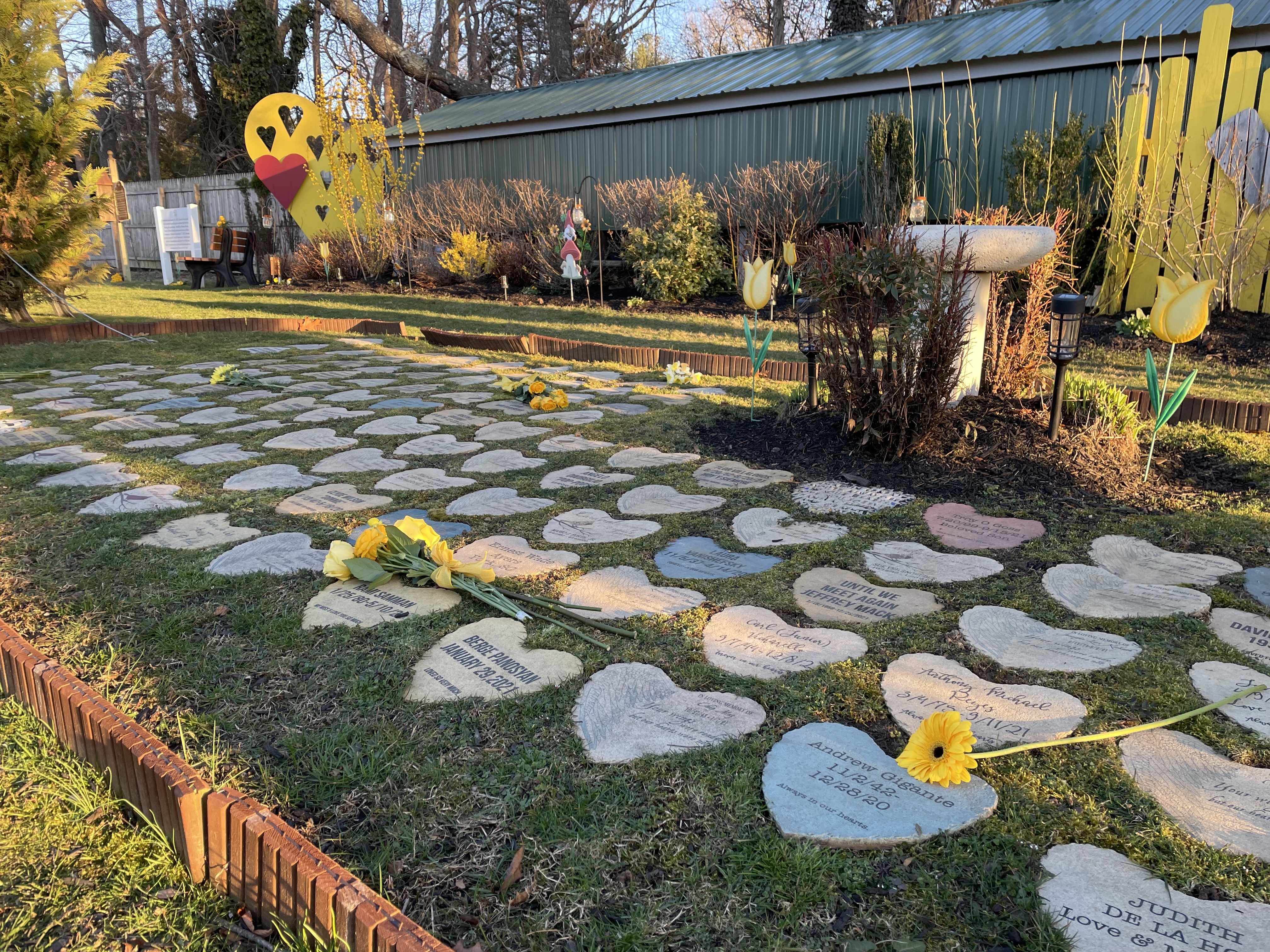
    Rami’s Heart COVID-19 Memorial (presented by Rima Samman-Whitaker):

    Website: https://www.ramisheartcovidmemorial.org/

    Facebook: www.facebook.com/Covid19MemorialRamisheart/

    Kentucky COVID Memorial (presented by Martha Greewald, on behalf of sculptor Amanda Matthews):

    A view of the Kentucky COVID Memorial in Frankfort, KY, featuring reflective sculptures of figures and a mirrored globe surrounded by greenery.
    A close-up view of a sculpture featuring figures holding a globe, with a bell visible through a circular detail.

    https://covidmemorial.ky.gov/Pages/index.aspx

    In America: Remember (presented by Suzanne Brennan Firstenberg):

    https://www.suzannefirstenberg.com/in-america-remember

    Naming the Lost Memorial (presented by Ed Koenig): https://ntlm.org/

    National COVID Memorial Wall (presented by Lorelei King)

    https://www.nationalcovidmemorialwall.org

    For more on the Wall, the hearts, and Lorelei and the other volunteers’ hard work in maintaining and protecting the site, see our dispatch from May 2025.

    At the conclusion of the final session, we thanked our attendees … and pledged to keep the dialogue going.

    A thank you message displayed with the word 'HOPE' made from photographs, in front of a large monument during dusk.
  • A Celebratory Virtual Launch

    A Celebratory Virtual Launch

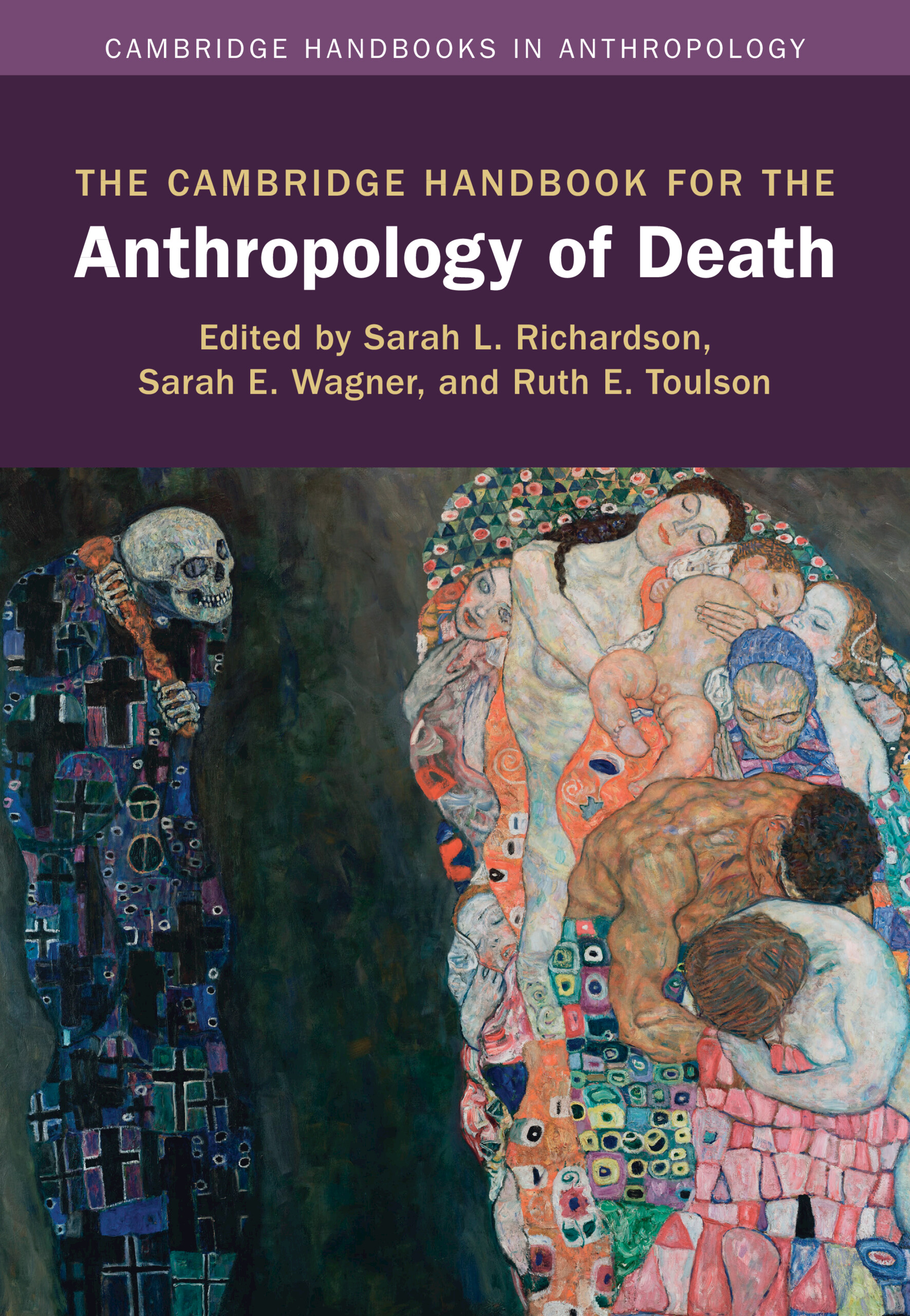
    Cover of 'The Cambridge Handbook for the Anthropology of Death' featuring abstract artwork and names of the editors.

    September 25, 2026

    At noon EDT, we gathered—editors, contributors, our website designer, friends and family, students and colleagues—to celebrate the humble but monumental arrival into the world of The Cambridge Handbook for the Anthropology of Death. With five chapters directly addressing COVID-19, including two co-authored by Rituals in the Making team members Richard Grinker and Joel Kuipers, and Martha Greenwald, Maria Jose Pelaez, and Sarah Wagner, the volume is one of RIM’s major academic contributions.

    The informal book launch attendees spanned at least three times zones: from Sarah Richardson, Tom Laqueur, and Robin Reineke (among others) on the West Coast and a whole slew of folks from the East, to Tam Ngo in the Netherlands, Graham Denyer Willis from a train in the UK, and Paco Ferrandiz who joined from a concert in Madrid. We convened in joy, levity, and, yes, a measure of relief. At long last, it’s out!!

    The three editors, Sarah Richardson, Ruth Toulson, and Sarah Wagner read aloud passages from the conclusion on why the volume was important to each of them on a more personal level. Lorelei O’Reilly walked us through her inspiration and aims in creating the companion website for the volume.

    We also seized the opportunity to fete various contributors for recent distinctions:

    Ruth Toulson, esteemed co-editor and Chapter 7 author: her book Necropolitics of the Ordinary: Death and Grieving in Contemporary Singapore was selected as the second prize winner of the 2026 Victor Turner Prize for Ethnographic Writing. Previous honorees include volume contributors Sarah Wagner, Casey Golomski, Shannon Dawdy, Robert Desjarlais, and Richard Grinker.

    Barbara King, Emerita Professor of Anthropology at William & Mary and author of the volume’s final chapter on animal grief, received the Anthropology in Media Award (AIME), Honorable Mention.

    Erica Borgstrom, author of Chapter 5 on end-of-life care, recently edited three books drawing together interdisciplinary perspectives in death studies, all published by Routledge, including one on palliative care and hospice, one on Covid-19, and one featuring interviews with death studies scholars.

    Paco Ferrandiz, author of Chapter 16 on Franco’s funerary project at the Valley of the Fallen in Spain, has teamed up with Élisabeth Anstett to edit the Routledge Handbook of Necropolitics (forthcoming next year).

    We then heard from two contributors who have books either just out or almost out:

    Tom Laqueur’s The Dog’s Gaze: A Visual History.

    Andreia Vicente’s Death rites in the Covid-19 pandemic: Cut-off rites, abbreviated and mediatized in contemporary Brazil

    Though unable to join us that day, Abou Farman also has a new book out, No Silence in the Afterlife, which Ruth Toulson described in brief but beautiful detail:

    When, finally, our hour was almost up, each of us raised a glass (Richard Grinker, a proper martini glass nonetheless!) or a mug and—across the sacred pixels of our Zoom gathering—toasted each other and our joint accomplishment.

    “Huzzah!!” in the words of Tom Laqueur.

    A virtual meeting image featuring Sarah Wagner and Ruth Toulson smiling and holding drinks, with other participants visible in a grid layout below.

    ***

    Postscript: Martha Greenwald, co-author of Chapter 25 with Maria Jose Pelaez and Sarah Wagner, summed it up in an email afterwards, “I am imagining a perfume named ‘Launch!’  Dunno why. . . .  It was genuinely touching and beautiful.”

  • The War within the Pandemic: An ICU Nurse’s Experience as a Frontline Worker

    By Avery Nennmann 


     On May 28, 2026, Avery Nennmann interviewed ICU nurse Robin Berry from San Angelo, Texas.

    Sign indicating the entrance to a COVID-19 drive-thru testing site, surrounded by landscaping and a clear blue sky.
    Image from: “Reports say San Angelo has the highest increase of COVID-19 cases in Texas,” Fox West Texas, September 13, 2021.

    It was a war. And we were at the forefront, the front line of the war, and it hasn’t been recognized as one… when we’ve had a war, we have to debrief. And so, in World War II, the guys came home, and they made a lot of war movies so that people could understand what had happened. But [the COVID-19 pandemic] hasn’t been acknowledged as a war, and therefore we haven’t been able to debrief from it.

    Robin Berry, a career ICU nurse in San Angelo, Texas, recalled the intensity of the first year of the pandemic, drawing a picture of camaraderie, battle, loss, and heroism – largely left behind by the general public. Her story began in Oklahoma City in early spring 2020 during a contract rotation. As the pandemic continued to spread, she moved down to San Angelo, where she battled the second surge in October of 2020 in her hospital’s Intensive Care Unit. Inside the 18-bed unit, “everybody was on a vent. And two patients to a room. And, um, no- nobody lived.”

    Among the most difficult moments for Robin were interactions with patients’ family members. Many wanted what they thought of as the unvarnished truth—meaning, the prognosis or likelihood of recovery. Which was non-existent. She struggled with her inability to relay to them that no one was making it out of that ICU alive. They would then say, “Well, God’s gonna heal my loved one.” Or, admonishing her, “You need to be more positive,” refusing to acknowledge the futility of the moment and the reality of the patient being on a ventilator. Robin was the one who carried the burden of this knowledge. 

    Every day that Robin was in the ICU with her “infantry” of other nurses and physicians, she bore witness to death after death and the grieving families, separated from their dying loved ones by glass, iPad screens, and PPE. The community she served was largely Hispanic and Catholic, and she reflected on how her patients’ families were “demonstrative in their grief.” For example, on the last days of a patient’s life a family member, Robin explained: 

    … would be standing at the door, with their hands on the window, talking to their wife and saying the most beautiful and loving things, ‘You were the light of my life. Every day with you was fulfilling. I don’t know what I’m gonna do without you. You’re a wonderful mother. Your children love you.‘ It was heart-wrenching… every minute.

    Amongst these heartbreaking moments were acts of defiance in which Robin’s patients and their families insisted on recognizing and lifting up the humanity of the dying—a common thread among the stories we have heard from other nurses in this project. In one instance, another nurse’s father was in the ICU, and she asked to give him a religious token, a ritual. In defiance and acknowledgment of her colleague’s hardship, Robin concocted a plan to provide her with the PPE to safely see her father in the ICU. Robin continues,  

    And so we did our little plan. And she came in, and she anointed him with oil and prayed for him, but he was not doing well, and I was afraid that he was gonna plummet quickly. And so, like, the only way to get family in there was to call the chaplain, and the chaplain had to make arrangements for them to come in. And so it took a long time. It was a Sunday. There was a chaplain on call. They weren’t in the building. It took a long time, and the patient got worse, and by the time the wife actually got there, he had coded and died. I mean, we were coding him. And she was outside watching us code him.

    This moment for Robin, while it ended in another tragic death of a patient, was a moment of care, not only for the family, but for her own sanity and psychosocial well-being. The relentlessness of seeing patients die makes these instances of breaking from restrictions placed on nurses by the hospital, institutions, government, etc., all the more important for the sake of humanizing these ICU deaths and connecting loved ones to those who passed.   

    Not all moments of her time as an ICU nurse, however, were viewed as heroic. As we know from previous interviews, healthcare professionals were subjected to acts of violence, both physical and verbal. Robin’s ICU received death threats from the father of a young patient who passed,. It was serious enough to close the unit temporarily. There were even families who, because of their anti-vax beliefs, felt that the nursing staff were not taking good care of their family members. 

    I speak for nurses that I spoke with during that time, we’re in favor of being able to choose whether you receive a vaccine or not. We didn’t like being forced into having a vaccine if we had had the choice. But also, we would never change the way we provide care because of the way a person believed, especially about a vaccine. We did try. 

    He needed ECMO and we don’t have ECMO here, and we tried to get him accepted to a hospital, but nobody would accept him. And finally, we did get somebody to accept him, but the closest place that would accept him was in New Mexico, and he would have had to be on a fixed-wing flight. I took care of him that day. That’s the reason I know this part. For weeks, we tried to get him transferred out because [his family] didn’t think that we were doing a good job because he just kept going downhill and downhill and downhill. 

    I personally was working whenever he got accepted… he was too sick to transport. He would have died before he got to the plane. It looked like we didn’t do anything. It looked like we didn’t do the right thing on his behalf. It looked like we didn’t want him to live because he didn’t want take the vaccine. None of which was true.

    The man ended up passing away. When I asked Robin what the hardest part about caring for COVID patients during this time was, she responded, “Hands down, everybody died.” 

    She could count the two or three people that lived, out of the entire 18-beds, two-patients-to-a-room ICU for the duration of that first year. She continued, “Everybody else died. Everybody else died. And we coded and coded and coded, and you wanted to say, ‘Please don’t make me do this again’ … not, not because you didn’t want them to live, not because you didn’t want to offer life-saving treatment if it were gonna, you know, help them. But, um, that hands down, everybody died.” 

    The metaphor of war and battle was consistent throughout Robin’s recollection of her time during the height of the COVID-19 pandemic. When asked about her relationships with her fellow nurses, Robin explains that they were tight with one another because it felt like “literally being in the trenches.” They supported one another through dark humor and becoming trauma bonded. “So that camaraderie that was there is—and this is just common in nursing—is not the same as it was. Like men who go off to war, [it] won’t ever be that same.”  

    The memory of the COVID dead become embedded in the healthcare workers—they linger in their lives and the stories they tell. While the public has moved on (with some actively seeking to forget its tolls), the nurses and frontline workers do not have that luxury. Having repeatedly born witness to the suffering and passing of patients, many left the bedside and were diagnosed with PTSD. Hospitals became a war zone with civilians on the outside and healthcare workers fighting for the lives of loved ones and for themselves. 

    Who is left to mourn and remember the war inside hospitals during the pandemic? The experiences of healthcare workers, and even the COVID dead, we argue, are being forgotten as society moves on. Working in healthcare has become unbearable as hospitals face budget cuts and the public turns to anti-science/anti-vax propaganda. Robin herself remarked, “a lot of people that entered into nursing during that time, mm, promptly left, uh, a few years after.” 

    On a personal level, the pandemic still continues to affect Robin, “I feel like the main thing is that we all just [went], ‘Oh, it’s over. You don’t have to wear the mask anymore. You don’t have to wear the PPE anymore. It’s over. We’re gonna assign you your two patients now. No big deal. Everything’s fine.’ The lack of acknowledgment, I guess, of the war, you know, that happened, is the main—I think that’s the only—thing I carry.” Robin even admitted that she herself does not talk about the pandemic; it brings forth emotions that are best left in the past—to those charged moments, surrounded by loss, contention, and grief.  

    Looking to the future, technology and medicine may have changed, but the ethos of nursing has not. In Robin’s words, “It’s still connection with a patient who, and families, who are facing, especially in ICU, the worst days of their life. It’s still they don’t wanna really hear the truth. It’s still they get angry when you have to offer them something they didn’t want to have to make a decision about. It’s still, this patient needs a DNR, or this patient needs a spiritual consult, or how can we better accommodate them… I think that kind of care hasn’t really changed.” While nurses within healthcare may be fundamentally altered by the pandemic, nursing as a field of expertise will still be about the humans who rely on them as caregivers during tumultuous times. Nursing will always, at the heart of it, be about care, but the pandemic has forced nurses to feel that survival comes before care. 

    I don’t think that nursing is of the mindset that we’re like, ‘We’re just gonna forget it and go on.’ We feel forgotten. And look overlooked, but not by our choice. But our nature is to go on. With or without working through it.

  • The House

    The House

    María José Peláez Sierra [1]


    I saw Katherine for a couple of seconds; then she turned off her camera. She told me she was from Cali, Colombia, and that, “as for everyone else, the world had begun and ended with the pandemic.” I had heard of her through our mutual MA thesis advisor. Katherine too had studied Literature in Bogotá, and was living there until the pandemic was declared. Then she traveled back to her native Cali, and the quarantine was immediately enforced.

    Her mom was in Belgium with one of her sisters and had not been able to return because of the border closures. Katherine, her other sister, and her dad remained then at the childhood house in Cali, waiting. The days passed slowly, spent watching the news voraciously and then stretching into long blocks of silence and tedium — but also, at times, of warmth: “we celebrated, argued, laughed, lived—all of us, shut in here, in this house. Here we talked, we read, we ate. Here everything.”

    During those first months, Katherine would press her skin to the door frame and watch her dad work for hours with his tools, fixing things around the house, here and there, coming and going with his hands full of collectible toy cars, repositioning them millimeter by millimeter on the shelves after hours of cleaning. They would talk at times; at others, she would just watch and smile at him, as if supporting the walls while leaning on the frames.

    **

    On July 20, 2020, her father began to feel ill. He had started working again in May. “My dad was an electrical technician and had been at Toyota for 35 years. The auto industry was one of the first to go back to the office, even in the middle of the first peak,” Katherine tells me.

    Eight days later he tested positive and Katherine too.

    “We took turns to take care of him between my sister, later my niece, and me, in eight-hour shifts, but it wasn’t enough. We were all exhausted and sick, and needless to say so was he… the fever, the discouragement, the shortness of breath, the pain. The house was enormous and, at the same time, so small. So suffocating. I would go into his room, always with a mask, to bring him food, to talk to him a while so he wouldn’t feel so alone, so scared, but there came a point when I told him: “papi, don’t get up anymore, don’t get out of bed anymore. Stay face down and pee into a little jar. Because by then I could see he was very bad. But he was a 61-year-old man with three daughters… He never managed to feel comfortable peeing that way, even though he had to.”

    The day they tested him, it was Katherine’s shift. That night, for the first time, he —a man of few words— told her he was afraid. She said to him firmly: “no, papi, don’t worry, everything is going to be fine. We’re going to be fine.” And yet she knew they weren’t fine. Everything was suddenly collapsing and she was looking out from within the ruins.

    Katherine would have wanted to tell him that she, too, was afraid. She would have liked to have had her last words there, in that moment, and not to lie to him. She would have liked to tell him that everything was wrong, that she didn’t understand why tragedy settled over them, why it had to be them, one of the many cases that would later appear in the news with an “In memoriam” attached. She would have liked to tell him that she was sorry he was leaving so soon, that the house asphyxiated them all. That she was sorry for, and cherished, his silence.

    But they didn’t appear in the news…

    “The house the world. It still is. And like the world, sometimes so narrow, so coiled up. We didn’t appear anywhere. The house —it was our news, our doctor, our psychologist, our reading, our unspoken words. Everything. This house”


    Suddenly Katherine adds: “I think a lot about what would have happened if we had let him take the Ivermectin[2], which he had in the closet the whole time. But the thing is my dad had cancer, prostate cancer, and we were very afraid he’d mix medications, and it would cause some reaction. Of course, on this too, we had no medical assistance. In moments like that you don’t even know what to do or how to do it. Sometimes you think you’re doing things right… and… well, no, or who knows.”

    I tried to say something, to let her know that of course I don’t think she’s to blame for anything. But what could I tell her beyond some heaviness, like: “I read that,” “maybe there is comfort in such-and-such author,” “if you look into this or that idea” —as in fact I did afterward, stammering out something. Which author, which concept, which nothing. Coiled up over myself, in the traffic jam of readings that now seemed lodged in my throat, I fell silent in the middle of the thought. I looked at her through the screen (even though I could not really see her) and waited for her to realize that I realized that nothing I had said made any sense. Her feeling was hers, disconsolate and tenacious, as life so often is[3].

    – “A few days later, construction began on the house next door,” she goes on.

    The atmosphere of the house —already made strange by the fever that stalked the three of them intermittently— grew even heavier with the cement dust that came in through the windows and the cracks in the doors. They tried to talk with the neighbor.

    – “She couldn’t stop her construction, she told me.”

    And so they decided to leave their place and go to the grandmother’s house, a few blocks away. “And so, sick as he was, we took him to my grandmother’s house. He didn’t want to go… I’ll settle you in over there, I told him. Easy now, papito, I… a-a-and… That night we stayed there.” And it was her dad’s last in any kind of house.

    “At 11 in the morning the next day my dad was already very short of breath, and I had a fever of 38. So, my sister started getting him ready for my niece to take him to the clinic, while I stayed glued to the phone trying to get someone from the health provider to come see us.”

    The last time Katherine saw her dad was that day, his full body leaning into the door frame as she herself used to do, in the other house.

    — “Bye, sweetie.”

    — “Bye, dad,” she said to him while she stayed on the phone with the switchboard in the background.

    “I said on the line to wait a moment, so I could tell him: in the name of God, take good care of yourself. And he only gave me a little nod, like yes. He lifted his shoulder off the frame and left. He took the house away, all the houses in the world with him —all the frames, all the rooms, all the rugs, everything— he took the house away.”

    On the third day they intubated him; on the sixth, he died alone.


    After she told me that, we talked a while longer about other things, and about those same things. When I stopped recording the conversation, she turned the camera on again and said to me very slowly: “that’s what I remember… the rest I’ve been forgetting. I have gaps, dark clouds that suddenly settle over me, I have a lot of confusion. We were all so sick in the house that I couldn’t say exactly how things happened. And even less now that my dad has died.”

    “We don’t talk about him anymore. These days, especially, I’d been feeling a strong urge to talk… I don’t know…”

    ***

    Just before hanging up, I ask her whether she would change anything about that farewell; whether now that the months have passed, she has imagined other conversations, other ways of saying goodbye to him. She, blunt, knowing where the question is headed, tells me:

    “I think I would change it, this time and a thousand times, that moment of the farewell, for a moment, maybe, more romanticized. But I know death isn’t like that; we will never, never manage to say all that we would like to say. Yes, people say things like: live this day as if it were your last, live to the fullest and blah, blah, blah —but is it like that?” (Are we capable of living every day as if it were the last? And besides, isn’t the last day just the same as the most ordinary of days?) “Even with my dad being so sick, there, standing, looking at me from the door frame —the phone, the illness itself, the anguish, the urgency of all those suffocating days went on being the same. And into that life that comes crashing down on us, the farewells too. We always stay there, with things left to say.”

    “We’re left with the words,” she insists, “we’re left even when everything is planned.”

    Her dad thought about death all the time; he did so for decades. He talked about it, he had insurance, and his funeral paid for, everything. He had cancer —maybe that was why, Katherine thinks— or simply because of his almost taciturn, light-hearted nature. “For him, thinking about death was thinking about life.” And not even he, whom death did not catch by surprise, and who was supposedly prepared for it, had the chance to rest into it, to take it in, to say goodbye and look it in the face; because who has words for death? For whom does a life suffice to prepare? We always end up left with something…

    But Katherine replies: “Even knowing that, almost as a fact, of course, in my imagination, I would change —and I do change, every day— that farewell. I play with it, I make it again, I say it again. In my mind I hang up the phone and I hug him. In other versions I recreate, I ask him how he feels. In others, I tell him to stay a little longer. In others, I stay at the door with him… I have re-created that farewell many times. And, in it, I tell my dad that I loved him, that I loved him so much, and that I still think about him all the time, even in the small things, like making the bed, for instance,” and she laughs in a way I hadn’t seen her laugh during the whole call.

    “My dad always told me that screws are unscrewed with the hands of the clock, and I still sometimes find myself arguing with him, letting him know that I don’t understand how to unscrew the bed and how the whole clock-hands thing goes… I talk to him all the time.”

    “In my imagination I talk to him because I think that way I can create memories with him that I didn’t really have. I talk to him because I would like to remember him the way one of his closest friends described him to us recently. His friend ended up almost bringing him back to life. It was very beautiful, because I realized he was much more than what we remembered. It’s like assembling a character, and it’s as if that character had a thousand voices, a thousand faces, a thousand forms. And that is precious; I would have loved to record that, to capture it somehow so as to keep filling in my dad bit by bit. Now, when I imagine him standing in the doorway, I remember him the way his friend described him to us.”

    And Gaston Bachelard (1964) resonates in me one last time, but I keep it to myself: “Is it possible, further still, to restore not only the timbre of the voices, the inflection of the beloved voices now silenced, but also the resonance of all the rooms of the sonorous house?” And in the middle of that room, in the childhood house once again, Katherine turns off the camera one last time. And then I know that no: the house no longer sounds, the frame no longer exists, the rarefied atmosphere clings to the walls, and there are no words for definite goodbyes.

    The skin on the door frame, in the room of toy cars, in the gaze. The skin taken over by the house. The skin he left her. The house abandoned by the skin.


    Notes

    [1]A longer Spanish version of this article was published in: Peláez Sierra, María José. (2022). La casa. Argos. 9. 63-75. 10.32870/argos.v9.n23.6a22.

    [2]At that time the WHO had not yet warned about the dangers and inefficacy of this medication in the treatment of COVID, and there was much speculation and disinformation about it.

    [3]In the face of that reality —certain, implacable— it is not the Elegy, as I have said in earlier pages, that finds its way into the last moments of life; it is the Farewell, a plain and raw genre, that speaks to us, with its sorrow pure and simple. Utter irremediableness. It is, as Idea Vilariño says in her Complete Poetry (2016), a pity, death.

    Qué lástima
    que sea sólo esto
    que quede así
    no sirva más
    esté acabado
    venga a parar en esto.
    Qué lástima que no
    pudiéramos
    sirviéramos
    que ya no demos más
    que no sepamos ya
    que estemos ya tan secos.
    Qué lástima
    qué lástima
    estar muertos
    faltar
    a tan hondo deber
    a tan preciada cita
    a un amor tan seguro.

    [What a pity that it should be only this / that it stays like this / be of no more use, be finished / come to rest in this. / What a pity that we could not / be of use / that we no longer know how, that we give no more / that we are already so dry. / What a pity, what a pity / to be dead, to fail / so deep a duty, so treasured an appointment, / a love so sure] (Vilariño, 2016, p.171).

  • Glossed Over: On Attending the Symposium at the Library of Congress

    Glossed Over: On Attending the Symposium at the Library of Congress

    By Ed Koenig

    Edited by Martha Greenwald

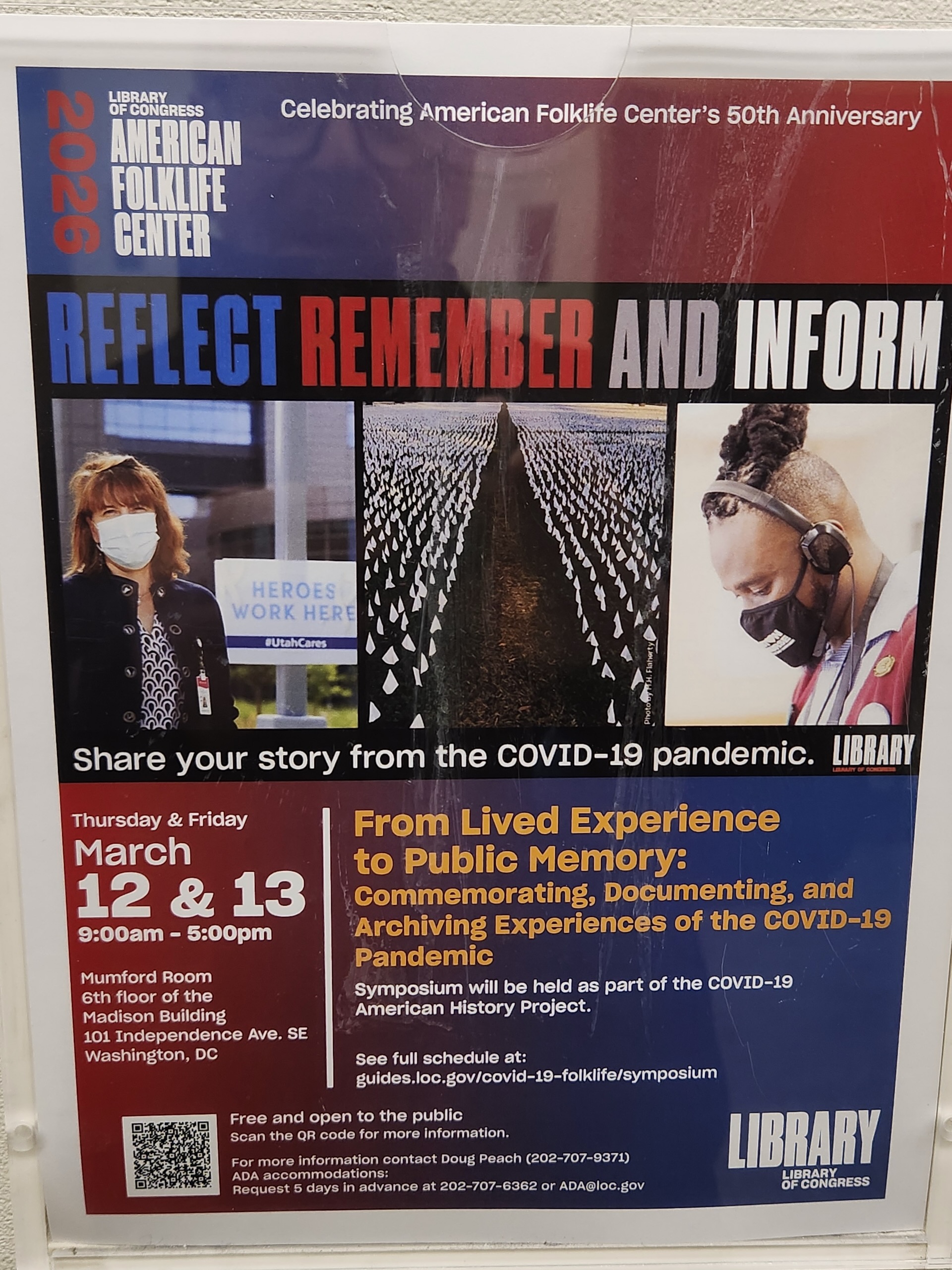
    On March 12 and 13, 2026, the American Folklife Center, a part of the Library of Congress, in Washington, DC, presented a symposium entitled “From Lived Experience to Public Memory: Commemorating, Documenting, and Archiving Experiences of the COVID-19 Pandemic.” The event coincided with the sixth anniversary of the declaration by the World Health Organization that COVID-19 had become a global pandemic.

    As one of the over 1.2 million Americans who has lost one or more loved ones to COVID-19 (my partner of 33 years, Jody Settle, died in April 2020,) I was curious to see how the lived experiences of those who were most severely impacted would be represented. Unfortunately, our experiences were either ignored or glossed over during the various presentations.

    The symposium instead looked at various aspects of how we coped and lived our lives during the temporary lockdowns that arose around the world to combat the spread of the SARS-CoV-2 virus and how some of those changes have impacted and continue to influence our daily lives.

    Sour, Dough

    One of the obvious areas that concerned everyone was food, its production, and the related delivery systems. As was sometimes true prior to the lockdowns, comfort food became a source of solace for many who were fearful or, worse, mourning the loss of loved ones to this new virus. I was a bit disillusioned with a reference to a meme that discussed common weight gains during that period as “the COVID nineteen” (much as first year college students are often said to experience a weight gain called the “freshman fifteen.”) Unfortunately, the laughter from the audience that ensued ignored the sentiments of those who were most severely impacted.

    One of the activities that seemed to become rampant during the lockdown period was the baking of sourdough bread. Myriads of families ordered bread making machines so they also could join in this activity. Perhaps, it was their way of feeling connected to others. Someone sent me one in the days after my partner died in April 2020. Looking at the box, I wondered what I was supposed to do with a bread making machine. I couldn’t bake a new partner! Sadly, the box sits unopened in the closet six years later.

    More interesting, there seems to have been an increased rediscovery of old family recipes for favorite meals that had been stored away unused due to the lack of time in our busy society. Now, staying and/or working at home, there was more time to reconsider these foods and the comforts and memories they provided. This, of course, required ingredients that many did not regularly have at hand.

    The food procurement system has been impacted or altered by the pandemic. There was a huge increase in the ordering of groceries on-line which stores then needed to deliver directly to the home. Restaurants, restricted from indoor dining, began relying on services like DoorDash and Grub Hub that came into prominence during this period. People began ordering take-out food from local restaurants if only to support them and help them to survive until the lockdowns were over. The message seemed to be that people wanted to continue enjoying their favorite foods without risk to themselves. Sadly, the risk to those who had to work to survive was only discussed in a passing remark that “comfort for one became discomfort for another.”

    Several other observations were made about the impact on food delivery systems. There has been a notable increase in the number of farmers markets around the country. Researchers presume that people felt that shopping at these open-air concessions was safer with less chance of exposure to the virus.

    A final thought is that there now seems to be an increased understanding of how the corporate industrial food system works. People have finally acknowledged that our food doesn’t miraculously appear on the shelves in our grocery stores. It requires a great number of human resources to grow, produce and ship products and then to stock the shelves – all of which put people at risk during the pandemic. The question left unsaid is whether people continue to care about those who are part of this important supply chain component.

    I would be remiss if I didn’t mention how friends and neighbors stepped up to prepare meals that they shared with me when Jody died. They would call and come over and we would meet outside. Maintaining the recommended social distance, they would place the food nearby and step back. I would then go over and pick it up. After a brief shouted “thank you,’ we would return to our homes. The comfort offered by a homecooked meal and a few minutes of face-to-face contact was not something discussed during this portion of the symposium.  

    Synchrony/Cacophony

    Music and the impact on musicians were the themes of several presentations. Because musicians were unable to perform together in-person, many of them tried to employ new on-line technologies, like Zoom, to continue their collaborations and performances. Because of the nature of internet technology at that time (since improved somewhat,) lags in transmission speeds often made the synchronization of the various musicians difficult, if not, impossible, often leading to cacophony. Musicians experimented, learned and implemented new techniques to overcome these difficulties such as writing compositions and arrangements where one performer’s last notes could be sustained and then the next performer would begin on the same note. Also, visual clues were used for one musician to cue another. These aided the musicians to continue their creative work until they could again work together in-person. An example of these new techniques was shown (performed via Zoom) by the Kronos Quartet performing the musical piece, Marejada (which translates as “surge”) composed during the lockdown.

    Other speakers spoke of the means musicians in small or isolated communities used to continue performing for themselves and others. One presenter discussed a group of blue grass musicians in southern Indiana. As they told her, if they were to live the lives they were used to living, they would have to adapt. And, they did. Single performers would play from their front porches while friends and neighbors would sit in their cars listening to the performance. Later, as restrictions eased, some of the groups would gather to perform outdoor concerts. She even showed videos of them precisely measuring out six-foot social distance circles around each performer. They did the same with the folks that came to listen and enjoy. All this helped them to live during the lockdown.

    Improvisation was the key to survival for many musicians. A project based in some impoverished neighborhoods of Washington, DC, put into service a rickety old van nicknamed the “COVID Van.” The organizer, from American University, and his wife would meet musicians, usually in their late teens or early twenties, who would perform while they, safely inside the van, recorded videos that, once edited, were shared on platforms like YouTube. This allowed these young musicians to continue creating and sharing new music with their fans even when they couldn’t appear in a public setting. Again, new ways of thinking worked and continue to be used now.

    Several researchers who worked in Spanish-speaking Latin American communities discussed the role of music in providing information and solace to people from Mexico to Argentina. One of the interesting things they discovered was that musicians were less concerned about making music during the pandemic, but rather they focused on creating music about the pandemic. As they termed it, the music was about the humanity of surviving.

    Much of this music focused on instructing people on how to stay safe — like washing your hands frequently, wearing a face covering, and maintaining social distance – “be a good citizen and we’ll get through this.” The one quirky thing they recognized in each country was that the music was usually upbeat and the videos created for these songs were almost always full of dancing and hope and smiles. They served as cheerleaders in a time of sorrow.

    The use of folk art provided some further insights. Some art work served to educate people on how to protect themselves and, in doing so, provided continued economic survival for the creators. Of course, some art work served to memorialize people who died from COVID-19.

    A Renaissance of Stitches

    In the early stages of the pandemic when there was a lack of personal protective equipment, ethical questions arose about the creation and sale for profit of face masks while people were dying. This included examples where protective face masks were decorated with distinctive patterns and designs and intended to be sold as art work rather than to be used as protection against the virus.

    Of interest to me was how seamstresses around the world gathered whatever materials they had at hand and produced many millions of masks for their friends and neighbors and others. Their work was so prolific that there was a run on the elastic materials used to keep the masks properly placed on the face. An interesting anecdote was how seamstresses in Cambodia produced and shipped face masks to underprivileged people in the United Kingdom and Australia.

    During the lockdown periods, there was a notable renaissance in the art of quilt making around the world. Many picked up an avocation that they had set aside a long time ago. Many others first came to quilting at that time.

    Over time, often influenced by social media posts that referenced the AIDS Memorial Quilt that was begun to memorialize those who had died during the HIV/AIDS epidemic in the 1980s and 1990s, many tried to reproduce the feelings those quilts invoked in them and moved to sew similar quilts for those lost to COVID-19. Examination of many of the quilts produced reflect the social anxiety the creators were feeling whether from being isolated, having to maintain social distance when interacting with others, and, even the simple task of trying to find toilet paper. One other interesting aspect of this work was the number of quilting bees that arose on the internet via apps like Zoom. The people could sew while talking to others doing the same thing. It provided them a chance to share their feelings and their work. It allowed them to practice a tactile art without the need to touch.

    Say Their Names

    Another use of art serving to memorialize appears in the work of the Naming the Lost Memorial project in New York City. Taking inspiration from the reaction to the murder of George Floyd in Minneapolis in May 2020 and the constant call to “say his name,” this small group formed and reached out to those communities that weren’t able to properly mourn their dead following their own customs and traditions.

    After receiving a grant, the group expanded and joined with local artists and musicians from various immigrant communities in New York City to develop memorial artwork and events that gave honor to their cultural ways of mourning. They scheduled two events per year: one at Brooklyn’s Green-wood Cemetery in the spring and the other celebrating the Day of the Dead (el Día de los Muertos) at the Church of St. Marks-in-the-Bowery in Manhattan. I attended both memorials in 2025 where I recall and experienced how the rituals of mourning in various places such as Mexico, Guyana, and West Africa, among others, were performed to honor the members of those communities who had passed on. While loved ones were lost, we continue to remember and learn from each other.

    The Naming the Lost Memorial project concluded with the most recent Day of the Dead event in November 2025. But the project will never really end as long as we continue to say their names.

    There were other various presentations. Some of them I found interesting. One dealt with the impact of COVID-19 on the Navajo Nation. It was noted that in May 2020, the indigenous peoples of the United States had the highest COVID-19 infection rates. On a brighter note, by February 2021, these same groups had the highest COVID-19 vaccine uptake rates. The primacy of elders in the indigenous populations as repositories of their language, oral and written history, and native learning methods promoted the care of these elders to primary importance in their communities as they struggled against COVID-19. An elderly Navajo woman noted speaking about COVID-19: “I look upon it as a monster that is feeding on us.” The lack of resources for these indigenous communities from the U.S. government (the case before the appearance of COVID-19) accelerated the situation. Sadly, a number of members of the Navajo community were lost.

    Others presentations I found disturbing. These made me wonder why anyone would want to characterize this period of history in this way. One of these compared some of the reactions to COVID-19 pandemic to those of the 1918 Influenza Pandemic dubbed the Spanish Flu even though credible scientific evidence shows it most likely originated at a U.S. Army base in Kansas City.

    In 2020, early on in the pandemic, the use of the internet and social media platforms led to “ideas” and disinformation such as the belief that 5G cell phone technology or the financier George Soros was the source of the pandemic. The somewhat racist depiction, Kung Flu, was an ad lib from Donald Trump in a speech he delivered during the beginning of the pandemic. Other strange ideas also arose at this time like “vegetarians are safe – only meat eaters get COVID” and “gargling with salt water would dislodge the virus from your throat.” Many of the numerous memes that were shared via social media showed a disconnect between the perceived image and actuality. The hurtfulness of many of these memes to those who lost loved ones to or continue to suffer from the impact of COVID-19 was not mentioned or just ignored. There was no discussion of counteracting the misinformation arising from these memes and other postings.

    For me, the most disturbing presentations made during the symposium revolved around the topic of play. One positive presentation in this area of play was an exception. Presented by two young scholar researchers from the United Kingdom who work with young people living with Tourette’s Syndrome. Their organization, Tourette’s Hero, developed several creative projects to help keep these individuals engaged. One they spoke of was named “Digital Heros of Imagination.” Using whatever materials were close at hand, the people worked to create their own superheroes and then to develop backstories surrounding their creations which they told through posters that shared with one another. When the severe lockdowns were lifted, they began a second program called “Journey to a Better World.” Here, they strove to instill and maintain a sense of joy and connection in their clients.

    Other presenters discussed games for children like “Coronavirus Tag” in which a designated player who, in theory, carried the coronavirus would run around and tag another player who would become “infected” and would fall down as if dead. This continued until all the players had been “infected.” The game would restart with a different player designated as the one having coronavirus. Parents seemed to find that this game, and others like it, were inventive and catered to the physical and psychological vulnerabilities of the children while including them as historical witnesses to life during the pandemic. As a person who lost someone to COVID-19, I found the idea of this game offensive, particularly because it was presented as a celebration of creativity. If only my loved one could just get up and live again. In Finland, “Korona” was a board game, much like Monopoly, where players moved along the board trying to infect the world with a virus. Players often exhibited joy in watching the virus spread. I tried to ask the presenters if they had considered the impact of these games on children who had lost a parent, sibling, or caretaker to COVID-19. They were adept at ignoring my question.

    All this leads to one overarching conclusion about these presentations. All of them, in their own way, were too focused on those who had the most privilege, e.g., those who had the ability to flee large urban areas for vacation homes in rural areas. There was very little note given to the financially challenged people who lived crammed together in urban centers and continued, at much personal risk, to venture out to “essential” jobs to serve the needs of those who were able isolate. In the end, I was disappointed. I think many of the presentations failed to consider the people who were most severely impacted by COVID-19, i.e., those who died and those who loved them.

  • Why Caring for the Dead and Aid for the Living Matter: The Ebola Outbreak in the DRC

    July 28, 2026

    “There are a lot of customs, but traditionally, funerals are multi-day affairs. . . . which sometimes could take one, two or three days, where people are living close to the dead body.”

    “These burial rituals must change. Local authorities … have limited the size of funerals.”

    – NPR, “Why are people attacking Ebola clinics? It revolves around trust, death and body bags,” May 29, 2026

    Over the past two months, headlines from the Democratic Republic of Congo (DRC) have raised alarms about another Ebola outbreak: specifically the Bundibugyo strain, for which there is no approved treatment or vaccine. According to Médecins Sans Frontières, it is the seventeenth Ebola outbreak recorded in DRC since the virus was first identified in 1976. To date, more than 700 Congolese have died from the virus and the outbreak has spread into neighboring Uganda. In mid-May, the World Health Organization declared it a “public health emergency of international concern,” noting that “the ongoing insecurity, humanitarian crisis, high population mobility, the urban or semi-urban nature of the current hotspot and the large network of informal healthcare facilities further compound the risk of spread.”

    Though different from COVID-19 with its global scale, the Ebola outbreak, its deadly impact, the uncertainty surrounding its transmission, and the pressing social concerns regarding proper care of the dead overlap in important ways with critical themes of our research on COVID death, mourning, and memorialization. The news from the DRC also illustrates the costs of the current administration’s withdrawal of aid and its continued undermining of medical and public health expertise. Even as COVID fades into the backdrop of American public discourse, its traces persist—especially in how we, as a society, understand and relate to more recent public health crises.

    For example, RIM teams members immediately recognized in the words of Congolese doctors, politicians, mourners, and aid workers how quickly fear centers on the dead—that is, the body as a vector of infection and the ritual acts of funerals and burials as superspreader events. Our project originally developed from basic questions of how rituals and thus social worlds were transformed by the pandemic’s prohibitions—and the fear, anger, sorrow, and misinformation that followed. We heard similar themes explored in the media coverage that followed reports of mourners storming local clinics.

    EMANUEL: The goal is to explain what makes a safe burial. Micaela Serafini of Doctors Without Borders says aid groups have also learned from past outbreaks. One major problem her team identified?

    MICAELA SERAFINI: We were putting the body inside a black bag, and we were zipping it. There was no image, so the family couldn’t even recognize the body.

    EMANUEL: This was counterproductive. So, she says, they changed the design. The new bags…

    SERAFINI: Have a transparent area in which the face of that loved one can be seen.”

    – Gabriel Emanuel, “Doctors in DRC work to dissuade traditional funeral practices amid Ebola outbreak,” May 26, 2026

    In addition to its emphasis on what constitutes a “safe burial,” the exchange demonstrates how closely trust in authorities is tied to the acts of recognition and witnessing, a dynamic that our colleague from Brazil, Andréia Vicente da Silva, has analyzed in her work on how COVID disrupted Pentecostal funerary rituals and our own project manager, Maria Jose Pelaez, has explored in a dispatch about Elsa Maldonado in Ecuador.

    (1) What fills the information gaps: “A second battle is also underway to fight misinformation”

    Following the attack on a hospital clinic during which families attempted to retrieve the bodies of their loved ones, Congolese local authorities and journalists reflected in the failure of communication on the part of public health officials. As Luc Mambele explained, “This lack of communication, this absence of communication from the health authorities in the province is what allowed rumors to take over and is what continues to this day.”

    “Angry residents burn down tents treating Ebola patients in DRC as health protocols clash with burial traditions,” CNN.com, May 22, 2026.

    (2) What occurs in the absence of aid

    On US withdrawal from WHO, wholesale gutting of USAID, and cuts to the CDC, medical anthropologist at American University, Lauren Carruth explains:

    “While officials from the WHO have downplayed the role of cuts to international organizations in hampering the response, local reports argue that the absence of USAID and U.S. funding has been highly consequential. According to this and other media reports, American officials did not learn of the confirmed outbreak until nine days after the WHO did, and almost a month after the first person died. The delay was compounded by samples being transported to the Kinshasa lab at the wrong temperature—a logistics task previously managed by USAID. USAID previously provided health worker training, contact tracing, testing, safe burial resources, and assistance with supply chains. In a recent New York Times article, Dr. Salim Abdool Karim from the Africa CDC asked, ‘Who else can bring 20 trucks in a matter of three days, have drivers, have fuel?’”

    (3) Finally, on the importance of historical and anthropological knowledge

    “We know that this is about so much more than that. It’s about history and culture and politics and even just about how people love and care for others in their family who are sick.” –Megan Schmidt-Sane, Research Fellow at the Institute of Development Studies

    In her July 20, 2026 New York Times Magazine report, “Why Epidemics Breed Rage at Health Workers,” Sheri Fink documents the role of scholars, namely historians and anthropologists, in informing policy responses to public health crises such as COVID-19 and this most recent Ebola outbreak. Among other parallels she examines, Fink notes the commonality of how uncertainty—even in the face of more exacting science—“breeds” distrust. She reminds us of COVID times:

    But unrest during epidemics is not about Ebola, Africa or education. It is something societies have struggled with for centuries, and it is evident in rich countries as well as poor ones, in modern times and medieval ones. During the Covid pandemic, Western doctors, nurses and health officials received not only applause and gratitude but also death threats. Patients denied that Covid existed as they died of the disease. Protesters carrying guns occupied sidewalks outside hospitals. Multitudes embraced treatments, such as ivermectin, that study after study showed to be ineffective. Vaccinators in Italy were assaulted. A German gas station attendant and a Michigan Family Dollar security guard were killed after asking customers to wear masks.

    Mistrust does arise out of thin air. It has historical context. Fink explains, for example:

    “Ebola looms less large as a threat to people whose lives are at risk every day from hunger, destitution and common infectious diseases. Ebola is just the latest shock after decades of conflict and suffering, state neglect, colonial and post-colonial violence, and the failure of international peacekeepers to stop civilian massacres.”

    And, echoing theme #2 above (absent aid), Fink concludes her essay with a nod to current conditions:

    “The country’s population also faced a precipitous drop in foreign assistance last year, when the Trump administration dismantled the U.S. Agency for International Development, an effort championed by the world’s richest man, Elon Musk.”

  • We’re Not Done Yet: Taking Stock and Charting a Path Forward

    We’re Not Done Yet: Taking Stock and Charting a Path Forward

    It’s been a little over a year since we learned that the National Science Foundation grant supporting the Rituals in the Making project was “terminated, effective immediately.” As we wrote in a recent essay for Anthropology News, just because we lost our funding doesn’t mean we’ve lost our drive to research and write about the lasting effects of pandemic loss on American society.

    We’ve been busy this past academic year, presenting our findings at the DDD conference and the American Anthropological Association and publishing several books chapters:

    • Rituals in the Making Collective. “Case Study: ‘In America’ COVID Memorial Art Installation on the DC National Mall.” In Practicing Digital Ethnography, edited by Devin Proctor. New York: Routledge, 2026.
    • Vicente da Silva, Andreia, and Sarah Wagner. “Ritualising and Memorialising Unjust Death: The Affective Force of COVID Loss in Brazil and the United States.” In Decolonising Death Studies, edited by Panagiotis Pentaris, Stacey Pitsillides, and Hajar Ghorbani. New York: Routledge, 2026.

    And so this past month, we gathered (in person and virtually) for a writing retreat—a chance to reflect on our individual and common goals and to reaffirm our commitment to researching and writing together. Though a smaller team, we are still the Rituals in the Making Collective.

    Here are a few scenes from the three-day retreat. We look forward to sharing the fruits of our redoubled efforts in dispatches throughout the summer. And a new website is “in the making” … please stay tuned!


    Three days of setting out goals, writing, reading, playing board games, and just being! Everything a successful retreat could be 🤭


    A smiling woman with long hair wearing a t-shirt that says 'GIRLS JUST WANNA HAVE FUNDING FOR SCIENTIFIC RESEARCH.' She is standing next to a dog wearing a cone collar.

    PS from Sarah W: When I got home on Saturday evening, my block was full of people enjoying the Petworth Porchfest 2026. I spotted my neighbors and was chatting with them when a young woman leaned over to say, “I really like your shirt.” The t-shirt was a gift from my fellow co-editor of the Cambridge Handbook for the Anthropology of Death, Sarah Richardson, also a staunch supporter of Rituals in the Making. It felt like a fitting end to the three days of working together with Martha, Avery, Paige, Maria Jose, and our virtual guest from Brazil, Andreia Vicente.

    GIRLS JUST WANNA HAVE FUNDING FOR SCIENTIFIC RESEARCH. (And Puppy Emmy just wants that cone off!)

  • March 2026 – Steeped in the Yellows of Early Spring: Rami’s Heart COVID-19 Memorial Sixth Annual Lighting Ceremony 

    March 2026 – Steeped in the Yellows of Early Spring: Rami’s Heart COVID-19 Memorial Sixth Annual Lighting Ceremony 

    A memorial garden featuring heart-shaped stones with names and dates, surrounded by greenery and decorative ornaments, including flowers and birdbath.

    By Sarah Wagner

    ***

    “We are talking about how we carry so many people with us wherever we go, how even simple living, these unearned moments, are a tribute to the dead.”

    – Ada Limón, “Forsythia”

    March 28, 2026: In the earnest, warm light of an early spring evening, Rami’s Heart COVID-19 Memorial once again gathered its own to remember their loved ones. Shades of yellow—hearts, shells, stones, candles, ribbons, and flowers—brought the space to life despite (or maybe because of) the setting sun. This year Paige Gavin and I had the honor of joining Rima Samman-Whitaker and the Rami’s Heart community for the occasion, and I write this dispatch with the evening’s sights and sounds still fresh in my mind. The essay combines photos from before and after the ceremony with captions drawn from the different speeches, as well as poetry that I stumbled on in the days since. I’ll start with a collage of photos and two poems that seem especially fitting. 

    ***


    Forsythia et al. 

    For this sixth annual lighting ceremony, Rima urged attendees to bring flowers. And so, gradually, as people arrived, so too did their floral tributes: a vase nested in the dark mulch, its bouquet brimming with shades of bright and pale yellow, pink, and green; clusters of canary-yellow roses tied to a memorial bench; a single stem of gerbera daisy resting atop a heart-shaped stone; florets of golden-yellow ranunculus (Persian Buttercups), tucked between names. 

    And forsythia, at the entrance and exit, just then in brilliant yellow bloom. 

    To my delight, I found that two of my favorite poets have written about forsythia: 

    Billy Collins, “Forsythia” 

    It caught my eye a while ago, lit up 
    against the gloom of the woods 
    in the corner of a wild field, 
    the pulsing color of caution. 

    And now that I have spent a little time 
    on this stone wall watching its fire 
    flare out of the earth 
    I begin to think about the long chronicle of forsythia, 

    how these same flowers have blazed 
    through the centuries, 
    roused from the ground by the churning of spring. 
    I would rather not look around the next 

    corner of the year to see how this will die, 
    its lights going out,  
    its bare, arcing branches 
    waving like whips in the bitter wind. 

    So I sit facing the past, 
    letting my feet dangle over the wall, 
    beating time against stone with my heels 
    as the long gray clouds roll over me. 

    Remember how Arnold by the Channel 
    thought of Sophocles who must have heard 
    the same shore-sounds long ago, 
    walking by the edge of the Aegean? 

    Well, I am holding in the palm of my thoughts 
    all the others who once were stopped, 
    like me, by this brightness, 
    this sulfuric cry for help: 

    women in tunics, women gathered by a well, 
    men in feathers, men swimming by a river, 
    all speaking languages I will never know, 
    saying the different words for its color 

    as I feel the syllables of yellow form in my mouth 
    and hear the sound of yellow fill the morning air. 

    Source: Poetry (April 1995)

    Ada Limón, FORSYTHIA 

    At the cabin in Snug Hollow near McSwain Branch creek, just spring, all the animals are out, and my beloved and I are lying in bed in a soft silence. We are talking about how we carry so many people with us wherever we go, how even simple living, these unearned moments, are a tribute to the dead. We are both expecting to hear an owl as the night deepens. All afternoon, from the porch, we watched an Eastern towhee furiously build her nest in the untamed forsythia with its yellow spilling out into the horizon. I told him that the way I remember the name forsythia is that when my stepmother, Cynthia, was dying, that last week, she said lucidly, but mysteriously, More yellow. And I thought yes, more yellow and nodded because I agreed. Of course, more yellow. And so now in my head, when I see that yellow tangle, I say, For Cynthia, for Cynthia, forsythia, forsythia, more yellow. It is night now. And the owl never comes, only more of night and what repeats in the night.


    *** 

    Scenes from the ceremony: Photo essay

    (The captions and quotations that accompany the images are from the ceremony’s speakers: Teresa Dimezza; Dr. Raynard E. Washington; Joann Burney; Sean Burney; and Rima Samman-Whitaker.)

    “[COVID] brought a lot of loss and disruption and uncertainty and quarantines and homeschooling and all kinds of home projects and just complete chaos in our lives. And while time has moved forward, the impact of that time certainly hasn’t. In New Jersey alone, we lost more than 35,000 residents to this virus, and while that’s a number, each one of those numbers counts to life, a story, a family that’s forever been changed. . . . So tonight is about honoring those individuals, about saying their names in our hearts, holding space for their stories, and recognizing that though they’re not here with us, the love that we share for them still is here.”

    – Dr. Raynard E. Washington, Commissioner of the New Jersey Department of Health

    A memorial display featuring black stones inscribed with names, arranged on wooden shelves. Below, yellow flowers and candles are arranged on the ground, creating a somber atmosphere.
    “Every candle we light represents a name, a life, a story and a love that continues to shape us.” – Teresa Dimezza 

    A crowd of people sitting on folding chairs and standing on grass during sunset, with trees in the background and buildings visible.
    “We [Allaire Community Farm] are a nonprofit that we are honored to host Rami’s Heart, and Rima and Travis have become an extended family to us, and I just want to thank them for all their hard work. I know you all appreciate them very much. They put their heart and soul into this, and without them, it wouldn’t be as beautiful as it is.”  – Joann Burney, Allaire Community Farm 
    Interior view of a path with visitors in winter clothing, lined with candles and flowers, under string lights, as they engage with a display or memorial.
    “I would like to also thank Don Corson. Don’s 91 now, and it was a little too cold for him to be here tonight, but he’s the one who, immediately after seeing the shadow boxes, saw that memorial in his head and put it together, and we had the materials. It was up in less than a week.” – Sean Burney, Allaire Community Farm 

    To the families I remember with you all this evening, to those that we lost, I honor you all this evening and to all gathered here, may we leave this place, not just with heavy hearts and remembrance of those that have been lost, but with a renewed sense of purpose to continue to act to make health possible for all of our neighbors here in New Jersey.” – Dr. Washington 

    ***

    “We also gather in a moment when there are voices who would rather we forget, who would have us move on without reflection and replace our very real, lived experiences with misinformation. But we can’t, and New Jersey won’t. Public health is based depends on trust and on truth and our willingness to learn from what we’ve endured together as communities. Remembering is not about looking backwards. It’s about honoring lives by doing better as we move forward.” – Dr. Washington 

    Three individuals standing outdoors, smiling for the camera with a clear blue sky and an American flag in the background.

    ***

    “But in the six years, each and every year, something happens, something brings us hope, something shows us that there’s still good things out there, like Sean and Joan who gave us the space, like Governor Mikie Sherrill and Dr. Washington for recognizing our grief, the board members that meet with us every month and help us plan everything out, and we all do it on our own time.” – Rima Samman-Whitaker, Founder of Rami’s Heart COVID-19 Memorial

    “So it’s another year that we go on grieving as the world moves on. The reality is we’ll never move on from our grief, but we’ll ever, will forever carry their love and their light. So tonight, when we light those candles, just know that we carry their light. And although grief may not be a great thing, it is a part of us. It is a part of who we are now, and it is up to us to keep them in our memory and our lives.”

    – Rima Samman-Whitaker, sister of Rami Samman

    A heart-shaped memorial stone with the name Rami Samman, birth and death dates, and the phrase 'We miss & love you so much,' accompanied by a bouquet of yellow roses tied with a ribbon, set on grass.