
Rituals in the Making: a George Washington University research project on memorialization, misinformation, and the consequences of the COVID-19 pandemic

Tag: writing

  • Lecture Recap with Jay Winter: “Surviving the Holocaust: The Mir Yeshiva from Vilna to Shanghai and Beyond” 

    Lecture Recap with Jay Winter: “Surviving the Holocaust: The Mir Yeshiva from Vilna to Shanghai and Beyond” 

    Written by: Paige Gavin

    On January 16th, the Rituals in the Making team invited Jay Winter to discuss his current research on the history of the Mir Yeshiva and their story of survival. 


    “All wounds are not healed by time. Time itself is a wound within which life prevails. We do not overcome the finitude of death; we share it, as we share it with the life to which we give birth and for which we too will belong along with those having-been.” – Hans Ruin, Being with the Dead, p. 14 

    DATE POSTED: 01/31/2025

On January 16th, the Rituals in the Making team invited Jay Winter to discuss his current research on the history of the Mir Yeshiva and their story of survival. 

    In collaboration with the GW History and Anthropology Departments, Rituals in the Making invited the esteemed Yale Professor Emeritus Jay Winter to lecture on his current research topic about the Mir Yeshiva. Dr. Winter is a historian of war and memory, focusing on the First World War, and is the author of numerous seminal works in the field, including his book Sites of Memory; Sites of Mourning: The Great War in European cultural history (Cambridge, 1995), and is editor, with the late Emmanuel Sivan, of War and Remembrance in the Twenty-First century (Cambridge, 2000). His most recent book is Statelessness after Arendt: Refugees in China and the Pacific during the Second World War, edited with Kolleen Guy. It will be published by Manchester University Press in 2025. 

    As a preview to his upcoming book, Winter lectured about the (deliberately) untold story of the Mir Yeshiva, a 300-person group of Jewish scholars, who survived the Holocaust by relocating from the town of Vilna (Lithuania) all the way to Shanghai, China. When the threat of fascism and genocide reached across Eastern Europe, the Mir Yeshiva found themselves as a crossroads—to leave or to stay put. The older generation within this yeshiva felt compelled to stay put in their homeland, but the younger generation urged the group to leave and find safety elsewhere. In order to leave, however, they needed money – and lots of it – to cover the cost of visas and travel. A few of the young Mir Yeshiva asked for visas from the Japanese, Russian, and Venezuelan ambassadors, who ended up giving them 300 visas. The visas, of course, cost around $36,000, which is equal to $11 million in 2025. The work and connections that went into obtaining this large amount of money relied on the younger generation who were brave enough to resist against their inner hierarchy—against the older generation in power.  

    The story of the Mir Yeshiva is quite astounding, as it is more than just about survival, but about the idea of parapolitics—the political power of the stateless. The Mir Yeshiva members were able to create their own cultural and political world in Shanghai for so long and were able to maintain their own spiritual world that they brought with them across the world.  The opposing State wants the stateless to be weak and vulnerable, but that is not the actual case. Could we say that they have more agency than we give them, and that their survival was based on pure luck? Yes, we could; however, this question brings to rise the intellectual problem that is the instability of war and memory. As stated previously, the story of the Mir Yeshiva has been, as Winter argues, deliberately untold, because of the problems the younger generation caused by going against the elders’ wishes. 

    Professor Jay Winter answering questions. Photo by Paige Gavin. 

    Both war and memory are unstable fields that are constantly changing. When one diverges, the other adapts. Memory and history, especially when it comes to Jewish culture, are quick to be erased by the State and those in power. There is also a tendency to not give enough credit to those who rebelled against the highest authority, as we saw with the younger generation of the Mir Yeshiva. Survival always comes with a price—whether that be the loss of someone’s homeland or the loss of intellectual freedom. The way we construct our historical memory entails false binaries, such as military and civilian, oppressor and oppressed, villain and hero, war and peace. Yet, we cannot separate these binaries as they are so entangled with one another that as one changes, the other does as well. As Winter said, “War changes, and so does peace. If this is true, what does that say about the instability of memory? It turns into a kaleidoscope of human cruelty.” 

    What interests us, as Rituals in the Making, is this idea of memory as unstable. Memory is not static; it contorts and bends to our will. Winter challenges us to think outside of our linear conceptions of memory and history. How will the COVID-19 pandemic be remembered? Our team would argue that we are going through a time of a violent historical revisionism, a concept that goes beyond the idea of social forgetting and that turns the act of memorialization into an act of resilience against the state. With the help of Winter, we came to a relative conclusion that ritual acts as a frail stabilization in an unstable world. The rituals we form and enact in response to catastrophic disasters are a simple attempt to make sense of the world as it falls apart before our eyes. We hold our rituals close to us; believe in them even if they don’t quite make sense, because they help us persevere. 
  • Transience: Reading Freud Before and During the Pandemic

    Transience: Reading Freud Before and During the Pandemic

    By: R.R. Grinker

    “All beginnings contain an element of recollection.” When the late British anthropologist Paul Connerton wrote these words (1989: 6), he had in mind a specific kind of memory: social memory that generates and is revitalized in commemorative practices (like rituals, holidays, and parades) as well as in material culture (like monuments, museums, and sacred texts). But there is an even more general point to be made: when we remember, and perhaps especially when the memories cause us pain, we try to find meaning in the pain; and when we search for meaning, we are engaged in creative and imaginative acts.  

    To illustrate our capacity for creativity, one need only look at two of the subjects covered in our dispatches: “In America: Remember” and “Rami’s Heart.” Both efforts came from mourning losses to COVID-19 – “In America: Remember” from artist Suzanne Brennan Firstenberg’s desire to mourn and honor the enormous number of people in the US who died from the virus, and “Rami’s Heart” from Rima Samman-Whitaker’s desire to mourn and honor her brother, and to invite us to join her and extend that honor to others. Importantly, the projects continue to grow, even in a divisive political climate in which many in the US deny the realities of the pandemic and urge us to forget. As we will see below, when Freud wrote during WWI about the positive effects of mourning, he was so critical of those who reacted to loss with apathy and dejection rather than with a therapeutic grieving process that he suggested they were engaged in a “revolt” against mourning. To the extent that Firstenberg and Samman-Whitaker’s projects seek to embrace rather than to revolt against mourning, they are counter-revolutionary.


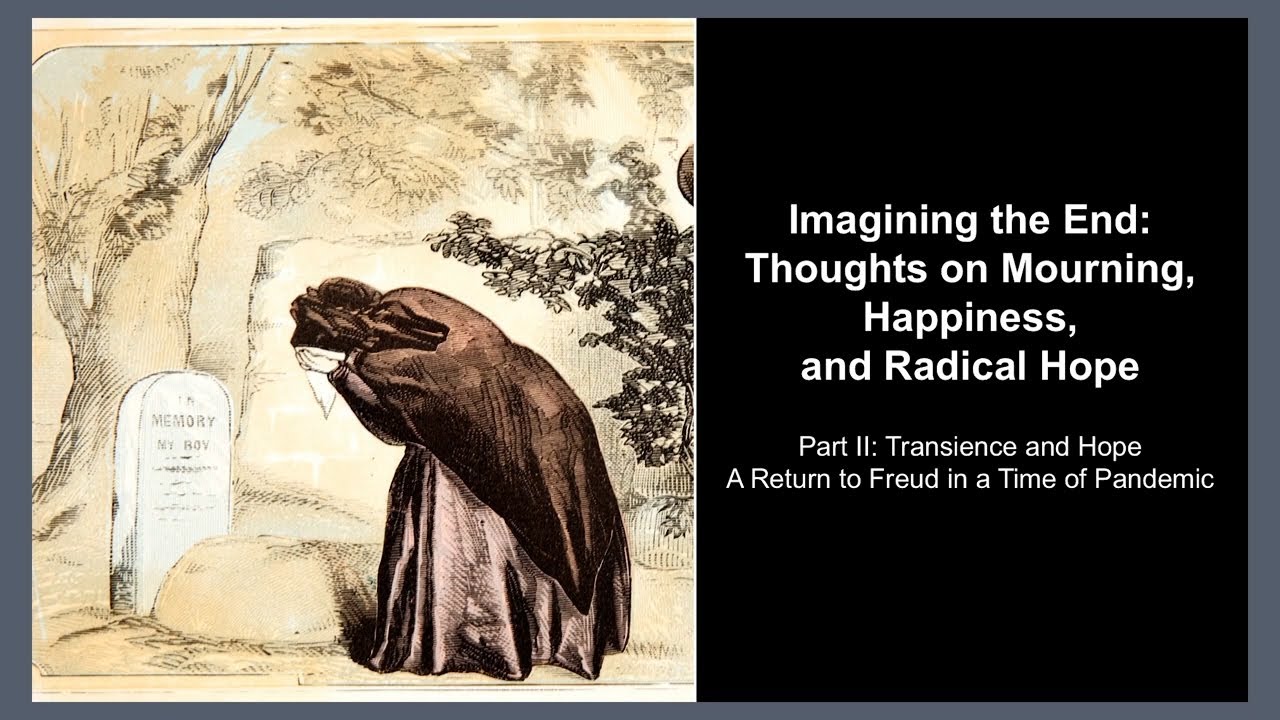
    I recently came across a fascinating short article by the philosopher and psychoanalyst Jonathan Lear, “Transience and Hope: A Return to Freud in a Time of Pandemic” (2021), that might help us understand the value of mourning we see in phenomena like “In America: Remember” and “Rami’s Heart.” I also bring it up for a simple academic reason: it is a relatively unknown work that may be of interest to many scholars who, if they are anything like me, had never even heard of it. 

    Given the title of his essay, I assumed Lear’s article would be about Freud’s 1917 “Mourning and Melancholia,” since so many scholarly works on the COVID-19 pandemic draw on this classic. Writers in numerous academic disciplines have argued that the pandemic and the restrictions on social interaction that followed (including mortuary rites) complicated the experience of loss, making it hard for survivors to move from what Freud considered pathological grief or melancholia (the unconscious experience of loss as grief of a part of one’s self) to “normal” mourning (the conscious experience of grief as the loss of someone outside of ourselves). 

    But Lear surprises us. Instead, he discusses Freud’s little-known 1916 piece “On Transience,” a short 2 ½ page reflection. The seeds of “Mourning and Melancholia” are there, but they are symbolized, as in a dream or a parable. 

    In “On Transience,” Freud reflects on a vacation in 1913, just one year before the onset of WWI, when war, in his words, “robbed us of very much that we had loved, and showed us how ephemeral were many things that we had regarded as changeless” (1957 [1916]: 307). He recounts a summer walk in the countryside (likely the Dolomite mountains in northeastern Italy) – with an unnamed “taciturn friend” and an unnamed “famous poet.” We learn almost nothing about the views of the taciturn friend, who remained taciturn; other than that, he did not enjoy the walk. The poet, however, expresses his displeasure. He becomes despondent when he considers that the beauty around him and indeed “all human beauty” will one day disappear. Freud cannot argue with the fact that many beautiful things perish; but he does dispute the idea that transience should get in the way of enjoying what is currently in front of us. In fact, transience should make that which is beautiful even more beautiful. As Freud puts it, “A flower that blossoms only for a single night does not seem to us on that account less lovely” (1957 [1916]: 306). Why, then, was the friend unhappy and the poet so disturbed? 

    Freud writes, “What spoilt their enjoyment of beauty must have been a revolt against mourning,” and more specifically the pain of mourning, even if they were unaware of the reason for their melancholy. For Freud, mourning is therapeutic; unlike melancholia, personified by his companions, mourning allows us to appreciate what we love, even if it perishes, while at the same time, it liberates us to attach ourselves to other new objects of love. Mourning doesn’t eliminate the loss—in fact, it transforms the natural phenomenon of death into an experienced loss, an absence in our lives to which we give a psychological meaning, and in so doing provides us with relief. This is the point Lear wishes to make: melancholia fixes us in one place; it is unproductive and can lead to depression, while mourning is creative. What’s more, the pain of mourning—at least one’s socially recognized withdrawal or the impairments in one’s everyday life—eventually wanes.

    Lear tells us that he read “On Transience” differently before and during the pandemic. Before the pandemic, he considered it merely a poignant meditation on ephemeral beauty, and the imagined losses of the impending war. After the pandemic, he read it as an allegory of Freud’s own process of mourning. Despite Freud’s insistence that he is different from the poet, having worked through the problem of how to sustain an appreciation of beauty in a chaotic and ephemeral world, there is evidence that Freud on the walk in the Dolomites is also melancholic, grieving a part of himself. Freud writes almost apocalyptically. He says that the war “tarnished the lofty impartiality of our science,” “let loose the evil spirits within us,” “made our country small again,” and “shattered our pride in the achievements of our civilization, our admiration for many philosophers and artists and our hopes of a final triumph over the differences between nations and races” (307). The losses of pride, admiration, faith in science, the nation, etc. are pieces of Freud, losses of his ideals. He does not sound like someone in “normal” mourning; he sounds like someone who needs to mourn.

    Lear is thus convinced that the essay, read as a whole, is an allegory for Freud’s own mourning process. “On Transience,” Lear concludes, is “a performance of psychic repair in the midst of world catastrophe” (2021: 13, emphasis in original). First, Lear suspects no such trip or conversation ever took place. The event is likely a fictional attempt to make a philosophical and psychological argument, and to illustrate a journey into mourning. Second, the two companions are part of Freud’s own mind, as he debates valuing and despairing that which is transient, an internal debate Lear considers to be both something personal for Freud, as well as a general, human, psychological process. By identifying melancholia in his fellow travelers and mourning in his own “working through” of transience, I even wondered if there was some attempt here to symbolize the taciturn traveler as the self-centered Id, the poet as the guilt-ridden superego, and Freud himself as the mediating ego. What’s more, the three individuals may also represent Freud’s reading audience, living in war and ambivalent about the future. 

    Even those who did not lose friends or family from COVID-19 suffered, as Freud did in WWI, as we witnessed the loss of faith in science, the loss of pride in our leaders, the loss of national unity in the face of a tragedy that, under different historical conditions, might have brought us together. If readers, Lear says, “can use [Freud’s] essay to make a similar journey” it might help them deal with the pain of their losses. 

    Even within the war, Freud remained optimistic about the possibilities of mourning. He writes that mourning is itself transient, and perhaps even evil is transient: “Once the mourning is over, it will be found that our high opinion of the riches of civilization has lost nothing from our discover of their fragility. We shall build up again all that war has destroyed, and perhaps on firmer ground and more lastingly than before.” 


    References Cited

    Connerton, Paul. 1989. How Societies Remember. Cambridge: Cambridge University Press. 

    Freud, Sigmund. 1957 [1916]. “On Transience.” The Standard Edition of the Complete Psychological Works of Sigmund Freud. James Strachey, trans. London: Hogarth. 

    Lear, Jonathan. 2021. “Transience and Hope: A Return to Freud in a Time of Pandemic.” International Journal of Psychoanalysis, 102 (1): 3-15. 

    Lear, Jonathan. 2022. Imagining the End: Mourning and Ethical Life. Cambridge, MA and London: Belknap Press of Harvard University Press.


    Acknowledgments: Many thanks to Paige Gavin for comments on a draft of this dispatch.