All kids who grow up in DC are united by a shared experience: being dragged to every museum the city has to offer. Long before Covid, I remember spending days inside the National Building Museum. It was rarely crowded, had lots of exhibits for kids, and—most importantly to my six-year-old self—the gift shop was beautiful.
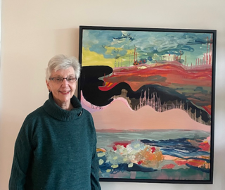
When I sat down to interview Dene Garbow, I was surprised to discover that she had started the building museum gift shop in the 1980s. Dene has been living in a newly renovated apartment at Ingleside, a retirement community in northwest Washington, DC, since early 2020. My job was to interview her about her experience during the COVID-19 pandemic.
Before my conversation with Dene, I had preconceived ideas about people’s experiences during the pandemic. I expected her to discuss feeling isolated and afraid during such a destabilizing time, and, to some extent, she did talk about loneliness and fear. “You already feel vulnerable getting older, and then of course you felt vulnerable during Covid too,” she said
When the pandemic started, Dene was also caring for her spouse, whose health was quickly declining. She explained: “I was aware that my husband was going to be transferred from a hospital to rehab, and I stood outside, I saw him on a stretcher, and I kissed him. He knew who I was, and that was two minutes.” It was the last time she saw her husband.
As painful as this time was for Dene, what struck me the most about our conversation was how resilient and close-knit she and the other residents at Ingleside became, especially those on the fifth floor. “Everyone calls us the fabulous fifth floor,” she told me with a small smile. “Sometimes the whole floor would meet by the elevator to sit and talk. We all became very close friends, which was a big support.”
My conversation with Dene left me deeply impressed by her resilience and by the community at Ingleside. When I once again visited the Building Museum a few weeks ago, I couldn’t help but notice the gift shop and think about the person who made it.
A guest post by Rebekka Loeffler, Department Operations Manager (GW Anthropology)
Rebekka joined the department in April 2024. One of the first things she encountered when she began setting up her office space was a curious artifact left over from the pandemic—something no one had touched in the four years in between the campus shutting down and her arrival. She reflects here on the artifact and what it means to her to this day.
***
I found this calendar in the office of Anthropology. They are as ephemeral as one can get—blocks meant to be changed daily with a sticky note meant to be a temporary addition in an office filled with strangers. On the surface, it is a tongue-in-cheek memorialization, a lighthearted imitation of a museum artifact. However, as a historian of the 20th century, I find this little artifact to be profoundly moving.
What does a wooden cube calendar and sticky note tell me about one of the largest pandemics since the 1918 Flu?
Given the nature of a pandemic, I am assuming this lighthearted memorial actually masked the deep grief felt by this event and the need to make sense of this disruption.
It tells me that this event was hugely disruptive in people’s everyday lived experience, because it completely stopped the use of an everyday object followed by a person feeling the need to explain why. It tells me that there was a need to mark an event of historical significance and that this need was not met by institutions. It tells me that this was deeply personal, because personal shrines are usually for joy (like a wedding) or for grief. Given the nature of a pandemic, I am assuming this lighthearted memorial actually masked the deep grief felt by this event and the need to make sense of this disruption. And it tells me that institutions or leadership failed to stop this feeling of disruption. They failed to craft a narrative making sense of what happened to people and failed to give them a way to grief and move forward. This is the main function of memorials. Memorials are meaning-makers for the aftermath of a huge shift in space and time or as we like to call it “history.” If institutions fail to craft an authentic narrative, people will craft their own, with their own memorials.
So here we have that rare self-aware artifact – an everyday object transformed by everyday users into a memorial attempting to capture the Zeitgeist, the exact point in time where the space we occupied irrevocably and forever changed. We often spend millions on impressive statues and gardens in order to create exactly what four little wooden cubes and a sticky note managed to capture so clearly: This was real. All of the personal and societal costs of the pandemic mattered. We mattered. This was History and we were her unwilling participants.
On January 16th, the Rituals in the Making team invited Jay Winter to discuss his current research on the history of the Mir Yeshiva and their story of survival.
“All wounds are not healed by time. Time itself is a wound within which life prevails. We do not overcome the finitude of death; we share it, as we share it with the life to which we give birth and for which we too will belong along with those having-been.” – Hans Ruin, Being with the Dead, p. 14
In collaboration with the GW History and Anthropology Departments, Rituals in the Making invited the esteemed Yale Professor Emeritus Jay Winter to lecture on his current research topic about the Mir Yeshiva. Dr. Winter is a historian of war and memory, focusing on the First World War, and is the author of numerous seminal works in the field, including his book Sites of Memory; Sites of Mourning: The Great War in European cultural history(Cambridge, 1995), and is editor, with the late Emmanuel Sivan, of War and Remembrance in the Twenty-First century (Cambridge, 2000). His most recent book is Statelessness after Arendt: Refugees in China and the Pacific during the Second World War, edited with Kolleen Guy. It will be published by Manchester University Press in 2025.
As a preview to his upcoming book, Winter lectured about the (deliberately) untold story of the Mir Yeshiva, a 300-person group of Jewish scholars, who survived the Holocaust by relocating from the town of Vilna (Lithuania) all the way to Shanghai, China. When the threat of fascism and genocide reached across Eastern Europe, the Mir Yeshiva found themselves as a crossroads—to leave or to stay put. The older generation within this yeshiva felt compelled to stay put in their homeland, but the younger generation urged the group to leave and find safety elsewhere. In order to leave, however, they needed money – and lots of it – to cover the cost of visas and travel. A few of the young Mir Yeshiva asked for visas from the Japanese, Russian, and Venezuelan ambassadors, who ended up giving them 300 visas. The visas, of course, cost around $36,000, which is equal to $11 million in 2025. The work and connections that went into obtaining this large amount of money relied on the younger generation who were brave enough to resist against their inner hierarchy—against the older generation in power.
The story of the Mir Yeshiva is quite astounding, as it is more than just about survival, but about the idea of parapolitics—the political power of the stateless. The Mir Yeshiva members were able to create their own cultural and political world in Shanghai for so long and were able to maintain their own spiritual world that they brought with them across the world. The opposing State wants the stateless to be weak and vulnerable, but that is not the actual case. Could we say that they have more agency than we give them, and that their survival was based on pure luck? Yes, we could; however, this question brings to rise the intellectual problem that is the instability of war and memory. As stated previously, the story of the Mir Yeshiva has been, as Winter argues, deliberately untold, because of the problems the younger generation caused by going against the elders’ wishes.
Professor Jay Winter answering questions. Photo by Paige Gavin.
Both war and memory are unstable fields that are constantly changing. When one diverges, the other adapts. Memory and history, especially when it comes to Jewish culture, are quick to be erased by the State and those in power. There is also a tendency to not give enough credit to those who rebelled against the highest authority, as we saw with the younger generation of the Mir Yeshiva. Survival always comes with a price—whether that be the loss of someone’s homeland or the loss of intellectual freedom. The way we construct our historical memory entails false binaries, such as military and civilian, oppressor and oppressed, villain and hero, war and peace. Yet, we cannot separate these binaries as they are so entangled with one another that as one changes, the other does as well. As Winter said, “War changes, and so does peace. If this is true, what does that say about the instability of memory? It turns into a kaleidoscope of human cruelty.”
What interests us, as Rituals in the Making, is this idea of memory as unstable. Memory is not static; it contorts and bends to our will. Winter challenges us to think outside of our linear conceptions of memory and history. How will the COVID-19 pandemic be remembered? Our team would argue that we are going through a time of a violent historical revisionism, a concept that goes beyond the idea of social forgetting and that turns the act of memorialization into an act of resilience against the state. With the help of Winter, we came to a relative conclusion that ritual acts as a frail stabilization in an unstable world. The rituals we form and enact in response to catastrophic disasters are a simple attempt to make sense of the world as it falls apart before our eyes. We hold our rituals close to us; believe in them even if they don’t quite make sense, because they help us persevere.
Suzanne Brennan Firstenberg’s In America Remember Three Years On
By: Roy R. Grinker
To highlight the complexity of memorial art and politics, the renowned scholar of memory James Young occasionally invokes the German artist Horst Hoheisel, who conjured up an idea for a kind of anti-memorial. Instead of building something new to memorialize the dead, he proposed, why not remove a physical object. The vacant space itself would then evoke loss and absence. Hoheisel wrote that a vacant space might be “…an invitation to passersby who stand upon it to search for the memorial in their own heads. For only there is the memorial to be found.”
For Hoheisel, a physical memorial is a cop-out; it relieves the burden of memory because the memorial does the work for us.
Most scholars and artists would likely disagree with Hoheisel’s position, arguing instead that the preservation of memory is always enhanced when scaffolded by something material. But I empathized with Hoheisel as I sat on the national mall on September 21 and 22, 2024, contemplating the absence of something monumental that had materialized and then was gone: the 701,113 flags that for two weeks in 2021 carpeted the national mall in Washington, D.C. in honor of those who died from COVID-19. The social action artist Suzanne Brennan Firstenberg conceived and installed the memorial. Between September 17 and October 3, countless visitors came to look, remember, and reflect, alone and with others, and compose written messages on flags they planted on the grounds adjacent to the Washington Memorial.
Now, three years after the installation was dismantled, Suzanne and her team of volunteers returned to the Mall for two days (September 21 and 22) to write down their memories of the installation and record oral histories.
The first thing I did when I got to the mall was to look at photographs of the installation on my phone. I needed to remind myself of what it looked like. It seemed easy to remember by looking at photographs, but only the shape of memory, not memory itself or the depth of feeling I experienced. The harder part was transporting myself back to those actual lived moments in September 2021.
First, I returned to the environment: the sun beating down, somewhat hot for late September, the thousands of flags flapping loudly in strong, warm winds. The impressive sound accentuated the size and gravity of what the installation was about and overshadowed any other sounds, paradoxically creating its own kind of solemn silence.
Next was the feeling of loss. There were my own losses. My entire family of origin – my mother, father, and sister – died during the pandemic, and though they did not die from COVID-19, the installation spoke to me more generally about grief.
I have walked or jogged through the National Mall dozens of times in the three years since the installation ended, but while the installation always comes to mind, this visit was different. We were there again to think about In America.
Suzanne and I spoke to a park ranger who was embarrassed because, he said, he had forgotten about her. But it came back now. He recalled looking out from the top of the Washington Monument, five hundred feet above ground, and seeing how the reflections of the sun made the white flags look as if they were silver. He said, “It’s so consoling to have somebody to sit and think about the lives that were lost, and then what is being done in place of those who have been lost. That was so consoling to me. That’s how I felt.”
Returning to the present, he added, “And you know what, that I feel bad that I forgot about you, but you know what, meeting you again, it’s just like, just like I said, it’s so consoling, you understand.”
For the ranger, the installation commemorated the collective; for many others, however, like the thousands of people who wrote and planted flags, the losses it denoted were both collective and individual.
A former volunteer named Jennifer came to the mall to write and talk about In America, but also to remember her “baby brother” John-John, who died of COVID-19 at the age of 30. John-John had Down Syndrome. He was non-speaking and had significant intellectual disabilities. She said, “I like it when I get the opportunity to talk about [John-John]. I have no fear about being forgotten, but for whatever reason, I have this fear of him being forgotten, and so I will talk about him as much as I possibly can.”
After John-John passed, Jennifer found support online from other mourners, and several came together in person to volunteer at In America and to participate in other forms of advocacy, such as fundraising and making gift baskets for front-line healthcare workers. John-John’s disability, she said, predisposed her to be an advocate, to fight to make things better in the world. Being a sister to John-John, she said, “made me kind.” “And I felt like him passing away, like I almost felt like that kindness was gone. It took a bit for me to find it again.”
Being at the site of the installation helped her to reflect on her own suffering. “I feel like it’s completely like, you know, just, I feel like I’ve broken into multiple pieces.”
She added that even when she drives near the Washington Monument she is reminded of her brother, and those memories are not only painful but comforting. The comfort is in keeping the memory of John-John alive. She does not seek a resolution. Indeed, she is critical of those who think one can move on beyond loss and stop talking about it.
Speaking about loss, she said, “[Many people] pretend like it’s not going to happen, and then one day it happens, and then we’re, you know, trying to put it all the pieces together, to try to, you know, bury this individual that we care about. And then after that, it’s like, oh, how are you doing? I’m so sorry for your loss. And then no one asks about them anymore, which is why I have every intention to talk about my brother.”
Jennifer echoes the wise words of the writer Pauline Boss, for whom closure is a myth and grief is an ongoing process. For Boss, there is no “getting over” grief. Instead, people learn to live with grief, whether by incorporating their deceased loved ones in their daily lives, as Jennifer does through advocacy and volunteer work, or by believing that their relationship to them transcends the living world, in that they are never truly “gone.”
As we sat on the mall talking about John-John, Jennifer acknowledged her own special grief, that the loss of a sibling for whom she would have been the primary caretaker in the future, was a double loss: the loss of a brother, and the loss of the caretaking responsibility she embraced. Those losses are perhaps the two pieces of herself she refers to when she says “I’ve lost some of those pieces [of myself], and I don’t know how to put them all back together.”
***
We will never know if Jennifer would have articulated her special pain in the same way in another location. But she came to the mall intending to grieve. She wants to grieve and will continue to do so, whether the flags for the multitudes who died are planted in the ground or not, or whether the names of the dead are written in permanent marker or etched in stone. When she sees the National Mall, she sees her brother. And on September 21 and 22, we saw him too.
Volunteers archiving the In America flags reflect on how they solve even the most challenging puzzles among the flag collection and database.
By Valerie Mathews, Alicia Murphy, and Sarah Wagner
sleuth 2 of 2 verb
sleuthed; sleuthing; sleuths intransitive verb : to act as a detective : search for information transitive verb : to search for and discover
From the moment the flags from In America: Remember arrived from the National Mall to artist Suzanne Brennan-Firstenberg’s studio in Bethesda, MD, work began to clean, order, and store them. Almost two and a half years later the archiving efforts for the installation have expanded to include flag-by-flag cross referencing and transcription for both the initial installation at the DC Armory (In America: How Could This Happen …) and the In America: Remember collection.
We’ll post a dispatch on how the RIM team has been helping with transcribing flag dedications not yet included in the digital archive, but here we’re focusing on the painstaking, fussy work of solving discrepancies among ID numbers, photographs, names, and even puzzles that have arisen with the inscriptions themselves – in short, the sleuthing that volunteers Valerie Mathews and Alicia Murphy have taken on. We’ll also highlight Suzanne Firstenberg’s knack for deciphering dedications that seem all but lost to the human eye.
***
Alicia Murphy
There are many steps in caring for the 20,000 dedicated In America: Remember flags. Once the flags arrived in the studio after flying on The National Mall, they had to be cleaned. From weeks of being outside, the flag stems were beginning to rust and the flag faces were dirty from dust and rain. Volunteers spent countless hours over the course of months removing rust with steel wool; waxing flag stems to reduce the future possibility of rusting; cleaning flag faces with damp Q-tips to ensure the handwritten dedications were not damaged. Next, came the task of ordering the flags numerically and packing them into boxes according to the section of the Mall that they had flown in. This huge task took nearly a year to complete.
The next phase of curation is ongoing. We are in the process of entering individual flag ID numbers into a database to be cross-referenced with the geolocation database which contains flag photos, dedication transcriptions, and other identifying information. The goal is to allow the future study of the flags to be primarily through the database with the option to easily access the physical flags when needed.
While cleaning and cataloging the flags, we often encounter difficulties with flag identification numbers. A number might be illegible, or faded, or duplicated. There are several databases that we use to determine the correct ID. During the installation, those wishing to register their dedicated flags completed an online form that included information such as the deceased’s name, state, and the registrant’s name and contact information. Geolocators would take a photo of the flag in the field, tagging it with specific coordinates that would enable a flag photo to be accessed on the website at a later date. If we were unable to determine the flag ID number, Suzanne was often able to find the information in the geolocation database, and later we were able to use the GW database of flag photos and dedication transcriptions to cross-reference flag information. We can determine the correct ID numbers by matching names or other identifying information.
Some flag dedications are registered with a formal name but written using a nickname, so with that alone, we would be unable to match the flag with the correct number. But, perhaps it was signed with the names of several family members. And one was also the name of the registrant. So, we can positively identify the correct number. We have found multiple flags that were registered by a single person to honor several different people. Dedications have been written on the wrong flag with the information in the database corresponding to the other flag. Or occasionally, two flags share the same ID number (the 8-digit number assigned to a flag indicates the day, hour, minute & second of the registration). We can use the databases to find the flags so that we can assign a letter to one flag to make it a unique identifier. Our goal is to clean and catalog the flags, enter all the identifying information, flag transcription and flag photos into several databases in order to make it easier for future scholars, curators, and the public to access the information and the actual flags.
***
Valerie Mathews
“Solving a Discrepancy”
Situation: One number of the 8-digit geolocator ID code is illegible on the physical flag
Solution Steps
Cross-reference the Name Of Deceased (NOD) on the flag to the Master Flag Excel Spreadsheet (Alicia’s) and the Transcription Excel Spreadsheet (GWU/RIM’s).
Confirm the NOD and ID code when the flag was registered (located in the Transcription Spreadsheet).
During Step 2 it was discovered the flag photo and text transcription were not entered in the Transcription Spreadsheet (yet), but the name of the flag registrant appears in that Spreadsheet.
Research online obituaries for the NOD and discover that his wife’s name matches the name of the flag registrant.
Resolution: Confirm that the Transcription Spreadsheet ID code matches the NOD on the flag; therefore, the correct digit is written on the flag and so the geolocator ID is accurate.
***
Sarah Wagner
Among the 20,000 dedicated flags, there are some 3,300 flags that bear inscriptions but were never formally registered as submissions to the In America: Remember installation and thus did not get geolocated. They were, however, included in the flags gathered up during de-installation and have since become part of the permanent archive. Many of the dedications were written in non-permanent markers (e.g., ballpoint pens), and some ended up damaged by rain or other elements.
Just because the script isn’t immediately visible doesn’t mean that it’s irretrievably lost. Suzanne Firstenberg has spent hours examining these “puzzle” flags, trying to make out text from even the slightest indentations that remain on the plastic surface.
Take this one for example:
From what appears an almost blank flag, Suzanne was able to decipher the dedication, “John Daskos Scarsdale, NY 10/8/39 12/18/20 Loved and missed by all.”
Or this one: “Harry Warren Kendall Oklahoma City 1946-2020″
Finally, this one: “Aunque pase el tiempo siempre estaras en mí corazón. Te amo [heart] Papito Jorge Ergueta”
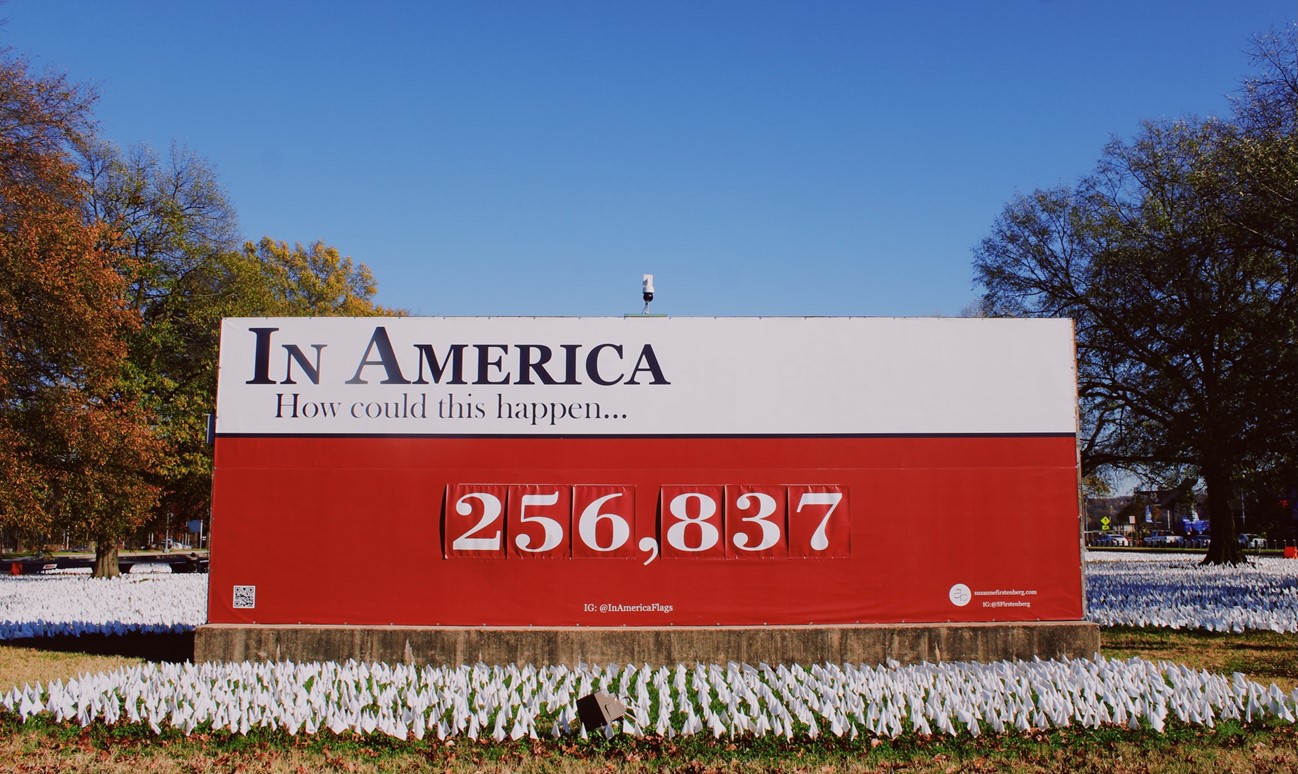
On November 23, 2020, I attended the In America installation by artist Suzanne Firstenberg. At a park in front of the RFK Memorial Stadium and the DC National Guard Armory, Suzanne and a team of volunteers had planted one white flag for each victim of the COVID-19 pandemic in the United States. At the installation’s entrance stood a large sign with the title of the piece and large numbers counting the number of victims and, thus, how many flags. At the time of my visit, the number was 256,837.
One of my first observations was the installation’s specific location. It stood at the end of East Capitol Street and, while it couldn’t be seen over the hills, the sign counting the rising death toll directly faced the US Capitol. Additionally, the installation is located in front of RFK Stadium, a memorial site of its own. The DC National Guard Armory was a few feet away. As Suzanne explained to me, it served as a base from which the National Guard mobilized during the Black Lives Matter protests over the summer.
The flags and their positioning invoked the image of the white gravestones of Arlington National Cemetery. The white also gave people the opportunity to write short epitaphs, either in person or by sending a request to Suzanne. Most are names, some stylized after formal gravestones with dates, while others include brief obituaries with phrases such as we will miss you and thank you. Other messages strive to communicate more collective sentiments: rest in peace everyone. Most but certainly not all are written in English.
A pair of signs bookmark the two ends of the installation. One is an advertisement for the National Guard, the other an insurance ad. In a way, these two signs create a moment of ironic condemnation. These are two institutions toward which many Americans look for safety and yet suspended between them is a representation of a quarter-million deceased citizens.
An insurance advertisement.A DC National Guard advertisement.
We approached grief counselors in the greater Washington, D.C. area, to find out how their clients were managing during the pandemic.
Bunny, a counselor who works at a hospice in Maryland, has been impressed by the creativity and resourcefulness of her clients, clients like Patty. After her mother died of COVID, Patty wanted to give her the same kind of funeral she’d given to her father many years earlier. But there was no gathering, and most hurtful, no flowers. Her mother loved flowers. Before the burial, Patty went to her mother’s house and picked the few azaleas that remained in the yard.
“I cut sprigs and then tucked them in the grave by the coffin. I think these were more meaningful than store-bought flowers because they were her flowers. Her azaleas.”
Patty reflected, “I don’t know who said it, but when everything is stripped away, what is left is all we really need.”