
By Sarah E. Wagner and Martha Greenwald
Tag: politics
-
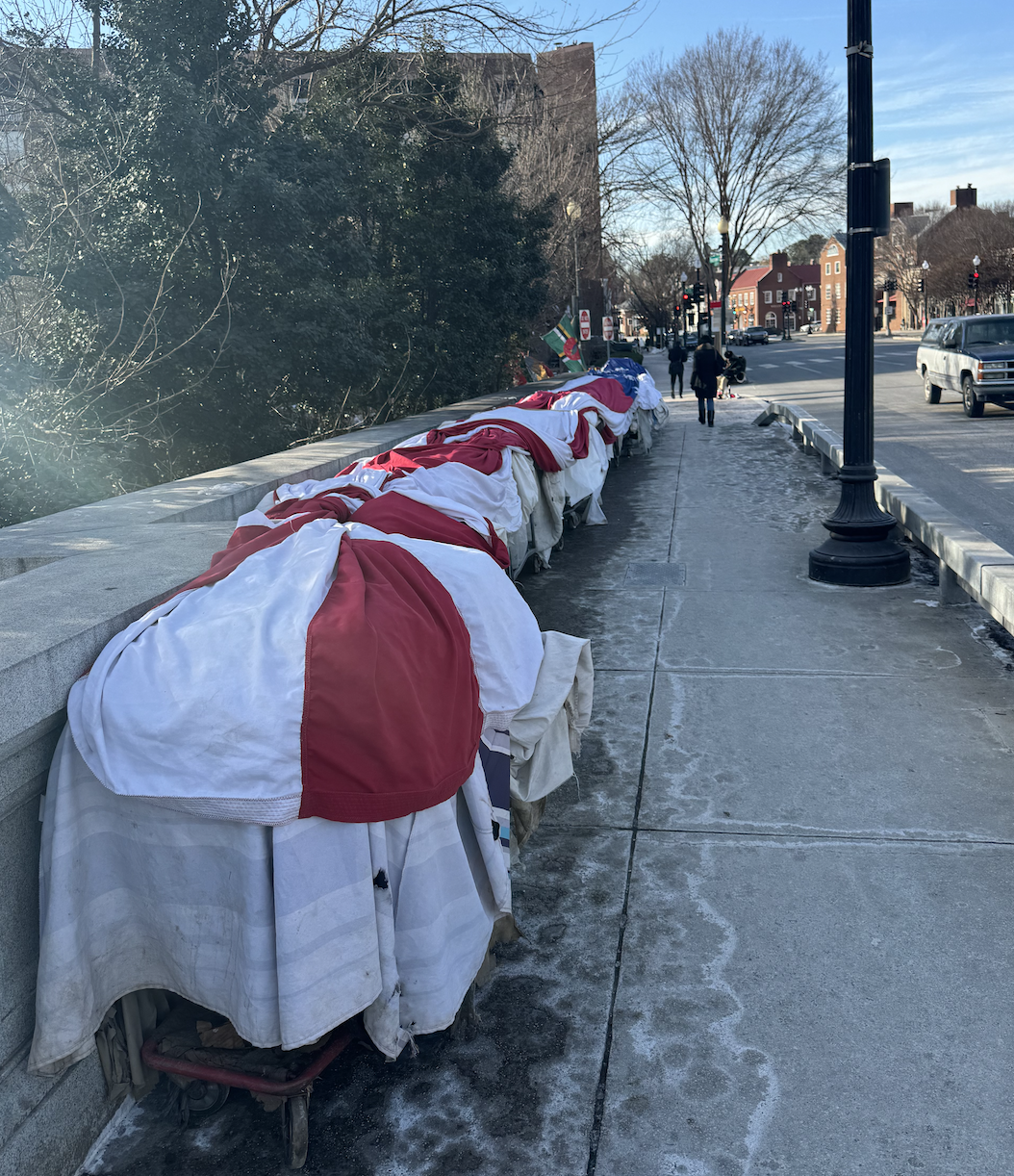
The Privilege of Hesitancy
By: Hanaan Khabir
***
On May 16, 2025, Hanaan Khabir (they/he) interviewed Eddy (she/her) on her experiences working with unhoused populations during the official years of the pandemic (March 2020-May 2023). She currently works as the director of a university-based organization that supports survivors of sexual violence, intimate-partner violence, and stalking. Before becoming director, she worked as a case manager on a sexual assault response team, providing the advocacy response for survivors of sexual assault, an agency that also included advocating in hospitals where SANE (sexual assault nurse examiner) exams were conducted.

Photo taken by: Hanaan Khabir
This interview functions as the first interview within the Unhoused Narratives Project, a project that exists within the Rituals in the Making Healthcare Heroes Initiative subteam. The Unhoused Narratives Project aids in answering questions brought on by the Healthcare Heroes Initiative: What other narratives have been forgotten and neglected? Who else has been severely underrepresented in COVID discourse? What can a collection of narratives be used to do? This project exists with the overarching goal to collect the narratives of unhoused populations through third parties and those who were formerly unhoused, in order to influence public health policy.
Eddy imparted important information and perspective in the interview. She mentioned that members of the unhoused populations, those experiencing homelessness, understand how exposed they are as compared to others. In the general populace, where we saw vaccine hesitancy and outright refusal, the same behavior was not observed within her client population. “I think most of the vaccine hesitancy came from very privileged people. Folks who were unhoused were actually eager for this service to keep themselves safe because they are more exposed to the public than anyone else.”
Eddy’s observations about vaccine hesitancy draw a stark contrast between public narratives and the lived experiences of marginalized populations. The eagerness observed in those experiencing homelessness comes not only from the desire for safety and survival but also from a foundational (and sometimes subconscious) understanding of the structural neglect experienced by members of these populations. Routinely, members of the unhoused populations, and the people who serve them, are ignored in the face of giving necessary funds and resources to “better” causes—causes that tend to have more broader political support, like fitness initiatives and research that centers conditions/diseases impacting wealthier and/or insured populations. What reason would they have to think the response towards them would be better or different just because of the COVID-19 pandemic?
While she did not have any specific stories or moments where her clients expressed particular doubts or fears, she did mention observing a “performance of resiliency.” At the end of the day, what research on unhoused populations during specific crises fails to acknowledge or really delve into—and what Eddy touches on several times over the course of her interview—is that public crises are just “one problem on top of all of these.” Homelessness is an epidemic in it of itself. For those who are already navigating the personal and structural hardships that come with being forced to persevere through this epidemic, a public-facing crisis is simply another entry on a long list of hardships and issues. This is not to say that these populations did not take COVID-19 seriously. In fact, Eddy touches on observing her clients get tested, vaccinated, and wear PPE without the fanfare and controversy observed within the general populace. As mentioned earlier, these populations did not have the privilege of saying no to certain public health interventions; however, when you are in crisis, the world being in crisis doesn’t necessarily add to your load.
What does COVID-19 reveal about systemic weaknesses in how we support unhoused populations in public health crises? This is the question driving this project. For Eddy, the answer lies in a broader political failure: Why did we not come out of this pandemic with single-payer universal healthcare? Her answer touches on a contentious point within U.S. politics—a point also made in the 2020 Democratic primary debates. Eddy says, as seen in the public health response at the state, local, and federal levels, that we have the space, the resources, and the infrastructure to support not only housing members of these populations but also providing them with a “vast array of healthcare services.” COVID showcased, better than any public health crisis in the last 60 years, that there are diseases that “one person having…could have implications for other people,” yet it takes those implications reaching the “powerful people in the ruling class” for “wide-scale efforts to reach unhoused people, to meet them where they are, and offer them healthcare services.” Local, state, and federal government responses to unhoused populations, in the form of providing both funds and resources, clearly showcase an ability to provide those same resources outside of a crisis, despite that same effort and energy not being kept in the so-called post-pandemic world.
Eddy ends her interview, touching on the importance of this project. “We live in a society where…people who are impacted by something and their advocates could shout at the top of their lungs about something for decades, but until somebody does a study on it and produces statistical data and publishes a peer-reviewed report, people don’t seem to care.”
-
What We Were Reading and Writing: COVID Coverage in the Run-up to the 2024 Presidential Election
In the months, weeks, and days running up to the presidential election, the Rituals in the Making team paid close attention to how various candidates, Democratic nominee Kamala Harris and former President Donald Trump especially, addressed (or sidestepped) the pandemic. We tracked stump speeches, debate lines, radio and television interviews, and social media posts, and, above all, media reports. We also published a piece of our own.

Robert F. Kennedy Jr. spoke at a rally outside Atlanta last week for former President Donald J. Trump. Credit: Kenny Holston/The New York Times But anger and anxiety about Covid-19 are woven into all those issues, simmering underneath as a proxy for the larger debate over trust in government that has shaped the 2024 race. – Sheryl Gay Stolberg
Here’s just a sampling of articles that caught our attention that last month of the campaign:
“Trump secretly sent COVID tests to Putin during 2020 shortage, new book says,” Washington Post, Oct. 8, 2024.
“Why did JD Vance accuse Kamala Harris of engaging in censorship ‘at an industrial scale’?” Austin American-Statesman, Oct. 4, 2024
“I’m Running Out of Ways to Explain How Bad This Is,” The Atlantic, Oct. 10, 2024
“Marjorie Taylor Greene says Covid vaccines may be responsible for ‘all-time high’ cancer rates,” Yahoo News (The Independent), Oct. 18, 2024.
“Jon Stewart Tries to Make Sense of the ‘Fever Dream’ Part of the Election: ‘Did We All Die During COVID?‘” The Wrap, Oct. 22, 2024.
“6 Takeaways From Donald Trump’s 3-Hour Podcast With Joe Rogan,” New York Times, Oct. 25, 2024.
Arguably the piece that most struck a chord with our own research was Sheryl Gay Stolberg’s October 29 article in the New York Times, “Despite Covid ‘Amnesia,’ the Pandemic Simmers Beneath the 2024 Race.” “Anger and anxiety about COVID,” she explained, “are woven into all those issues, simmering underneath as a proxy for the larger debate over trust in government that has shaped the 2024 race.”
We also weighed in on the debate on COVID denialism. Four days before the election, on November 1, Martha Greenwald and Sarah Wagner published an opinion editorial in the Lexington Herald Leader: “The worst ‘weave’ from Trump is lies about a pandemic that killed so many Americans.”
Among other points, we homed in on a particularly disturbing example of the commodification of COVID denialism:
Trump and his acolytes have built a conspiracy-fueled set of dangerous pandemic counter-truths since the former president left the White House in 2021. Even while denying its facts, his circle has never stopped commodifying COVID. . . . The Contagion Kits were even the obvious star during the RSBN coverage of the Madison Square Garden rally just a few days ago. Available for over $300 per person, they are a bucket of medical disinformation, containing Ivermectin and Hydroxychloroquine, generic antibiotics, Tamiflu, and a nebulizer with a recipe for a DIY “protocol” that was warned about by many authorities when it was first pushed online in 2020. The reason you need the Contagion Kits? To “get the life-saving medications that were withheld” previously during COVID. The language on the Wellness Company website hawking the merch, all derived from the Make America Healthy Again lexicon, is deployed to instill fear and monetize their followers’ distrust in standardized medicine.
X post by Craig Mauger. Despite the election results, we hold fast to our closing argument that “these stories [of COVID loss] have to be told, both before and after the election, as their experiential truths are an antidote to the denial of scientific evidence.”
