Rituals in the Making: a George Washington University research project on memorialization, misinformation, and the consequences of the COVID-19 pandemic

Tag: pandemic

  • Glossed Over: On Attending the Symposium at the Library of Congress

    Glossed Over: On Attending the Symposium at the Library of Congress

    By Ed Koenig

    Edited by Martha Greenwald

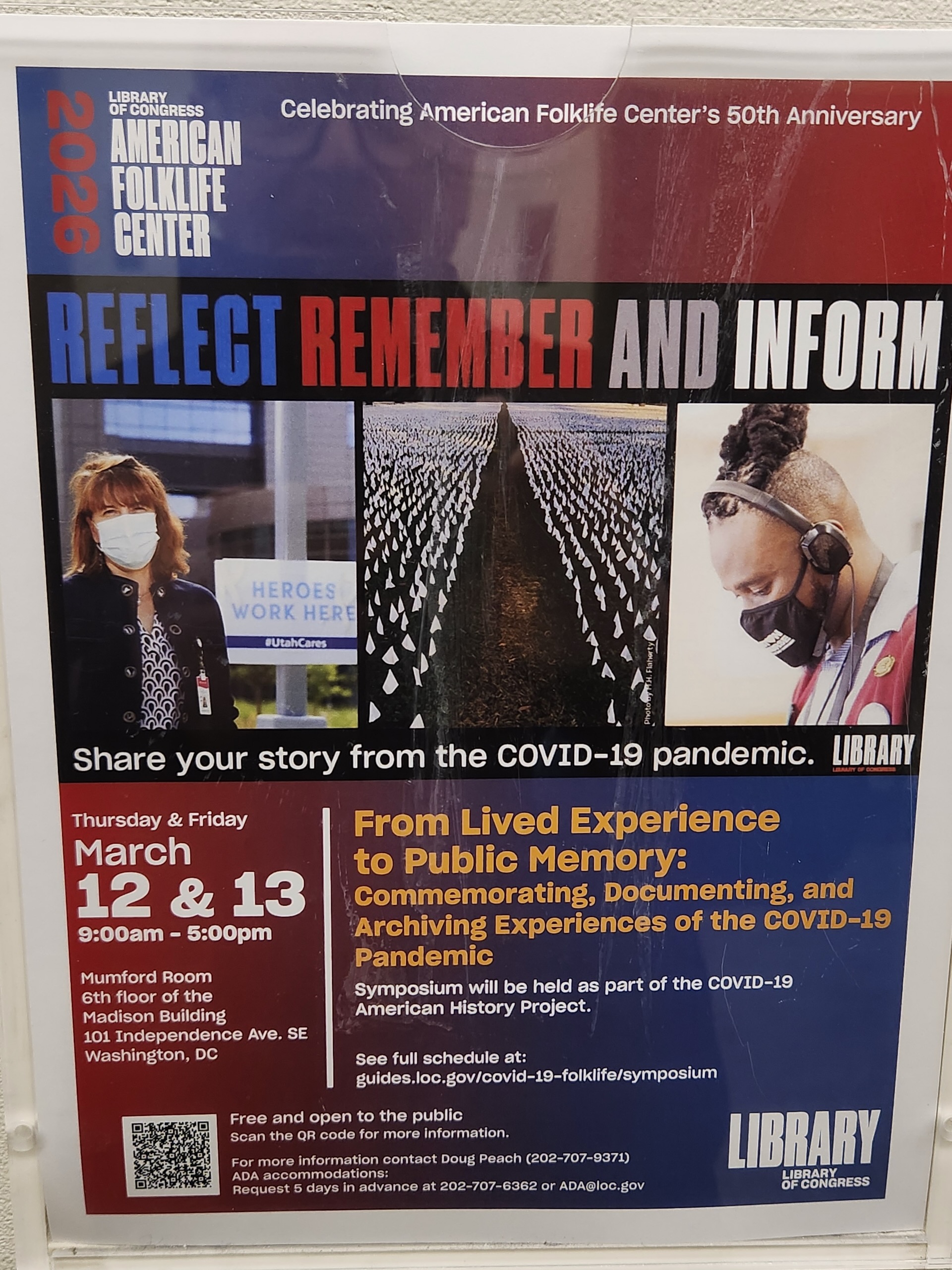
    On March 12 and 13, 2026, the American Folklife Center, a part of the Library of Congress, in Washington, DC, presented a symposium entitled “From Lived Experience to Public Memory: Commemorating, Documenting, and Archiving Experiences of the COVID-19 Pandemic.” The event coincided with the sixth anniversary of the declaration by the World Health Organization that COVID-19 had become a global pandemic.

    As one of the over 1.2 million Americans who has lost one or more loved ones to COVID-19 (my partner of 33 years, Jody Settle, died in April 2020,) I was curious to see how the lived experiences of those who were most severely impacted would be represented. Unfortunately, our experiences were either ignored or glossed over during the various presentations.

    The symposium instead looked at various aspects of how we coped and lived our lives during the temporary lockdowns that arose around the world to combat the spread of the SARS-CoV-2 virus and how some of those changes have impacted and continue to influence our daily lives.

    Sour, Dough

    One of the obvious areas that concerned everyone was food, its production, and the related delivery systems. As was sometimes true prior to the lockdowns, comfort food became a source of solace for many who were fearful or, worse, mourning the loss of loved ones to this new virus. I was a bit disillusioned with a reference to a meme that discussed common weight gains during that period as “the COVID nineteen” (much as first year college students are often said to experience a weight gain called the “freshman fifteen.”) Unfortunately, the laughter from the audience that ensued ignored the sentiments of those who were most severely impacted.

    One of the activities that seemed to become rampant during the lockdown period was the baking of sourdough bread. Myriads of families ordered bread making machines so they also could join in this activity. Perhaps, it was their way of feeling connected to others. Someone sent me one in the days after my partner died in April 2020. Looking at the box, I wondered what I was supposed to do with a bread making machine. I couldn’t bake a new partner! Sadly, the box sits unopened in the closet six years later.

    More interesting, there seems to have been an increased rediscovery of old family recipes for favorite meals that had been stored away unused due to the lack of time in our busy society. Now, staying and/or working at home, there was more time to reconsider these foods and the comforts and memories they provided. This, of course, required ingredients that many did not regularly have at hand.

    The food procurement system has been impacted or altered by the pandemic. There was a huge increase in the ordering of groceries on-line which stores then needed to deliver directly to the home. Restaurants, restricted from indoor dining, began relying on services like DoorDash and Grub Hub that came into prominence during this period. People began ordering take-out food from local restaurants if only to support them and help them to survive until the lockdowns were over. The message seemed to be that people wanted to continue enjoying their favorite foods without risk to themselves. Sadly, the risk to those who had to work to survive was only discussed in a passing remark that “comfort for one became discomfort for another.”

    Several other observations were made about the impact on food delivery systems. There has been a notable increase in the number of farmers markets around the country. Researchers presume that people felt that shopping at these open-air concessions was safer with less chance of exposure to the virus.

    A final thought is that there now seems to be an increased understanding of how the corporate industrial food system works. People have finally acknowledged that our food doesn’t miraculously appear on the shelves in our grocery stores. It requires a great number of human resources to grow, produce and ship products and then to stock the shelves – all of which put people at risk during the pandemic. The question left unsaid is whether people continue to care about those who are part of this important supply chain component.

    I would be remiss if I didn’t mention how friends and neighbors stepped up to prepare meals that they shared with me when Jody died. They would call and come over and we would meet outside. Maintaining the recommended social distance, they would place the food nearby and step back. I would then go over and pick it up. After a brief shouted “thank you,’ we would return to our homes. The comfort offered by a homecooked meal and a few minutes of face-to-face contact was not something discussed during this portion of the symposium.  

    Synchrony/Cacophony

    Music and the impact on musicians were the themes of several presentations. Because musicians were unable to perform together in-person, many of them tried to employ new on-line technologies, like Zoom, to continue their collaborations and performances. Because of the nature of internet technology at that time (since improved somewhat,) lags in transmission speeds often made the synchronization of the various musicians difficult, if not, impossible, often leading to cacophony. Musicians experimented, learned and implemented new techniques to overcome these difficulties such as writing compositions and arrangements where one performer’s last notes could be sustained and then the next performer would begin on the same note. Also, visual clues were used for one musician to cue another. These aided the musicians to continue their creative work until they could again work together in-person. An example of these new techniques was shown (performed via Zoom) by the Kronos Quartet performing the musical piece, Marejada (which translates as “surge”) composed during the lockdown.

    Other speakers spoke of the means musicians in small or isolated communities used to continue performing for themselves and others. One presenter discussed a group of blue grass musicians in southern Indiana. As they told her, if they were to live the lives they were used to living, they would have to adapt. And, they did. Single performers would play from their front porches while friends and neighbors would sit in their cars listening to the performance. Later, as restrictions eased, some of the groups would gather to perform outdoor concerts. She even showed videos of them precisely measuring out six-foot social distance circles around each performer. They did the same with the folks that came to listen and enjoy. All this helped them to live during the lockdown.

    Improvisation was the key to survival for many musicians. A project based in some impoverished neighborhoods of Washington, DC, put into service a rickety old van nicknamed the “COVID Van.” The organizer, from American University, and his wife would meet musicians, usually in their late teens or early twenties, who would perform while they, safely inside the van, recorded videos that, once edited, were shared on platforms like YouTube. This allowed these young musicians to continue creating and sharing new music with their fans even when they couldn’t appear in a public setting. Again, new ways of thinking worked and continue to be used now.

    Several researchers who worked in Spanish-speaking Latin American communities discussed the role of music in providing information and solace to people from Mexico to Argentina. One of the interesting things they discovered was that musicians were less concerned about making music during the pandemic, but rather they focused on creating music about the pandemic. As they termed it, the music was about the humanity of surviving.

    Much of this music focused on instructing people on how to stay safe — like washing your hands frequently, wearing a face covering, and maintaining social distance – “be a good citizen and we’ll get through this.” The one quirky thing they recognized in each country was that the music was usually upbeat and the videos created for these songs were almost always full of dancing and hope and smiles. They served as cheerleaders in a time of sorrow.

    The use of folk art provided some further insights. Some art work served to educate people on how to protect themselves and, in doing so, provided continued economic survival for the creators. Of course, some art work served to memorialize people who died from COVID-19.

    A Renaissance of Stitches

    In the early stages of the pandemic when there was a lack of personal protective equipment, ethical questions arose about the creation and sale for profit of face masks while people were dying. This included examples where protective face masks were decorated with distinctive patterns and designs and intended to be sold as art work rather than to be used as protection against the virus.

    Of interest to me was how seamstresses around the world gathered whatever materials they had at hand and produced many millions of masks for their friends and neighbors and others. Their work was so prolific that there was a run on the elastic materials used to keep the masks properly placed on the face. An interesting anecdote was how seamstresses in Cambodia produced and shipped face masks to underprivileged people in the United Kingdom and Australia.

    During the lockdown periods, there was a notable renaissance in the art of quilt making around the world. Many picked up an avocation that they had set aside a long time ago. Many others first came to quilting at that time.

    Over time, often influenced by social media posts that referenced the AIDS Memorial Quilt that was begun to memorialize those who had died during the HIV/AIDS epidemic in the 1980s and 1990s, many tried to reproduce the feelings those quilts invoked in them and moved to sew similar quilts for those lost to COVID-19. Examination of many of the quilts produced reflect the social anxiety the creators were feeling whether from being isolated, having to maintain social distance when interacting with others, and, even the simple task of trying to find toilet paper. One other interesting aspect of this work was the number of quilting bees that arose on the internet via apps like Zoom. The people could sew while talking to others doing the same thing. It provided them a chance to share their feelings and their work. It allowed them to practice a tactile art without the need to touch.

    Say Their Names

    Another use of art serving to memorialize appears in the work of the Naming the Lost Memorial project in New York City. Taking inspiration from the reaction to the murder of George Floyd in Minneapolis in May 2020 and the constant call to “say his name,” this small group formed and reached out to those communities that weren’t able to properly mourn their dead following their own customs and traditions.

    After receiving a grant, the group expanded and joined with local artists and musicians from various immigrant communities in New York City to develop memorial artwork and events that gave honor to their cultural ways of mourning. They scheduled two events per year: one at Brooklyn’s Green-wood Cemetery in the spring and the other celebrating the Day of the Dead (el Día de los Muertos) at the Church of St. Marks-in-the-Bowery in Manhattan. I attended both memorials in 2025 where I recall and experienced how the rituals of mourning in various places such as Mexico, Guyana, and West Africa, among others, were performed to honor the members of those communities who had passed on. While loved ones were lost, we continue to remember and learn from each other.

    The Naming the Lost Memorial project concluded with the most recent Day of the Dead event in November 2025. But the project will never really end as long as we continue to say their names.

    There were other various presentations. Some of them I found interesting. One dealt with the impact of COVID-19 on the Navajo Nation. It was noted that in May 2020, the indigenous peoples of the United States had the highest COVID-19 infection rates. On a brighter note, by February 2021, these same groups had the highest COVID-19 vaccine uptake rates. The primacy of elders in the indigenous populations as repositories of their language, oral and written history, and native learning methods promoted the care of these elders to primary importance in their communities as they struggled against COVID-19. An elderly Navajo woman noted speaking about COVID-19: “I look upon it as a monster that is feeding on us.” The lack of resources for these indigenous communities from the U.S. government (the case before the appearance of COVID-19) accelerated the situation. Sadly, a number of members of the Navajo community were lost.

    Others presentations I found disturbing. These made me wonder why anyone would want to characterize this period of history in this way. One of these compared some of the reactions to COVID-19 pandemic to those of the 1918 Influenza Pandemic dubbed the Spanish Flu even though credible scientific evidence shows it most likely originated at a U.S. Army base in Kansas City.

    In 2020, early on in the pandemic, the use of the internet and social media platforms led to “ideas” and disinformation such as the belief that 5G cell phone technology or the financier George Soros was the source of the pandemic. The somewhat racist depiction, Kung Flu, was an ad lib from Donald Trump in a speech he delivered during the beginning of the pandemic. Other strange ideas also arose at this time like “vegetarians are safe – only meat eaters get COVID” and “gargling with salt water would dislodge the virus from your throat.” Many of the numerous memes that were shared via social media showed a disconnect between the perceived image and actuality. The hurtfulness of many of these memes to those who lost loved ones to or continue to suffer from the impact of COVID-19 was not mentioned or just ignored. There was no discussion of counteracting the misinformation arising from these memes and other postings.

    For me, the most disturbing presentations made during the symposium revolved around the topic of play. One positive presentation in this area of play was an exception. Presented by two young scholar researchers from the United Kingdom who work with young people living with Tourette’s Syndrome. Their organization, Tourette’s Hero, developed several creative projects to help keep these individuals engaged. One they spoke of was named “Digital Heros of Imagination.” Using whatever materials were close at hand, the people worked to create their own superheroes and then to develop backstories surrounding their creations which they told through posters that shared with one another. When the severe lockdowns were lifted, they began a second program called “Journey to a Better World.” Here, they strove to instill and maintain a sense of joy and connection in their clients.

    Other presenters discussed games for children like “Coronavirus Tag” in which a designated player who, in theory, carried the coronavirus would run around and tag another player who would become “infected” and would fall down as if dead. This continued until all the players had been “infected.” The game would restart with a different player designated as the one having coronavirus. Parents seemed to find that this game, and others like it, were inventive and catered to the physical and psychological vulnerabilities of the children while including them as historical witnesses to life during the pandemic. As a person who lost someone to COVID-19, I found the idea of this game offensive, particularly because it was presented as a celebration of creativity. If only my loved one could just get up and live again. In Finland, “Korona” was a board game, much like Monopoly, where players moved along the board trying to infect the world with a virus. Players often exhibited joy in watching the virus spread. I tried to ask the presenters if they had considered the impact of these games on children who had lost a parent, sibling, or caretaker to COVID-19. They were adept at ignoring my question.

    All this leads to one overarching conclusion about these presentations. All of them, in their own way, were too focused on those who had the most privilege, e.g., those who had the ability to flee large urban areas for vacation homes in rural areas. There was very little note given to the financially challenged people who lived crammed together in urban centers and continued, at much personal risk, to venture out to “essential” jobs to serve the needs of those who were able isolate. In the end, I was disappointed. I think many of the presentations failed to consider the people who were most severely impacted by COVID-19, i.e., those who died and those who loved them.

  • Why Caring for the Dead and Aid for the Living Matter: The Ebola Outbreak in the DRC

    July 28, 2026

    “There are a lot of customs, but traditionally, funerals are multi-day affairs. . . . which sometimes could take one, two or three days, where people are living close to the dead body.”

    “These burial rituals must change. Local authorities … have limited the size of funerals.”

    – NPR, “Why are people attacking Ebola clinics? It revolves around trust, death and body bags,” May 29, 2026

    Over the past two months, headlines from the Democratic Republic of Congo (DRC) have raised alarms about another Ebola outbreak: specifically the Bundibugyo strain, for which there is no approved treatment or vaccine. According to Médecins Sans Frontières, it is the seventeenth Ebola outbreak recorded in DRC since the virus was first identified in 1976. To date, more than 700 Congolese have died from the virus and the outbreak has spread into neighboring Uganda. In mid-May, the World Health Organization declared it a “public health emergency of international concern,” noting that “the ongoing insecurity, humanitarian crisis, high population mobility, the urban or semi-urban nature of the current hotspot and the large network of informal healthcare facilities further compound the risk of spread.”

    Though different from COVID-19 with its global scale, the Ebola outbreak, its deadly impact, the uncertainty surrounding its transmission, and the pressing social concerns regarding proper care of the dead overlap in important ways with critical themes of our research on COVID death, mourning, and memorialization. The news from the DRC also illustrates the costs of the current administration’s withdrawal of aid and its continued undermining of medical and public health expertise. Even as COVID fades into the backdrop of American public discourse, its traces persist—especially in how we, as a society, understand and relate to more recent public health crises.

    For example, RIM teams members immediately recognized in the words of Congolese doctors, politicians, mourners, and aid workers how quickly fear centers on the dead—that is, the body as a vector of infection and the ritual acts of funerals and burials as superspreader events. Our project originally developed from basic questions of how rituals and thus social worlds were transformed by the pandemic’s prohibitions—and the fear, anger, sorrow, and misinformation that followed. We heard similar themes explored in the media coverage that followed reports of mourners storming local clinics.

    EMANUEL: The goal is to explain what makes a safe burial. Micaela Serafini of Doctors Without Borders says aid groups have also learned from past outbreaks. One major problem her team identified?

    MICAELA SERAFINI: We were putting the body inside a black bag, and we were zipping it. There was no image, so the family couldn’t even recognize the body.

    EMANUEL: This was counterproductive. So, she says, they changed the design. The new bags…

    SERAFINI: Have a transparent area in which the face of that loved one can be seen.”

    – Gabriel Emanuel, “Doctors in DRC work to dissuade traditional funeral practices amid Ebola outbreak,” May 26, 2026

    In addition to its emphasis on what constitutes a “safe burial,” the exchange demonstrates how closely trust in authorities is tied to the acts of recognition and witnessing, a dynamic that our colleague from Brazil, Andréia Vicente da Silva, has analyzed in her work on how COVID disrupted Pentecostal funerary rituals and our own project manager, Maria Jose Pelaez, has explored in a dispatch about Elsa Maldonado in Ecuador.

    (1) What fills the information gaps: “A second battle is also underway to fight misinformation”

    Following the attack on a hospital clinic during which families attempted to retrieve the bodies of their loved ones, Congolese local authorities and journalists reflected in the failure of communication on the part of public health officials. As Luc Mambele explained, “This lack of communication, this absence of communication from the health authorities in the province is what allowed rumors to take over and is what continues to this day.”

    “Angry residents burn down tents treating Ebola patients in DRC as health protocols clash with burial traditions,” CNN.com, May 22, 2026.

    (2) What occurs in the absence of aid

    On US withdrawal from WHO, wholesale gutting of USAID, and cuts to the CDC, medical anthropologist at American University, Lauren Carruth explains:

    “While officials from the WHO have downplayed the role of cuts to international organizations in hampering the response, local reports argue that the absence of USAID and U.S. funding has been highly consequential. According to this and other media reports, American officials did not learn of the confirmed outbreak until nine days after the WHO did, and almost a month after the first person died. The delay was compounded by samples being transported to the Kinshasa lab at the wrong temperature—a logistics task previously managed by USAID. USAID previously provided health worker training, contact tracing, testing, safe burial resources, and assistance with supply chains. In a recent New York Times article, Dr. Salim Abdool Karim from the Africa CDC asked, ‘Who else can bring 20 trucks in a matter of three days, have drivers, have fuel?’”

    (3) Finally, on the importance of historical and anthropological knowledge

    “We know that this is about so much more than that. It’s about history and culture and politics and even just about how people love and care for others in their family who are sick.” –Megan Schmidt-Sane, Research Fellow at the Institute of Development Studies

    In her July 20, 2026 New York Times Magazine report, “Why Epidemics Breed Rage at Health Workers,” Sheri Fink documents the role of scholars, namely historians and anthropologists, in informing policy responses to public health crises such as COVID-19 and this most recent Ebola outbreak. Among other parallels she examines, Fink notes the commonality of how uncertainty—even in the face of more exacting science—“breeds” distrust. She reminds us of COVID times:

    But unrest during epidemics is not about Ebola, Africa or education. It is something societies have struggled with for centuries, and it is evident in rich countries as well as poor ones, in modern times and medieval ones. During the Covid pandemic, Western doctors, nurses and health officials received not only applause and gratitude but also death threats. Patients denied that Covid existed as they died of the disease. Protesters carrying guns occupied sidewalks outside hospitals. Multitudes embraced treatments, such as ivermectin, that study after study showed to be ineffective. Vaccinators in Italy were assaulted. A German gas station attendant and a Michigan Family Dollar security guard were killed after asking customers to wear masks.

    Mistrust does arise out of thin air. It has historical context. Fink explains, for example:

    “Ebola looms less large as a threat to people whose lives are at risk every day from hunger, destitution and common infectious diseases. Ebola is just the latest shock after decades of conflict and suffering, state neglect, colonial and post-colonial violence, and the failure of international peacekeepers to stop civilian massacres.”

    And, echoing theme #2 above (absent aid), Fink concludes her essay with a nod to current conditions:

    “The country’s population also faced a precipitous drop in foreign assistance last year, when the Trump administration dismantled the U.S. Agency for International Development, an effort championed by the world’s richest man, Elon Musk.”

  • March 2026 – Steeped in the Yellows of Early Spring: Rami’s Heart COVID-19 Memorial Sixth Annual Lighting Ceremony 

    March 2026 – Steeped in the Yellows of Early Spring: Rami’s Heart COVID-19 Memorial Sixth Annual Lighting Ceremony 

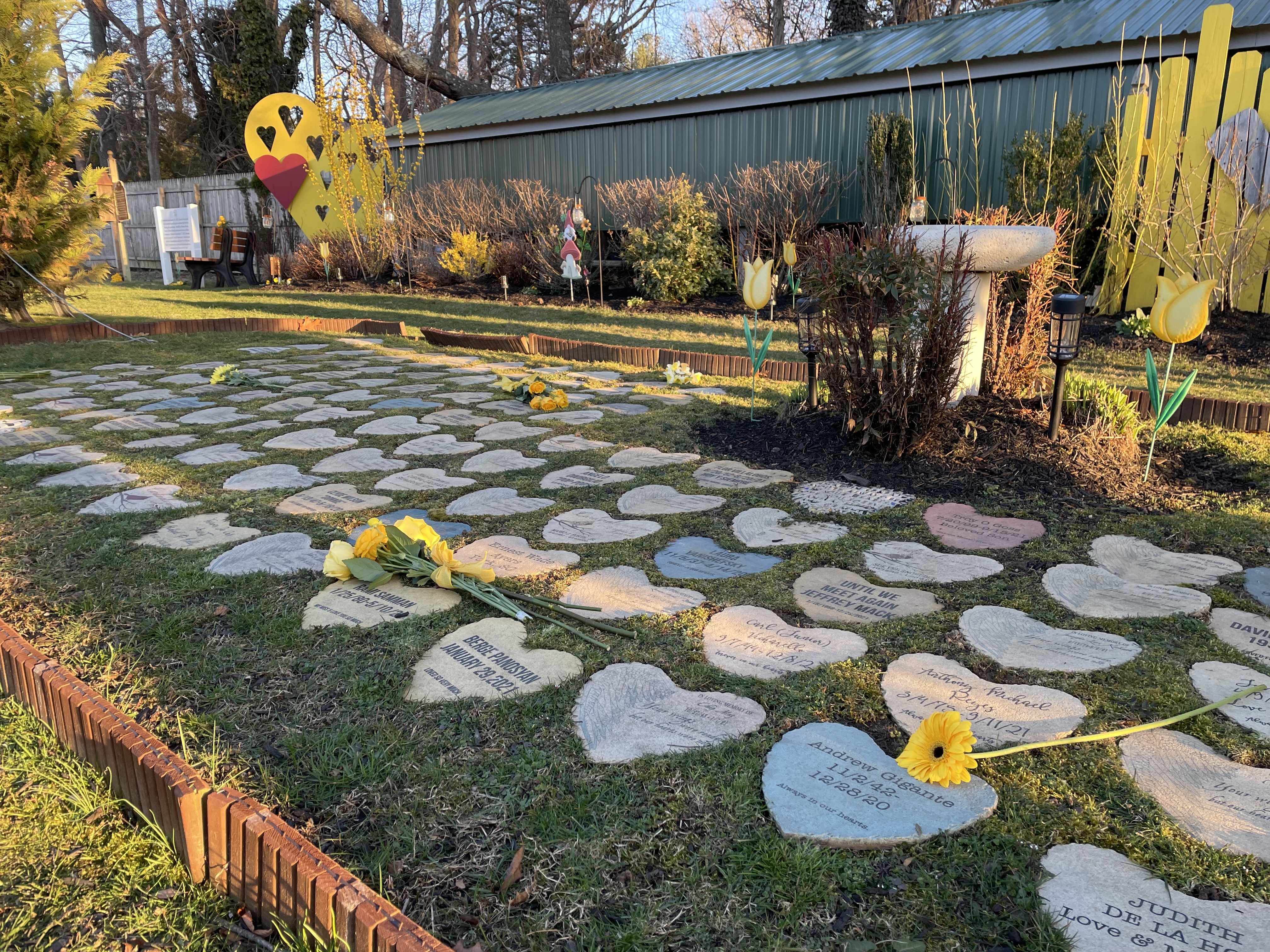
    A memorial garden featuring heart-shaped stones with names and dates, surrounded by greenery and decorative ornaments, including flowers and birdbath.

    By Sarah Wagner

    ***

    “We are talking about how we carry so many people with us wherever we go, how even simple living, these unearned moments, are a tribute to the dead.”

    – Ada Limón, “Forsythia”

    March 28, 2026: In the earnest, warm light of an early spring evening, Rami’s Heart COVID-19 Memorial once again gathered its own to remember their loved ones. Shades of yellow—hearts, shells, stones, candles, ribbons, and flowers—brought the space to life despite (or maybe because of) the setting sun. This year Paige Gavin and I had the honor of joining Rima Samman-Whitaker and the Rami’s Heart community for the occasion, and I write this dispatch with the evening’s sights and sounds still fresh in my mind. The essay combines photos from before and after the ceremony with captions drawn from the different speeches, as well as poetry that I stumbled on in the days since. I’ll start with a collage of photos and two poems that seem especially fitting. 

    ***


    Forsythia et al. 

    For this sixth annual lighting ceremony, Rima urged attendees to bring flowers. And so, gradually, as people arrived, so too did their floral tributes: a vase nested in the dark mulch, its bouquet brimming with shades of bright and pale yellow, pink, and green; clusters of canary-yellow roses tied to a memorial bench; a single stem of gerbera daisy resting atop a heart-shaped stone; florets of golden-yellow ranunculus (Persian Buttercups), tucked between names. 

    And forsythia, at the entrance and exit, just then in brilliant yellow bloom. 

    To my delight, I found that two of my favorite poets have written about forsythia: 

    Billy Collins, “Forsythia” 

    It caught my eye a while ago, lit up 
    against the gloom of the woods 
    in the corner of a wild field, 
    the pulsing color of caution. 

    And now that I have spent a little time 
    on this stone wall watching its fire 
    flare out of the earth 
    I begin to think about the long chronicle of forsythia, 

    how these same flowers have blazed 
    through the centuries, 
    roused from the ground by the churning of spring. 
    I would rather not look around the next 

    corner of the year to see how this will die, 
    its lights going out,  
    its bare, arcing branches 
    waving like whips in the bitter wind. 

    So I sit facing the past, 
    letting my feet dangle over the wall, 
    beating time against stone with my heels 
    as the long gray clouds roll over me. 

    Remember how Arnold by the Channel 
    thought of Sophocles who must have heard 
    the same shore-sounds long ago, 
    walking by the edge of the Aegean? 

    Well, I am holding in the palm of my thoughts 
    all the others who once were stopped, 
    like me, by this brightness, 
    this sulfuric cry for help: 

    women in tunics, women gathered by a well, 
    men in feathers, men swimming by a river, 
    all speaking languages I will never know, 
    saying the different words for its color 

    as I feel the syllables of yellow form in my mouth 
    and hear the sound of yellow fill the morning air. 

    Source: Poetry (April 1995)

    Ada Limón, FORSYTHIA 

    At the cabin in Snug Hollow near McSwain Branch creek, just spring, all the animals are out, and my beloved and I are lying in bed in a soft silence. We are talking about how we carry so many people with us wherever we go, how even simple living, these unearned moments, are a tribute to the dead. We are both expecting to hear an owl as the night deepens. All afternoon, from the porch, we watched an Eastern towhee furiously build her nest in the untamed forsythia with its yellow spilling out into the horizon. I told him that the way I remember the name forsythia is that when my stepmother, Cynthia, was dying, that last week, she said lucidly, but mysteriously, More yellow. And I thought yes, more yellow and nodded because I agreed. Of course, more yellow. And so now in my head, when I see that yellow tangle, I say, For Cynthia, for Cynthia, forsythia, forsythia, more yellow. It is night now. And the owl never comes, only more of night and what repeats in the night.


    *** 

    Scenes from the ceremony: Photo essay

    (The captions and quotations that accompany the images are from the ceremony’s speakers: Teresa Dimezza; Dr. Raynard E. Washington; Joann Burney; Sean Burney; and Rima Samman-Whitaker.)

    “[COVID] brought a lot of loss and disruption and uncertainty and quarantines and homeschooling and all kinds of home projects and just complete chaos in our lives. And while time has moved forward, the impact of that time certainly hasn’t. In New Jersey alone, we lost more than 35,000 residents to this virus, and while that’s a number, each one of those numbers counts to life, a story, a family that’s forever been changed. . . . So tonight is about honoring those individuals, about saying their names in our hearts, holding space for their stories, and recognizing that though they’re not here with us, the love that we share for them still is here.”

    – Dr. Raynard E. Washington, Commissioner of the New Jersey Department of Health

    A memorial display featuring black stones inscribed with names, arranged on wooden shelves. Below, yellow flowers and candles are arranged on the ground, creating a somber atmosphere.
    “Every candle we light represents a name, a life, a story and a love that continues to shape us.” – Teresa Dimezza 

    A crowd of people sitting on folding chairs and standing on grass during sunset, with trees in the background and buildings visible.
    “We [Allaire Community Farm] are a nonprofit that we are honored to host Rami’s Heart, and Rima and Travis have become an extended family to us, and I just want to thank them for all their hard work. I know you all appreciate them very much. They put their heart and soul into this, and without them, it wouldn’t be as beautiful as it is.”  – Joann Burney, Allaire Community Farm 
    Interior view of a path with visitors in winter clothing, lined with candles and flowers, under string lights, as they engage with a display or memorial.
    “I would like to also thank Don Corson. Don’s 91 now, and it was a little too cold for him to be here tonight, but he’s the one who, immediately after seeing the shadow boxes, saw that memorial in his head and put it together, and we had the materials. It was up in less than a week.” – Sean Burney, Allaire Community Farm 

    To the families I remember with you all this evening, to those that we lost, I honor you all this evening and to all gathered here, may we leave this place, not just with heavy hearts and remembrance of those that have been lost, but with a renewed sense of purpose to continue to act to make health possible for all of our neighbors here in New Jersey.” – Dr. Washington 

    ***

    “We also gather in a moment when there are voices who would rather we forget, who would have us move on without reflection and replace our very real, lived experiences with misinformation. But we can’t, and New Jersey won’t. Public health is based depends on trust and on truth and our willingness to learn from what we’ve endured together as communities. Remembering is not about looking backwards. It’s about honoring lives by doing better as we move forward.” – Dr. Washington 

    Three individuals standing outdoors, smiling for the camera with a clear blue sky and an American flag in the background.

    ***

    “But in the six years, each and every year, something happens, something brings us hope, something shows us that there’s still good things out there, like Sean and Joan who gave us the space, like Governor Mikie Sherrill and Dr. Washington for recognizing our grief, the board members that meet with us every month and help us plan everything out, and we all do it on our own time.” – Rima Samman-Whitaker, Founder of Rami’s Heart COVID-19 Memorial

    “So it’s another year that we go on grieving as the world moves on. The reality is we’ll never move on from our grief, but we’ll ever, will forever carry their love and their light. So tonight, when we light those candles, just know that we carry their light. And although grief may not be a great thing, it is a part of us. It is a part of who we are now, and it is up to us to keep them in our memory and our lives.”

    – Rima Samman-Whitaker, sister of Rami Samman

    A heart-shaped memorial stone with the name Rami Samman, birth and death dates, and the phrase 'We miss & love you so much,' accompanied by a bouquet of yellow roses tied with a ribbon, set on grass.

  • Ordinary Necropolitics: Presenting Loss at the 17th International DDD Conference in Utrecht, Netherlands

    Ordinary Necropolitics: Presenting Loss at the 17th International DDD Conference in Utrecht, Netherlands

    On August 27 – 30, 2025, members of the Rituals in the Marking team traveled to Utrecht, Netherlands, to participate in the 17th International Conference on the Social Context of Death, Dying and Disposal, hosted by the Association for the Study of Death & Society and Utrecht University. We presented our research as part of a double panel, “Ordinary necropolitics: Interrogating the state and its absence in everyday death,” organized by RIM research consultant Ruth Toulson, anthropology professor at the Maryland Institute College of Art, and PI Sarah Wagner.

    The morning of our presentation began with an auspicious sign (a view from Amsterdam).

    The two back-to-back panels were also in celebration of Ruth’s book, published in December 2024, Necropolitics of the Ordinary: Death and Grieving in Contemporary Singapore, which won Honorable Mention for the 2025 Association for Death and Society Book Prize (announced at the conference). Congratulations, Ruth!

    Paige Gavin, María José Pelaez, and Avery Nennmann presenting.


    During the first panel, four scholars from RIM presented:

    Maria Jose Pelaez: “‘Because you have already buried your dead’: Elsa’s dual loss and the politics of waiting in Ecuador’s COVID-19 pandemic.”

    Expanding on a previous dispatch, Maria Jose’s paper examined how bureaucracy during Ecuador’s COVID peak transformed routine administration into suffering. Elsa Maldonado’s experience with contradictory claims about her mother’s remains shows how “the politics of waiting” entangle families and bureaucrats in death verification.

    Paige Gavin: “Revisionism and social forgetting: Mass death from the 1918 influenza to the COVID-19 pandemic.”

    Paige’s talk looked at how the United States memorializes mass death due to disease, examining the historical, political, and social patterns of past disease events in parallel with the COVID-19 pandemic through the lens of revisionism and social forgetting. Among other sources, she drew on ideas that arose in the virtual seminar she hosted in January 2024 with historian Nancy Bristow and epidemiologist Katelyn Jetelina.

    Avery Nennmann: “The necropolitical landscape of COVID misinformation in public health”

    Avery addressed how misinformation and mistrust in medical authority during the COVID-19 pandemic prompted significant changes to public health in the United States and the ways in which denial undermines and harms healthcare systems and those who work within them. Many of the themes she explored came up in interviews she conducted as part of RIM’s “More Than a Healthcare Hero” project.

    Sarah  Wagner: “An American state of denial: The unreckoning of pandemic death, five years on.”

    Sarah’s paper considered how pandemic denialism has taken new shape in the wake of President Trump’s re-election, forcing COVID bereaved to grapple with the absence of state recognition of mass death and its long-term effects.

    ***

    Throwback photo: Here’s Ruth Toulson at the 14th International Conference DDD conference in Bath, England.

    The second panel on “necropolitics of the ordinary” included Ruth Toulson and our very own GW anthropology PhD graduate and professor of anthropology at Washington State University, Sarah Richardson, as well as Sally Raudon (University of Cambridge) and Sasha Kramer (Johns Hopkins University).

    Celebrating the end of a successful DDD17 conference.

    The two panels were a great success, with questions posed to each presenter and a robust discussion of not only COVID-19 but also the larger topic of state governance of the dead.

    ***

    Next up: Team RIM will be attending and participating in the American Anthropological Association’s annual conference, November 19-23, 2025, in New Orleans. Fittingly, the conference theme this year is “Ghosts.” Paige Gavin and Avery Nennmann will host a roundtable, “Narratives of Care: Medical Professionals and Their Lived Experiences during the COVID-19 Pandemic,” and Joel Kuipers and Richard Grinker have organized a panel, “Scale and Loss: frontiers of care and the ghosts of mediation.” Stay tuned for dispatches on both.

  • A Spring of Unravel and Confusion: Drinking from the Firehose of COVID (and Vaccine) Media Coverage, April – June 2025

    A Spring of Unravel and Confusion: Drinking from the Firehose of COVID (and Vaccine) Media Coverage, April – June 2025

    By Sarah Wagner and Martha Greenwald

    “Taking over the past is a point of no return. It’s not that we can’t get back to who we once were. It’s that we won’t even remember it.” – Monica Hesse, “Scroll through Trump’s new covid website — and have your mind blown,” The Washington Post, April 23, 2025)

    On April 18, 2025, an email from the National Science Foundation notified the Principal Investigators of the Rituals in the Making project that our grant had been terminated, effective immediately, because it was “not in alignment with current NSF priorities.” Ours was one of about 50 grants canceled because of its focus on misinformation.

    On that very same day, the White House unveiled its new COVID.gov website.

    ***

    There is no causal relationship between these two events. But they speak to a moment in time and remind us—members of this research team—that our work is to document not only how the pandemic was experienced in the past but also how it is understood today. Five years later, how do people in the United States make sense of its losses? What, if any,  lessons do they draw from it?

    Our project has assumed a new urgency in tracing ethnographically and archivally the forms of forgetting and narratives of revisionism. This dispatch chronicles some of the headlines that have struck us as most revealing of the political headwinds facing American society in its reckoning with the pandemic.

    Much of the national conversation about COVID of the past six weeks, since our grant’s termination, has centered on vaccines—from “do your own research” messaging coming from Secretary Kennedy in late April to FDA recommendations limiting the COVID vaccine to people 65+  and those with medical conditions (and notably not pregnant women, children, and young people).

    RFK Jr. tweeted his announcement limiting access:

    “Today, the COVID vaccine for healthy children and healthy pregnant women has been removed from @CDCgov recommended immunization schedule. Bottom line: it’s common sense and it’s good science. We are now one step closer to realizing @POTUS’s promise to Make America Healthy Again.”

    (See the New Yorker article, “How to Think About COVID-19 Vaccines in the Era of R.F.K., Jr.,” Dhruv Khullar, May 31, 2025)

    In addition to renewed debates about the virus’s origin (embraced by the White House’s covid.gov site and challenged in a new study examining natural origin, e.g., zoonotic links; see also David Wallace-Well’s helpful overview of shifting attitudes on the debate), another area of coverage has focused on expertise under fire or sprouting denialism, for example:

    (“This version of germ theory denialism has become quite common. It’s what drove the comorbidity fallacy during the pandemic—the belief that COVID wasn’t really what was killing people, that underlying health conditions were actually to blame. It also drove the rumor that if you just eat right and exercise enough, there’s no reason to get vaccinated, because your immune system will be sufficiently “boosted.” More recently, it can be seen in the rumor that vaccines didn’t really cause the decline in vaccine-preventable illnesses like measles and polio during the 20th century, rather, better nutrition and sanitation were the true drivers.”)

    Then came the bombshell on June 9, 2025, that HHS Secretary Kennedy fired the entire expert panel of the Advisory Committee for Immunization Practices (ACIP)—all 17 of them—and the charge that partisanship (not science) influenced his decision. (That second article was written by NYT journalist Sheryl Gay Stolberg, who was our keynote speaker in March 2025.) Here’s an opinion editorial penned by a CDC virologist who resigned in protest; and a short video spelling out the potential consequences of limiting vaccine accessibility. A few days later, the secretary faced allegations of “willful medical disinformation” underwriting his changes to the vaccine schedule.

    The Washington Post ran an article about how the threat of those changes and the wider uncertainty regarding the future of vaccine accessibility has mobilized a coalition of medical, policy, and industry experts in an effort to “create parallel systems of recommending, and perhaps even providing, vaccines.”* Included in the initiative is the Vaccine Integrity Project, “dedicated to safeguarding vaccine use in the U.S. so that it remains grounded in the best available science, free from external influence, and focused on optimizing protection of individuals, families, and communities against vaccine-preventable diseases.”

    (* We noted that this Washington Post article was co-authored by reporter Lena H. Sun, who lost her mother to COVID, and included a quotation by epidemiologist Katelyn Jetelina, who was a guest speaker for one of our virtual seminars about pandemic revisionism.)

    The newly constituted ACIP held its first meeting on June 25, 2025. Controversy ensued. One of its eight members had to withdraw because of “financial withholdings”; on his bio, the individual represented himself as a Professor of Pediatrics at George Washington University, but, according to GW, he hadn’t taught at the university for eight years. The committee’s chair, biostatistician Martin Kulldorf, called for the “need to ‘rebuild public trust’ in federal health institutions in the wake of the pandemic and what he called the ‘inflated promises’ about the COVID vaccines and mandates.” Kulldorf himself was fired by Harvard University for refusing to be vaccinated against COVID-19. He had previously claimed that “immunity from when he was infected with Covid-19 in early 2021 would better protect him than a vaccine.”

    ***

    It’s been a lot to take in—the fierce debates around the pandemic’s cause, the rapid-fire pace and highly consequential decisions emanating from HHS and the CDC regarding vaccines, the confusion swirling around expertise and evidence.

    (For the answer to the question on the left, see here. For the one on the right, see here. )

    One piece stood out for the more optimistic note it struck: Jeopardy! Host Ken Jennings published an opinion editorial in the New York Times in early June in which he invited us to think about hope in the face of growing distrust:

    “Facts may seem faintly old-timey in the 21st century, remnants of the rote learning style that went out of fashion in classrooms (and that the internet search made obsolete) decades ago. But societies are built on facts, as we can see more clearly when institutions built on knowledge teeter. Inaccurate facts make for less informed decisions. Less informed decisions make for bad policy. Garbage in, garbage out.

    In a dark time, my secret optimism is that our viewers’ love for quiz games is a sign of what can eventually save us: a practical belief in fact and error that is more fundamentally American than the toxic blend of proud ignorance and smarter-than-thou skepticism that’s brought us to this point.”

    It’s impossible to know if Jennings has a hand in what goes on in the Jeopardy Writer’s Room, but a casually observed tally of pandemic centered and adjacent questions clearly shows that at least on this one historied game show, the COVID pandemic is not being erased. Even in the contestants’ pithy introductory narratives, there are often references to hobbies begun, relationships initiated, and trivia memorized during “lockdown” and “social isolation.”  A few have even attributed their ability to be chosen for the episode to all the studying they did during “that time.” 

    Though the stories put forth are largely positive and whimsical, at least Jennings and his writers and contestants are not engaged in erasure.

  • The Work of Remembrance, 5 Years On: Rami’s Heart 5th Annual Lighting Ceremony

    The Work of Remembrance, 5 Years On: Rami’s Heart 5th Annual Lighting Ceremony

    By: Sarah E. Wagner

    “We’re literally the first permanent national memorial, which I can’t believe we’ve accomplished that because back then [in January 2021] we were so deep in our grief that we didn’t even realize what we were doing. So the fact that we did it and we continue to maintain it is really amazing.”

    – Rima Samman-Whitaker in a video interview for Asbury Park Press, March 13, 2025

    “There was and still is just a profound sense of emptiness, regret, blame, and longing. It’s drowning over and over again without ever catching your breath.”

    – Michelle Digangi, mother of Jonathan Digangi, who died of COVID at the age of 26.


    Members of the RIM team drove from Washington, DC, to the Allaire Community Farm in Wall, NJ, on March 15, 2025, to join Rami’s Heart, its community of mourners and supporters, in their efforts to mark five years since the start of the pandemic. This year’s fifth annual lighting ceremony began slightly later than in the past, at 6:00 pm, just as dusk was starting to settle over the farm and the memorial. Those who arrived early were immediately drawn toward a series of memorial signs (“In loving remembrance”) placed on either side of the stretch of lawn that leads to the covered memorial space of Rami’s Heart. Some lingered to study the faces; others took photographs of their loved one’s sign.

    The memorial itself also had a new feature: a printed directory at the entrance that allowed visitors to look up individual names and locate the memorial stone in the corresponding “”heart”—the display case that houses one of the twelve clamshell-bordered hearts.

    Visitors took their time walking through the memorial illuminated by lights strung above and lines of mason jars filled with tea lights below. Gestures of tender recollection, fingertips kissed and traced over names; cameras zoomed into focus; words shared in hushed tones—all combined to reinforce an aura of sacral remembrance. Shells, stones, memories, and the people who treasure them.

    Alongside these images and descriptions of memorial, its attendees, and the atmosphere of the day, in this dispatch we want to give space to a tribute of mourning shared by one of the ceremony’s speakers, Michelle Digangi, mother of Jonathan Digangi. Her words brought us, the audience, to tears, both in recounting the loss of her son and how the knowledge of his suffering and pain of his absence have forever changed her and her family:

    “Just over four years ago we lost our son Jonathan on January 3, 2021 after he fought relentlessly for 18 long days by himself with no one by his side. During those 18 days, he never allowed me or his father to know how sick he really was. It wasn’t till the day before he left us that we realized when he texted us both saying he was in too much pain he couldn’t fight anymore and he asked to be put on a ventilator. His words to his ICU nurse was just “Tell my mom I will be ok.”

    The hospital would not allow us to be by him even when they knew he was never coming home. There were no last goodbyes, no ‘I love you so much and I am proud to be your mom.‘

    There was and still is just a profound sense of emptiness, regret, blame, and longing. It’s drowning over and over again without ever catching your breath.

    As a family, we not only lost a son and brother, we lost our futures together. We have three boys and all their lives we did everything together, even as they became adults. We embodied a true sense of family in every way. From celebrating all holidays, birthdays and special events with each other. So to say we only lost a son would be a lie; we lost our family. There are no more happy holidays decorating the tree or dying Easter eggs. No longer do we look forward to our annual apple picking and hayrides. Where there was once so much love, happiness and joy, what has been left behind is sadness, and loss so profound the devil himself would be brought to his knees. We all lost so much the day JonJon was taken from us. The world lost a light so bright even the stars themselves would be jealous of him.

    Living without a child rips at not only [your] heart but your soul. It changes you in ways that you don’t even recognize yourself most days. It puts a stain on all your relationships because the person you were before is truly not the person you are today. Hell, somedays I don’t even like myself. I’ve lost the me that I was and do not know how to cope with the person I was forced to become.

    Our two other boys have been our reason to continue on. They are our life and without them not sure where we would be today. I wish I had some words to tell you it gets better or easier, but I would be lying to you all. For me the pain and longing are just as bad today as the day Jonathan left us. Nothing makes that broken shattered piece of your heart and soul stop aching and hoping that each morning you will wake up and it was all just a nightmare.

    I am grateful to Rami’s Heart for being a driving force in memorializing our loved ones because whether it’s a son, daughter, mother, father or any person you love, they all deserve to be remembered, loved, and honored for as long as we live.

    Thank you for taking the time to listen about the loss of our son Jonathan Digangi, forever 26.”


    In our own remarks, presented by RIM team member Paige Gavin, we sought to recognize the lasting imprint of losses such as Michelle’s, alongside the powerful, enduring work of Rami’s Heart Memorial. Paige explained:

    “We’ve learned that the work of remembrance happens through grand acts and small gestures. It’s with that in mind and on an occasion like today, that we as researchers can say to you, this vast but tightly knit community of mourners, that what you do will live on – for years and decades to come. Your memories will be this nation’s memories. Maybe they don’t know it yet, but the bright yellow shells and hand-painted rocks are laying the cornerstones of collective memory that no attempts at pandemic revisionism or social forgetting can brush away.”

    To Rima and Trav, to Michelle Digangi, her husband and her two other boys, to all of the Rami’s Heart community: thank you for allowing us to stand with you in this beautiful event of remembrance and solidarity.

  • Vignettes of Time: Reflections on the Week COVID Came to Be with Hanaan and Avery  

    Vignettes of Time: Reflections on the Week COVID Came to Be with Hanaan and Avery  

    By: Hanaan Khabir and Avery  Nennmann

    ***

    It’s been five years since COVID-19 was declared a pandemic. The days from March 11-14th, 2020, are etched with individual experiences of the world ending, life coming to a halt, and worry over what comes next. Though the WHO declared the COVID-19 pandemic on March 11th, 2020, it took federal and state governments a few days to catch up. In that confusion, it’s hard to put an official time stamp on the beginning of covid in the collective memory. Still, these vignettes in the moments during the initial chaos can lay the groundwork for remembering those anxiety-ridden days. For Hanaan, COVID began in December when the news began reporting it, working as a volunteer in the ER and seeing people come in droves, fearing they had contracted this virus. But the world officially ‘ended’ when everything in the United States shut down. For Avery, it was a slow trickle, then all at once with her birthday on the 14th of March in Texas – a state that would become contentious in the debate over covid restrictions that came from the community efforts to stop the spread of the virus.   

    ***

    Hanaan – It’s December, and COVID is a joke. I’m 16, a volunteer at my local emergency department, and the ED is filled with patients. Every sneeze, every cough, every runny nose and stomach ache is COVID, and it’s funny. The ignorance of patients is funny, a running joke among the nurses in my department. Part of my job is to bring them the questions and concerns of patients, and every question and concern is about this virus. The questions make no sense—I feel insane asking a nurse if you can get COVID from Amazon packages. Every time I repeat these questions and concerns, I’m met with laughter because it’s funny that patients don’t understand. It’s funny that they are so ignorant about how medicine works. It’s funny—until it isn’t. 

    We got our first confirmed case in late February. A patient was on a boat and later found out that someone on that boat tested positive for COVID. Now, there’s no laughing at symptoms that could be nothing and anything. Now, everything is COVID. Six providers huddle around a single phone, searching for information that doesn’t exist, a test not readily available, a treatment plan that is widely unknown. Now, the ignorance of patients is no longer funny. Now, everything is COVID. Now, that ignorance may actually be fact. 

    It’s March 7, 2020, and I don’t know it yet, but this is the last time I’ll be in the ED. My birthday is next week, but I don’t plan on coming in, so I bring donuts and coffee. I have been in this ED since October 2019, and at almost 17, I’m realizing that this is exactly what I plan on doing for the rest of my life. My shift is uneventful. It ends with my first experience with blood that isn’t mine. A car accident brings a family to the ED, and I’m wiping the blood off one of the kids’ faces, and that laughter is back. That laughter about COVID because the family appears to be Chinese. At this point, all of us are ignorant. We don’t know that a week from now, the world will end. A month from now, this virus will kill hundreds, if not thousands. A year from now, that joke about China and COVID will lead to unimaginable violence against those who appear Asian. At this point, we’re just as ignorant as the patients we laughed at. 

    It’s March 13th, and time has stopped. I would liken it to the world ending, and it felt like everything in my life got turned upside down and ripped right out from under my feet, but time has never meant the same thing anymore since 2020.  


    Avery – It’s March 10th, and I’m standing in a gift shop in the Grand Canyon. A frantic man approached me and my friend, looking to proselytize. Out of breath and standing too close, he begins to explain and show data of a virus coming out of China. Being in my undergrad at the time in Biomedical Sciences, I was aware in December through my infectious disease courses that we were overdue for a bird-like flu and that a new virus was causing rumbles half a world away. The man became more animated, stepping closer to cry out, “We’re all going to die! You need to prepare now! I’m here to get supplies, then I’m getting the hell out of here.” Feeling unnerved from this prophetic interaction, I carried on with my spring break plans. [In hindsight, the WHO declared COVID-19 a pandemic on March 11th, and I believe that is what the man was referencing. I think about him a lot.]  

    The following days blur together for me; I’m uncertain on when things began and ended, but this is markedly due to Texas’s lack of leadership and mitigations. It’s March 12th, and my university in Texas has moved all classes online for 2 weeks. Panic starts to creep in. How am I going to finish my Organic Chemistry Lab online? Do I need to move back home? How severe is this disease? We cut our time in Santa Fe short, as the day dragged on since the pandemic announcement, it began to feel like a ghost town. The unsettled feeling never leaves my body the whole ride home to Texas.   

    Paired with the growing social unrest within the country, this time was a breeding ground for growing resentments and misinformation.  

    Hanaan – It’s now March 13, 2020, and instead of a happy birthday, I wake up to the world ending. President Trump shuts down the country—no domestic or international travel, no non-essential services, no school. The hospital shuts down volunteer services, the speech I was supposed to give is canceled. The day I turned 17 felt like the world had stopped. I get calls, not to wish me a happy birthday, but to ask my opinion as a budding medical professional, and I have nothing to say. I’m not angry or sad; I’m terrified. To me, the world has stopped. Every day, someone is dying from something that was once just a joke. Doctors and nurses are quitting or committing suicide, the death toll and the slowly increasing hatred becoming a burden too much to bear. I’m terrified because this could be me one day. On March 7, I was sure this was what I was going to do for the rest of my life, and now it’s June, and I can’t say that with the same certainty. 


    Avery – It’s March 14th, my 20th birthday. Texas leadership has not declared quarantine, has not restricted travel, and is keeping businesses open, so my family and I go to dinner in downtown Ft Worth to celebrate my getting older as the world crumbles around me. The restaurant was nearly empty, adding to the unease and my regret and embarrassment at being outside after our government had officially declared a pandemic. Sometimes, it feels like I’m right where COVID left me – blowing out the candles of my 20th birthday. Frozen in time with what could have been. 

    The rest of 2020 goes by in a blur, filled with medical appointments, online classes, and escaping to the countryside. As the pandemic progressed, I saw the hospital in my small college town fill up to the brim with patients, some on beds in the hallway, and only necessary personnel entering the hospital. I was only allowed in because of the severity of my growing brain tumor, putting me in an immunocompromised state that shifted how I navigated the pandemic. By December 2020, I was the first in line with the geriatrics and immunocompromised to receive the vaccine. I was a huge advocate for protecting ourselves against this disease and led efforts to get all of my close friends vaccinated by March 2021.  

    For Texas, this is when the timeline splits. The state had reopened by June 2020, so by the beginning of 2021, in many minds, the pandemic was already over – despite the growing number of cases. It became business as usual, despite classes continuing to be online and restaurants and venues still beholden to federal regulations. Paired with the growing social unrest within the country, this time was a breeding ground for growing resentments and misinformation.  


    Hanaan – It’s 2021, and I’m back, this time as a CNA, and it’s not fun. No one laughs at sneezes, coughs, and runny noses. I wear two masks and a face shield, I change in the garage, and I don’t greet my family until I take a shower. People say it’s over. People say masks are silly and there’s no point in wearing them. People are protesting masks and vaccine mandates because it’s all fear-mongering. But all I can think about is how it used to be funny, and now it’s not. How a cold can now be COVID, and COVID can kill. And how it’s not over. 


    Avery – From 2022 to now, 2025, I could see these shifts growing larger in its polarization. In early 2022, I lived in Germany, where the lockdowns and precautions were ever-present and akin to the beginning of 2020. For the rest of the world, there were still mitigations to take and apps and new technology that aided in taking those steps. From the outside looking in, America was the Wild West, where covid was able to run amok with no clear leadership from both state and federal governments. This really emphasized the individualism that seeps into every corner of our society.  


    Hanaan – Today is March 12, 2025, and my birthday is tomorrow, and I still wear a mask because now it’s COVID, the flu, the measles, RSV, and a bunch of other things. Tomorrow is my birthday, and still, no one laughs at sneezes, coughs, and runny noses. It’s been five years, and everything is still not funny. 


    Avery – Today is March 14th – I’m 25. Covid has taken so much and altered my life’s trajectory in ways I still may not even understand. I feel more cautious now than I was at the beginning of 2020, but now with an unshakable knowledge of the realities of what a pandemic can do and what it did do. My only hope is that we can do better for next time and that I will be released from the shackles of time. 

  • For Noni and countless others, the pandemic reshaped daily life

    For Noni and countless others, the pandemic reshaped daily life

    A Case for the Mundane


    By Amaia Catan


    Moving to an assisted living home in the midst of a global pandemic might seem like a controversial choice, but for Ilona Lund (“Noni”) and her husband, the decision was simple. “The isolation and not knowing how the pandemic was going to end, played a large role in our decision to move.”


    Prior to the outbreak of COVID-19, Noni lived with her husband in an apartment in Silver Spring, Maryland. “There were a lot of young people in Silver Spring, so they were working from home,” she said. “You never saw anybody.” Isolation affected Noni immensely, but surprisingly, it was seemingly boring, everyday interactions that she missed most. For Noni and countless others, the pandemic reshaped daily life. A turning point came when Noni saw her sister-in-law die over FaceTime. “My niece visited her, but her two other children couldn’t; they lived in Colorado,” she said. “They saw their mother pass over FaceTime. That was really hard.”


    The more Noni thought about it, the more she wanted to be around her peer group, people who understood what she was experiencing. She made the move and hasn’t looked back. I asked Noni about the differences between pre- and post-pandemic life. “I think people are now more conscious of others.” She explained that people today are now more likely to take precautions if they become sick, like wearing masks or staying home.


    “One thing that I don’t care for so much is that we became very dependent on technology,” she said. “It’s not always a bad thing, but I think we have lost a lot of interpersonal relationships between you and your physician or even your pastor.”

    It was the loss of normal everyday interactions that affected Noni the most. She said that, especially for seniors, small interactions make up the bulk of their social life. As much as Noni suffered from isolation, she equally mourned the loss of the mundane. “It’s the random stuff you don’t think much about. Until you have to.”

  • “It Was the Most Stressful Year of My Career. Hands Down.”

    “It Was the Most Stressful Year of My Career. Hands Down.”

    An Interview with Dr. Eileen Gavin on Serving Native Communities During the COVID-19 Pandemic.

    By: Avery Nennmann 


    On June 19, 2024, Avery Nennmann, Paige Gavin, Daria Dzen, and Martha Greenwald interviewed Dr. Eileen Gavin on her experiences during 2020-2021 of the pandemic for the More Than a Healthcare Hero Initiative. Dr. Gavin currently works as a travel doctor, going where the people need her, with short stints throughout the year in various indigenous reservations across the Upper Midwest. During the first year of the pandemic in 2020, Dr. Gavin was working on the Bad River Reservation in the northernmost part of Wisconsin on Lake Superior. The reservation had one clinic that serviced the entire tribal territory causing most tribal members to travel 30-40 minutes from their residence to receive any sort of medical care. The closest tertiary care hospital was in Duluth, MN, a car ride an hour and forty minutes away. 

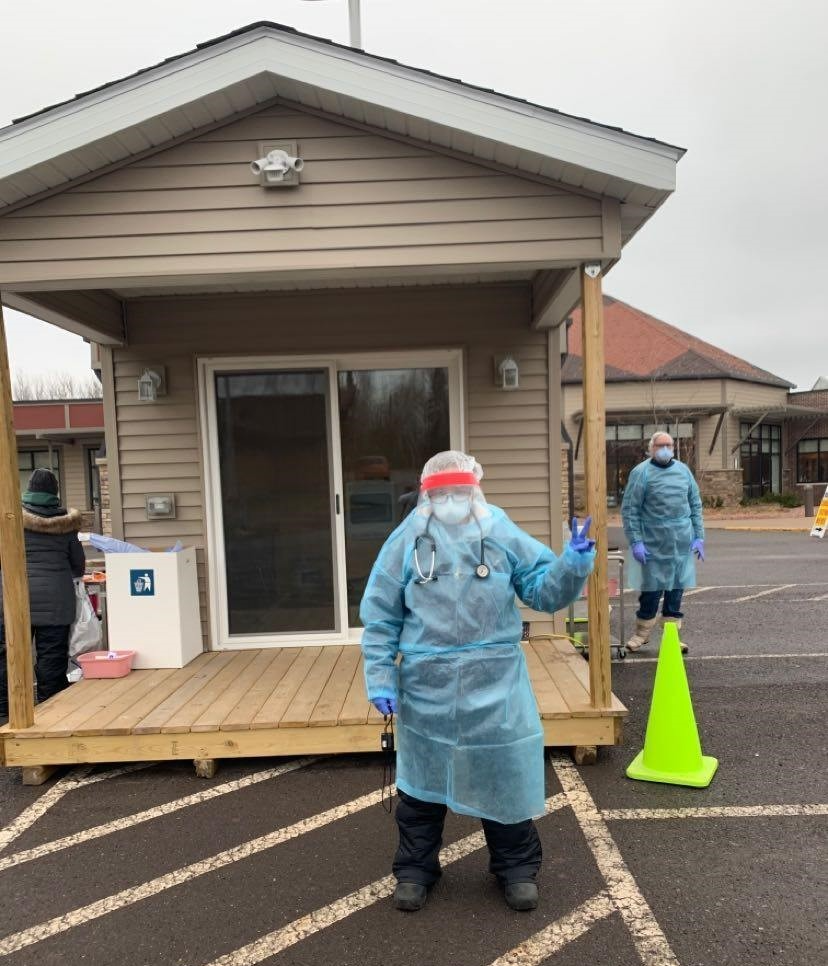
    Dr. Gavin flashing a peace sign in full PPE gear outside of a drive-through clinic on the Bad River Reservation, November 2020.  

    Dr. Gavin, an outsider to the Bad River Tribe, relied heavily on building doctor/patient relationships with community members who were suspicious of Western medicine. To do this she acknowledged traditional medicine as a healing tool alongside her Western approach to medicine. She contended that she didn’t “have anything [better] to offer them and [was] not going to argue with a 1000+ year practice” during a time filled with such uncertainty and fear. Dr. Gavin also noted that no one was well prepared to deal with a pandemic, especially when it came to tribal governments that are often the last to receive care and feel the effects of policy changes from the federal government. She waited for the Centers for Disease Control and Prevention and the federal government to step in and bring resources, but nothing came. With no one but herself and one other nurse practitioner, Dr. Gavin resolved to creating a system of care to mitigate the weight of the pandemic felt by the community. She anticipated what was coming early in February of 2020 and took it upon herself as an independent contractor to tell the clinic director to close the casino. She began holding meetings to brace for the imminent pandemic. At first, everyone thought she was blowing circumstances out of proportions, but her fail safes became safety rafts in the months to come.  

    Dr. Gavin likened the initial year of the pandemic as “kind of like being a firefighter” with her gear and respirator on for protection – she saw the fire coming but only had a fire hose to put it out. She stated her “biggest concern was the feeling of helplessness. There was nothing to do, there were no treatments, there was no vaccines, there was just supportive care, even if we hospitalized them.” Since COVID-19 was a novel virus, Dr. Gavin had no idea how it worked or mutated but thankfully Indian Health Services kept the clinic stocked on the necessary PPE to stave off the disease as much as they could. The Native community wanted to protect their elders by keeping them separated and prioritizing their care – a difficult feat as many households were multigenerational.  

    Alongside the Nurse Practitioner, Dr. Gavin treated all sick patients outdoors, with one day of the week dedicated to only seeing respiratory patients to screen them for COVID or other infectious diseases and diagnose treatment. During the interview, Dr. Gavin mentioned multiple times how overwhelmed and hopeless she was throughout that first year. She was working four-five days a week, with ten-twelve-hour days, and an additional two-three-hour commute from home and loved ones. Despite the medical necessity of the pandemic, Dr. Gavin continued to care for everyday health matters as “we still had to practice medicine. People still got pregnant, people still got pneumonia, people still had diabetes.” 

    Dr. Gavin disclosed that at the beginning of the pandemic, it was “a lot easier for me to manage it mentally, physically, spiritually, psychologically because I just had that education and pandemics and how they work, and knowing that lots of people are going to die. And I was much more comfortable with that, than a lot of most of the other people that I worked with. Having worked in hospice and palliative medicine, I mean, that’s what you do all day long is death and dying, and you just become used to it just as a natural state of life ending and not as a horrific event, it’s not a failure.” Despite this sentiment, Dr. Gavin was not immune to infection or her own impending burnout.  


    As the pandemic wore on, she became more depleted and fatigued as the commute and futility of care took its toll on her body and mind. As she dedicated her life to her oath of care, she was not able to be with her aging parents, nor her husband and daughters, which made it more difficult to persevere through the initial year of the pandemic. She said she wished she would have known we would have gotten the vaccine so quickly because she would have had more hope and wouldn’t have been in such a panic during that time. Dr. Gavin reiterated that it “was the most stressful year of my career. Hands down. I can’t stress that enough.” In December of 2020, COVID caught up to Dr. Gavin despite her precautions, leading her to take a year-long break from medicine. Dr. Gavins’s story is reminiscent of the moral injury and fatigue faced by physicians with little resources and an inability to save everyone from a devastating disease.  

  • Pandemic Revisionism and Social Forgetting: Intersections and Reflections

    Pandemic Revisionism and Social Forgetting: Intersections and Reflections

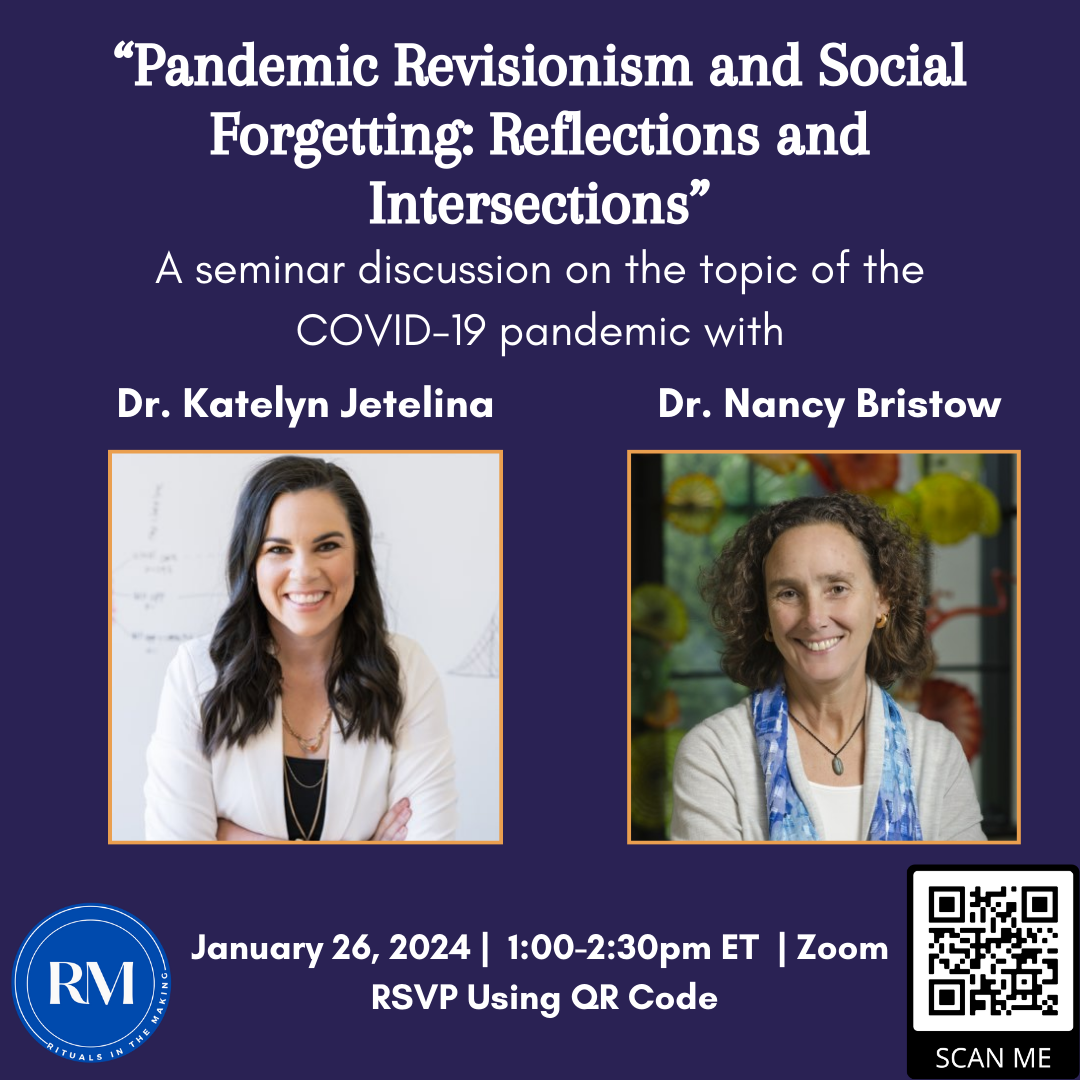
    On January 26, 2024, the Rituals in the Making research team hosted its second virtual seminar that examined COVID-19 pandemic revisionism through the lens of social forgetting. The entire seminar can be viewed here: https://www.youtube.com/watch?v=F4bY7RuX7w0&t=85s.

    The seminar speakers included:

    Dr. Katelyn Jetelina, an epidemiologist and data scientist whose newsletter, Your Local Epidemiologist, explores topics including public health education and outreach, and pandemic revisionism.

    Dr. Nancy Bristow, a historian who specializes in early 20th-century American history in terms of race and social change and author of American Pandemic: Lost Worlds of the 1918 Influenza Pandemic (2012).

    Paige Gavin, a second-year master’s student in anthropology at the George Washington University and a research assistant on the Rituals in the Making team, who moderated the event.

    Now we’re in that moment, we can remember or we can forget, we can learn or we can turn our back on the education we’ve been offered through COVID-19. – Dr. Bristow

    Dr. Bristow noted: “The flu pandemic of 1918 to 1920 faded from the nation’s attention, and ultimately, its public memory in the decades that followed the pandemic. As historian Alfred Crosby described this was in a sense, America’s forgotten pandemic. But in reality, we probably shouldn’t be that surprised about this national cases of amnesia. Historians have memory note that communities and nations routinely choose to remember some episodes and forget others in order to create a version of their past that fits their sense of themselves in the past and the present, and helps them imagine and dream for the future as they want. Such forgetting though, requires the erasure of significant parts of our past and often some of the most traumatic events.”

    Dr. Jetelina noted: “[T]here is a very scary decline in trust on an institutional level, but I’m very focused on public health and on science. . . . mistakes were made during the pandemic. Also, misinformation is supercharged by social media. And there’s also just bad actors driving the majority of, for example, anti-vaxx content. And so I think a lot of people need to work with these challenges and find solutions for them really quickly. So all of this kind of goes into reimagining public health and what we think as a society of public health for the 21st century.”