Rituals in the Making: a George Washington University research project on memorialization, misinformation, and the consequences of the COVID-19 pandemic

Tag: New York

  • At Naming the Lost Memorial, St. Mark’s in the Bowery

    At Naming the Lost Memorial, St. Mark’s in the Bowery


    By Ed Koenig

    Curated and edited by Martha Greenwald

    ***

    On November 2, 2025, a beautiful autumn afternoon in New York City, I attended the annual Día de Muertos ceremony sponsored by Mano o Mano, a New York City based Mexican cultural association. As part of this event, the COVID remembrance project, Naming the Lost Memorial, held its final presentation honoring the more than 46,000 New York City residents who have died from COVID-19. This concluded five years of work, throughout the five boroughs, putting names and faces to those who have been lost.

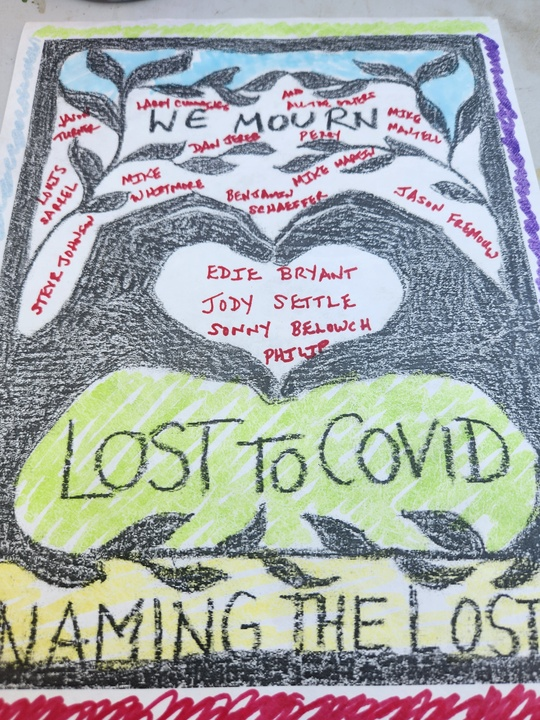
    A colored memorial drawing with the words 'WE MOURN' at the top and names of individuals lost to COVID-19, including 'Jody Settle' and 'Edie Bryant,' surrounded by artistic embellishments. The bottom section reads 'LOST TO COVID' and 'NAMING THE LOST.'
    Photo by: Ed Koening

    I first encountered the work of NTLM in the spring of 2021 when they created a memorial at the Morris-Jumel Mansion, one of the oldest buildings in Northern Manhattan, dating back to 1765. That time, the memorial consisted simply of long, multicolored ribbons, each inscribed with the name of a loved one who had passed. This was the first time I added the name of my partner of thirty-three years, Jody Settle, to a COVID memorial. Jody succumbed to COVID-19 in April 2020. I attended other NTLM events, most recently this past spring at The Green-Wood Cemetery in Brooklyn.

    I arrived early and strolled along the fences that surround the church, St. Mark’s in the Bowery. Numerous memorial panels hung on the fence, all created by the survivors of these cherished victims. Reflecting the diversity of New York City, the displays were inscribed with thoughts in English, Spanish, and Mandarin Chinese. Some were just words of love. Many were hand-drawn portraits of loved ones. One of the larger displays was created by a young man who had been incarcerated in prison during the time of the pandemic. His work tries to show some of the people who were unable to “flee” when the city was overrun with fear and uncertainty. His message is that no one should be excluded from our memorials just because they were serving time in jail.

    I continued my walk and soon turned into the courtyard in front of the church. The people from NTLM had set up tables where passersby could create simple remembrances for their loved ones. They provided me with some sample templates I could use to create my own drawing. I chose the butterfly template and sat down with colored pens and markers and got to work.

    I have been a member of a small group of men and women who lost a spouse or partner to COVID. Formed during the early days of the pandemic to comfort and support each other, five years later, our group is still in almost daily contact, friends with a common reason for connection. I decided to include the names of all our spouses on my display. So, I started. I wrote the names all over the template and finished it with a rainbow of background shadows encompassing all of them.

    While I was working on my memorial, four or five others were seated nearby doing the same. We all chatted about our works in progress, but, more importantly, we shared the stories of those we were memorializing. As I write this, it seems to me that our sharing was more joyous than mournful. We have had over five years to heal the scars of our devastating losses and can now remember their lives more than their deaths. Our drawings completed, they were added to the display along the fence—more names to remind those going by that our losses were real.

    The NTLM ceremony was very simple. The people assembled formed a line, and we marched around the border of the church grounds. As we passed the numerous banners hanging on the fences, a pungent, but sweet, incense was passed over the banners, calling to mind, I guess, the spirits of those remembered there. At several of the displays, we stopped for a few minutes so that the creators could talk about their work.


    Eventually, the crowd of 50 to 60 returned to the courtyard of the church. All of us were given an orange marigold to hold in honor of our loved one. Led by Kay Turner, one of the founders of the Naming the Lost Memorial project, we were all encouraged to speak aloud the names of those we had lost. Everyone responded chanting: “naming the lost.” This continued for quite a while until the sound of names quietly dissipated. I looked around as the names were spoken. The faces of many still showed the pain of their loss. A young couple standing near me hugged each other while tears poured down their cheeks. I could only wonder who they mourn now and forever.

    The event ended with a charge that, even though the official NTLM project was coming to its conclusion, we must all go forth and continue to name the lost. 
  • Reinventing the Wheel 

    Reinventing the Wheel 

    Interview with Homeless Resource Center Executive Director, Brett Hartford, for the Unhoused Narratives Project  

    Hanaan Khabir

    ***

    On June 10, 2025, Hanaan Khabir interviewed Brett Hartford (he/him) on his experiences working with unhoused populations during the official years of the pandemic (March 2020-May 2023). Hartford is currently the executive director of the Homeless Resource Center, a Kansas-based organization offering aid and resources to those experiencing homelessness. Before becoming director, he served as the director of outreach and operations at City Relief in New York, providing an on-the-ground mobile resource hub for members of the unhoused populations across different boroughs in New York City. 

    “Overnight, 30% of all nonprofits shut down… [and] we went from serving two to three to 400 people on an outreach event…to overnight serving 800…We went from having a line that went a block or half a block to lines that were going three and four blocks. And in order for someone to access a cup of soup and a piece of bread, people were standing in line for over two hours.” Hartford’s words capture the scale of the immediate crisis brought on by the COVID-19 pandemic. In 2020, New York City had a population of approximately 8 million, with an estimated 8 in 1000 people experiencing homelessness, accounting for almost 90% of the state’s unhoused population. The consequences of shutting down and restricting indoor and nonessential services were as immediate as they were devastating.  

    On the morning of March 22, 2020, New York City was still bustling in the way it’s known to: people went to work and to school, rode the subway, hung out in bars and restaurants. Even with the looming threat of COVID, the city that never sleeps continued to do what it does. People were encouraged to stay home if they were sick, but everything was still open. But at 8 pm that day, the city that never sleeps was put to rest. The governor at the time, Andrew Cuomo, signed “The New York State on Pause” executive order — effectively closing all non-essential and indoor businesses and organizations. By the morning of March 23, many businesses — including those that provided aid and resources to individuals experiencing homelessness — closed their doors for the foreseeable future.  

    For many New Yorkers, these changes simply meant work and school became virtual — for those experiencing homelessness, it meant a complete disruption of life and routine. Hartford pushed back on the stereotype that those experiencing homelessness have no structure or routine, that they have more freedom because they seemingly have nothing to do. “A lot of times you assume that homeless people don’t have a schedule, like they can do anything at any time because they have no job or nowhere to go.” The lives of those experiencing homelessness are heavily routined: from only being able to stay in certain spaces for specific durations in order to avoid conflict with law enforcement to needing to arrive to specific areas of the city at certain times to stand in lines that could take one hour or three to get basic necessities before they run out. COVID shattered this. Hartford described the challenges, “because so many things close[d] down…their systems and schedules and everything was thrown off. And then 30% of all services shut down, the lines to everything else increased massively.” 

    When asked about how equitable he felt his clients’ access to masks, sanitation, testing, and vaccines was, Hartford was blunt. “Not at first for sure…it was inequitable at the beginning until we could build systems around…as they realized that we needed better options [the] New York City Department of Public Health started getting better and doing pop-up clinics for testing, and we were able to partner with different Medicaid-type settings and other government health settings that…started doing the temp pop ups on street corners —that was helpful.” His reflections underline a central truth: unhoused populations are often an afterthought in responses to crises. In many cases, this is due to stigma; however, in other cases, it is simply a case of erasure. Unhoused populations are frequently forgotten in overall responses to public health crises. Given how often the unhoused tend to be forgotten and excluded from policy and response, unprecedented circumstances — like those of the  COVID-19 pandemic — require spending time figuring out how to include unhoused populations in policy and overall response, and sometimes that means not getting a truly equitable or robust response until six months into the crisis.  

    ***


    Hartford repeatedly returned to this theme of reinvention throughout his interview. “Everybody was literally recreating systems and figuring out new ways to do things when that happened.” There was nothing to build on — no precedent to use as a guide. Systems built and put into place in response to previous public health crises could not keep pace with the mental, emotional, and physical toll of COVID. New systems had to be developed from scratch and repeatedly refined as new information became available. Even the 1918-1919 Influenza Epidemic and the Bubonic plague – which outpaced COVID in death toll — did not occur in as globalized society as now. These diseases ravaged populations that were much more fragmented and localized; in contrast, the COVID-19 pandemic occurred in real time before a global audience, with daily updates, digital tracking of outbreaks, and an international sense of crisis.  

    Despite the challenges, Hartford emphasized his pride in his city’s response: from the city allowing unhoused individuals to stay in hotels versus crowded, congregate shelters, to public health professionals coming to outreach events and providing services on site. Especially when comparing the city’s experience to states and regions that viewed COVID as something that wasn’t real or didn’t exist, he believes that New York City, overall, did a great job. 

    One of the most important points Hartford raised in our discussion was a seemingly simple but straightforward assessment — and one that substantiates the central purpose driving this project. “Combining of homeless housing solutions alongside of public health…has to stay because if your body is not good, then you are in crisis, and you cannot think about housing or sobriety or anything else if you are sick.” His words point to a lasting lesson of COVID: health and housing are not separate. In a globalized society where the health of one impacts the health of all, we must ensure that the most vulnerable of society are included in public health policies and initial responses. We cannot keep reinventing the wheel; public health infrastructure in the United States must be changed and rebuilt in a way that includes vulnerable and marginalized communities from the start.  

  • ‘These Are Grievous Times’: In Memoriam at a Lutheran Church in Upstate New York

    ‘These Are Grievous Times’: In Memoriam at a Lutheran Church in Upstate New York

    One of the first virtual memorial events we attended as a part of this study was a service held at Christ’s Lutheran Church in Woodstock, NY on June 30, 2020. Here are some excerpts from the event, elements that caught our attention as we were just beginning to think about how memorial ritual is translated into the virtual.

    Creating Community — ‘How Much of Grief is Communal‘

    Pastor Sonja Maclary begins by recalling her own mother’s funeral two years prior to the day. Family, friends, and congregants gathered at the Lutheran church to grieve together as a community. She speaks her words slowly and with care, standing slightly off of center in the mobile-captured frame to allow for the altar, candles, and flowers to remain visible in the background. “Gathering around the bedside of a loved one, holding or attending a wake, gathering for a funeral, even eating or talking together at a funeral luncheon or dinner is part of the communal expression of grief that carries us through these difficult times. All of those processes have been curtailed by COVID-19.”

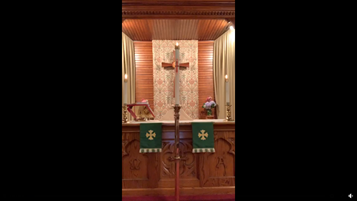
    A screenshot from the virtual service showing a wooden altar with two pieces green, cross-emblazoned fabric draped over it, and a large candle placed in front.
    Screenshot from the virtual service

    Since the early months of the COVID-19 pandemic, mental health professionals, public health officials, and death care workers have issued warnings about the dangers of prolonged or complicated grief. The burdens of grief compound and extend: the loss of loved ones, the loss of those meaningful gatherings and rituals to honor them, and the loss of communal experiences more broadly. However, Pastor Sonja articulates the experience to those in attendance in a different idiom: What does it mean to live during grievous times? 

    Since the onset of the pandemic, the church has sought to maintain connectivity between congregants through live-streamed Sunday services, prayer groups, and coffee hours. Despite these virtual gatherings, there still seemed to be something lacking–the possibility to share grief.

    Grief all boils down to separation, to being apart in a very final way from someone who was loved. Grief is the pain of separation…it’s very human… One of the most important human things we do is honor our dead and grieve. 

    Pastor sonja maclary

    The Reading of Names

    The centerpiece of the service is the reading of names—names of loved ones that participants have submitted beforehand. Among the names Pastor Sonja reads is that of George Floyd, the list entwining the pandemic losses with this other emblematic death.

    “Racial injustice so grievously present in the United States and elsewhere. The Christian faith teachers that we are one body together. When one part of the body hurts, it all hurts. When one part grieves, it all grieves”

    Pastor Sonja invites all those in attendance who have not already submitted names to type them into the chat of the Facebook stream. As she nears the end of her commemoration, a name appears in the chat alongside a prayer emoji. Moments later, another commenter adds: “in memorial to everyone. you are not alone.” This brief interaction recalls an image that Pastor Sonja evoked earlier in the service, the notion that an act of love might travel “through the internet.” 

    Through this act of commemoration, the names of the deceased are offered up in the presence of a now-virtual community of mourners. Whether through Pastor Sonja’s slow, deliberate recitation or typed into the chat, flanked by hearts and folded hands, each name is inscribed, not just momentarily within this streamed event, but rather in a digital archive and material commemoration that would extend into the future.

    The Afterlives of Facebook Comments

    During her opening remarks, the pastor invites all those viewing the Facebook live stream to contribute to the chat—comments, she notes, that will be “public and permanent”—with names and memories of those lost since the beginning of the pandemic. As the memorial services goes on, attendees inscribe the names of the deceased in the chat alongside messages in Spanish and English with memories and notes of thanks for those paying tribute to their loved ones. 

    A screenshot of a memorial message in Spanish from Facebook.

    I am the sister of  R., who passed away on March 30, he was an exemplary human being, an excellent father, son, husband, brother, both caring and honest. He was the youngest of the siblings. I’ll share something very special that came to my mind at this moment. Our mother passed away in 1995. He was such a special son that he helped us dress our mother for the funeral. That’s how it was with R., always caring. Peace upon his soul.

    A screenshot of a memorial message in Spanish from Facebook.

    Comments from Christ’s Lutheran Church Memorial Service.

    The names and memories shared during the service extend outward both in time and in space. They will become part of the “public and permanent” recording of the service and remain an inseparable part of the archived service. Pastor Sonja notes that she is looking forward to rewatching the video after the live service’s conclusion, as she cannot view the comments in real time. “I’m curious about what each of you will share.” 

    Virtual and physical memorials

    In addition to being digitally ensconced in the archived service, the names of the deceased become materialized in the form of crosses erected on the church grounds. We learn later in an interview with Pastor Sonja and co-organizer artist Julia Santos Solomon, that the virtual service was an extension of a art installation, In Memoriam, created by Julia. “The dead become part of a statistic, while our broken hearts rage,” she explains in the Facebook post about the service. “In Memoriam explores an alternative way to honor the dead.”

    While our notes from the In Memoriam service emphasized how ritual was adapted to the virtual context, less apparent to us was the rich collaboration that gave rise to the event—as Julia explained later, “The sense of grief and loss that brought Sonja and I together to create this project.”

    “The material representation allows those who are mourning to have a place to grieve.
    We’ve found mementos on the crosses and fake flowers.
    As COVID rages on, the crosses are increasing in numbers.”

    Julia santos solomon