Back in 2024, reflecting on the first two years of the pandemic (2020-2021), members of Rituals in the Making team (Ariel Santikarma and Sarah Wagner) published an article in the journal Anthropological Quarterly in which we challenged the public rhetoric characterizing pandemic death in the US as exceptional. Instead, we argued the opposite: “(1) that the politics of interrupted mourning [was] not new; and (2) within the United States, COVID-19 death [was] anything but exceptional when considered within a broader history of precarious and disposable life.”
We presented a different way of thinking about efforts to memorialize unjust death – that is, “memorialization as movement work,” or the intertwining projects of memory and political transformation. In our definition, the dead and specifically their memory are animating forces in pushing for political change:
“[F]rom the movement of an individual’s hand in tracing the portraits of the deceased to creating a space of memorialization that forges social ties through and beyond life, the living work with the presence of the absent. The dead are thus remembered and transformed as kinful forces, who make the revolution of memory—and its movements toward both a livable present and future—possible.” – Santikarma and Wagner
***
Over the past days (and weeks and months), we at Rituals in the Making have been struck by parallels and connections between our core research questions about pandemic loss and other forms of memorialization as movement work.
In the coming days, we will share several separate but linked dispatches that focus on the transformative “movement work” of memorializing unjust death. Lessons from our research on COVID commemoration (like the work of Rami’s Heart, events such as Naming the Lost Memorial’s Día de los Muertos, or Suzanne Brennen Firstenberg’s In America: Remember) inform how we understand the relationship between emotion and action.
Sarah Wagner: On Friday morning, November 6, my phone pinged. My younger brother had just forwarded a Reddit thread about people in the Twin Cities (in Minnesota, where we both have family) going to the impromptu memorials dedicated to Renee Good and Alex Pretti to add their “I voted” stickers. In the span of three weeks in January 2026, during “Operation Metro Surge,” first Good and then Pretti were gunned down by U.S. Immigration and Customs Enforcement agents in south Minneapolis. In the wake of each killing, people flocked to the two sites to leave flowers, candles, and personal tributes.
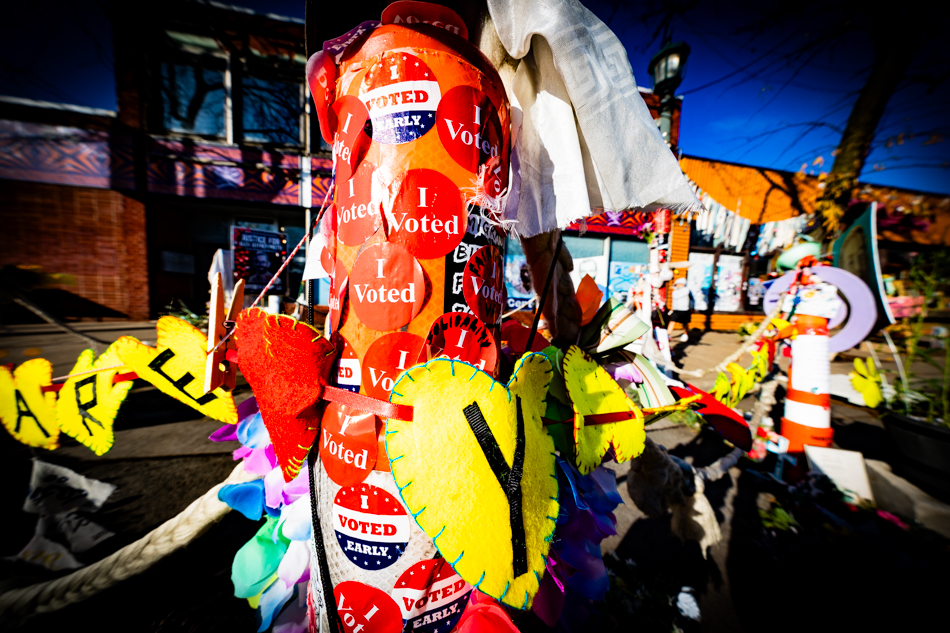
Since October a new item—the “I voted” stickers that people receive after casting their ballot—began appearing at the grassroots memorials.
As I read through the Reddit thread, I noticed how many of the comments linked emotions to action, namely, the act of voting:
“I’m never forgetting the frostbite I got and the rage I felt. Fuck these fascists”
“We’re voting for them. We won’t let their deaths be meaningless, we will fight like hell to protect people and put people in power who will do the same.”
“May they only grow”
“I just realized Renee Good never got to vote in MN. But she ended with a bunch of people voting in her honor.”
I then reached out to another family member in Minneapolis, who put me in touch with Gregory Gilbert, a hospice chaplain and visual artist based in the Twin Cities. I asked Greg if he had any photos of the memorials from the past few days. From the “I voted” sticker memorialization as movement work. He emailed right back with the pledge that he would visit both sites the following day to document the memorials with their sticker additions.
Here are the photos he sent, of both Alex Pretti’s memorial and Renee Good’s:
In the months preceding the election, the memorial for Alex Pretti was repeatedly vandalized—raw bacon, raw tuna, human feces were left; it was spray painted, motor oil and truck bed liner dumped on it; someone even tried to burn it. The attempts to deface the memorial—to deny the violence that snuffed out Alex Pretti’s life—represented a different form of acknowledgment, an admission even. You don’t try to destroy a memorial to something that never happened.
Its custodians doubled down in their commitment to caring for Pretti’s memory:
“Whatever happens, we will be there to restore and repair and recover and clean,” said Jadah Green, one of the caretakers. “Now I think, ‘Okay, you’re coming with whatever violence you have in your life, and you’re inflicting that on the memorial, and the memorial is just going to generate more love.’” – Madison McVan, Minnesota Reformer, October 30, 2026
Voting as ritual, as an act of love.
In his victory speech on November 3, US Senator-elect (D-TX) James Talerico spoke of the transformative politics of love—rather than hate:
“Love is not passive. Love is not neutral. Love is not weak. Love requires that we stand between the bullies and the bullied. Love requires that we look evil in the eye and not blink. That kind of love has always been a threat to the powers that be. That kind of love is revolutionary. That kind of love is creative.” – James Talerico
Despite the hatred directed toward Pretti’s memorial, its caretakers insist that it will only “generate more love.” To my anthropological eye, I read both the caretaking and the “I voted” sticker assemblages through the lens of ritual. One of anthropology’s pre-eminent scholars on ritual processes, Victor Turner explained how rituals take place in particular settings through sequenced action to influence forces (such as divine forces or mystical beings) and advance interests (like beliefs). They also depend on symbols. “The ritual symbol becomes a factor in social action, a positive force in an activity field” (Turner, The Forest of Symbols, 1967, p. 20)
Just as the grassroots memorials to Renee Good and Alex Pretti are made up of the symbols of flowers and candles, portraits and tributes, so too the “I voted” stickers do crucial symbolic work of manifesting a politics of generative, creative love. Sticker by sticker layered upon their surfaces, the memorials become an archive not only of violence and its commemorative rejoinder, but also of a specific form of ritual action: casting one’s ballot.
To vote is to take purposeful, directed action, one that concretizes blame and enacts accountability.
And in Minnesota, voting last week exceeded all expectations. As my family member pointed out, “MN also broke records for midterm voting”:
“SAINT PAUL – Unofficial results show more than 2.8 million Minnesotans cast ballots in the 2026. Statewide General Election. This breaks the previous record for midterm participation set in 2018.
In addition, Minnesota is projected to have had the highest voter participation rate in the nation, according to preliminary estimates from the University of Florida’s Election Lab.
‘Minnesota has once again made history for voter participation,’ said Minnesota Secretary of State Steve Simon. ‘This is a victory for every Minnesotan who showed up during the voting period to take part in our shared democracy.’” – Office of the Minnesota Secretary of State, November 4, 2026
Or, again, in the words of one of the Reddit posters: “We’re voting for them. We won’t let their deaths be meaningless, we will fight like hell to protect people and put people in power who will do the same.”
As one of the over 1.2 million Americans who has lost one or more loved ones to COVID-19 (my partner of 33 years, Jody Settle, died in April 2020,) I was curious to see how the lived experiences of those who were most severely impacted would be represented. Unfortunately, our experiences were either ignored or glossed over during the various presentations.
The symposium instead looked at various aspects of how we coped and lived our lives during the temporary lockdowns that arose around the world to combat the spread of the SARS-CoV-2 virus and how some of those changes have impacted and continue to influence our daily lives.
Sour, Dough
One of the obvious areas that concerned everyone was food, its production, and the related delivery systems. As was sometimes true prior to the lockdowns, comfort food became a source of solace for many who were fearful or, worse, mourning the loss of loved ones to this new virus. I was a bit disillusioned with a reference to a meme that discussed common weight gains during that period as “the COVID nineteen” (much as first year college students are often said to experience a weight gain called the “freshman fifteen.”) Unfortunately, the laughter from the audience that ensued ignored the sentiments of those who were most severely impacted.
One of the activities that seemed to become rampant during the lockdown period was the baking of sourdough bread. Myriads of families ordered bread making machines so they also could join in this activity. Perhaps, it was their way of feeling connected to others. Someone sent me one in the days after my partner died in April 2020. Looking at the box, I wondered what I was supposed to do with a bread making machine. I couldn’t bake a new partner! Sadly, the box sits unopened in the closet six years later.
More interesting, there seems to have been an increased rediscovery of old family recipes for favorite meals that had been stored away unused due to the lack of time in our busy society. Now, staying and/or working at home, there was more time to reconsider these foods and the comforts and memories they provided. This, of course, required ingredients that many did not regularly have at hand.
The food procurement system has been impacted or altered by the pandemic. There was a huge increase in the ordering of groceries on-line which stores then needed to deliver directly to the home. Restaurants, restricted from indoor dining, began relying on services like DoorDash and Grub Hub that came into prominence during this period. People began ordering take-out food from local restaurants if only to support them and help them to survive until the lockdowns were over. The message seemed to be that people wanted to continue enjoying their favorite foods without risk to themselves. Sadly, the risk to those who had to work to survive was only discussed in a passing remark that “comfort for one became discomfort for another.”
Several other observations were made about the impact on food delivery systems. There has been a notable increase in the number of farmers markets around the country. Researchers presume that people felt that shopping at these open-air concessions was safer with less chance of exposure to the virus.
A final thought is that there now seems to be an increased understanding of how the corporate industrial food system works. People have finally acknowledged that our food doesn’t miraculously appear on the shelves in our grocery stores. It requires a great number of human resources to grow, produce and ship products and then to stock the shelves – all of which put people at risk during the pandemic. The question left unsaid is whether people continue to care about those who are part of this important supply chain component.
I would be remiss if I didn’t mention how friends and neighbors stepped up to prepare meals that they shared with me when Jody died. They would call and come over and we would meet outside. Maintaining the recommended social distance, they would place the food nearby and step back. I would then go over and pick it up. After a brief shouted “thank you,’ we would return to our homes. The comfort offered by a homecooked meal and a few minutes of face-to-face contact was not something discussed during this portion of the symposium.
Synchrony/Cacophony
Music and the impact on musicians were the themes of several presentations. Because musicians were unable to perform together in-person, many of them tried to employ new on-line technologies, like Zoom, to continue their collaborations and performances. Because of the nature of internet technology at that time (since improved somewhat,) lags in transmission speeds often made the synchronization of the various musicians difficult, if not, impossible, often leading to cacophony. Musicians experimented, learned and implemented new techniques to overcome these difficulties such as writing compositions and arrangements where one performer’s last notes could be sustained and then the next performer would begin on the same note. Also, visual clues were used for one musician to cue another. These aided the musicians to continue their creative work until they could again work together in-person. An example of these new techniques was shown (performed via Zoom) by the Kronos Quartet performing the musical piece, Marejada (which translates as “surge”) composed during the lockdown.
Other speakers spoke of the means musicians in small or isolated communities used to continue performing for themselves and others. One presenter discussed a group of blue grass musicians in southern Indiana. As they told her, if they were to live the lives they were used to living, they would have to adapt. And, they did. Single performers would play from their front porches while friends and neighbors would sit in their cars listening to the performance. Later, as restrictions eased, some of the groups would gather to perform outdoor concerts. She even showed videos of them precisely measuring out six-foot social distance circles around each performer. They did the same with the folks that came to listen and enjoy. All this helped them to live during the lockdown.
Improvisation was the key to survival for many musicians. A project based in some impoverished neighborhoods of Washington, DC, put into service a rickety old van nicknamed the “COVID Van.” The organizer, from American University, and his wife would meet musicians, usually in their late teens or early twenties, who would perform while they, safely inside the van, recorded videos that, once edited, were shared on platforms like YouTube. This allowed these young musicians to continue creating and sharing new music with their fans even when they couldn’t appear in a public setting. Again, new ways of thinking worked and continue to be used now.
Several researchers who worked in Spanish-speaking Latin American communities discussed the role of music in providing information and solace to people from Mexico to Argentina. One of the interesting things they discovered was that musicians were less concerned about making music during the pandemic, but rather they focused on creating music about the pandemic. As they termed it, the music was about the humanity of surviving.
Much of this music focused on instructing people on how to stay safe — like washing your hands frequently, wearing a face covering, and maintaining social distance – “be a good citizen and we’ll get through this.” The one quirky thing they recognized in each country was that the music was usually upbeat and the videos created for these songs were almost always full of dancing and hope and smiles. They served as cheerleaders in a time of sorrow.
The use of folk art provided some further insights. Some art work served to educate people on how to protect themselves and, in doing so, provided continued economic survival for the creators. Of course, some art work served to memorialize people who died from COVID-19.
A Renaissance of Stitches
In the early stages of the pandemic when there was a lack of personal protective equipment, ethical questions arose about the creation and sale for profit of face masks while people were dying. This included examples where protective face masks were decorated with distinctive patterns and designs and intended to be sold as art work rather than to be used as protection against the virus.
Of interest to me was how seamstresses around the world gathered whatever materials they had at hand and produced many millions of masks for their friends and neighbors and others. Their work was so prolific that there was a run on the elastic materials used to keep the masks properly placed on the face. An interesting anecdote was how seamstresses in Cambodia produced and shipped face masks to underprivileged people in the United Kingdom and Australia.
During the lockdown periods, there was a notable renaissance in the art of quilt making around the world. Many picked up an avocation that they had set aside a long time ago. Many others first came to quilting at that time.
Over time, often influenced by social media posts that referenced the AIDS Memorial Quilt that was begun to memorialize those who had died during the HIV/AIDS epidemic in the 1980s and 1990s, many tried to reproduce the feelings those quilts invoked in them and moved to sew similar quilts for those lost to COVID-19. Examination of many of the quilts produced reflect the social anxiety the creators were feeling whether from being isolated, having to maintain social distance when interacting with others, and, even the simple task of trying to find toilet paper. One other interesting aspect of this work was the number of quilting bees that arose on the internet via apps like Zoom. The people could sew while talking to others doing the same thing. It provided them a chance to share their feelings and their work. It allowed them to practice a tactile art without the need to touch.
Say Their Names
Another use of art serving to memorialize appears in the work of the Naming the Lost Memorial project in New York City. Taking inspiration from the reaction to the murder of George Floyd in Minneapolis in May 2020 and the constant call to “say his name,” this small group formed and reached out to those communities that weren’t able to properly mourn their dead following their own customs and traditions.
After receiving a grant, the group expanded and joined with local artists and musicians from various immigrant communities in New York City to develop memorial artwork and events that gave honor to their cultural ways of mourning. They scheduled two events per year: one at Brooklyn’s Green-wood Cemetery in the spring and the other celebrating the Day of the Dead (el Día de los Muertos) at the Church of St. Marks-in-the-Bowery in Manhattan. I attended both memorials in 2025 where I recall and experienced how the rituals of mourning in various places such as Mexico, Guyana, and West Africa, among others, were performed to honor the members of those communities who had passed on. While loved ones were lost, we continue to remember and learn from each other.
The Naming the Lost Memorial project concluded with the most recent Day of the Dead event in November 2025. But the project will never really end as long as we continue to say their names.
There were other various presentations. Some of them I found interesting. One dealt with the impact of COVID-19 on the Navajo Nation. It was noted that in May 2020, the indigenous peoples of the United States had the highest COVID-19 infection rates. On a brighter note, by February 2021, these same groups had the highest COVID-19 vaccine uptake rates. The primacy of elders in the indigenous populations as repositories of their language, oral and written history, and native learning methods promoted the care of these elders to primary importance in their communities as they struggled against COVID-19. An elderly Navajo woman noted speaking about COVID-19: “I look upon it as a monster that is feeding on us.” The lack of resources for these indigenous communities from the U.S. government (the case before the appearance of COVID-19) accelerated the situation. Sadly, a number of members of the Navajo community were lost.
Others presentations I found disturbing. These made me wonder why anyone would want to characterize this period of history in this way. One of these compared some of the reactions to COVID-19 pandemic to those of the 1918 Influenza Pandemic dubbed the Spanish Flu even though credible scientific evidence shows it most likely originated at a U.S. Army base in Kansas City.
In 2020, early on in the pandemic, the use of the internet and social media platforms led to “ideas” and disinformation such as the belief that 5G cell phone technology or the financier George Soros was the source of the pandemic. The somewhat racist depiction, Kung Flu, was an ad lib from Donald Trump in a speech he delivered during the beginning of the pandemic. Other strange ideas also arose at this time like “vegetarians are safe – only meat eaters get COVID” and “gargling with salt water would dislodge the virus from your throat.” Many of the numerous memes that were shared via social media showed a disconnect between the perceived image and actuality. The hurtfulness of many of these memes to those who lost loved ones to or continue to suffer from the impact of COVID-19 was not mentioned or just ignored. There was no discussion of counteracting the misinformation arising from these memes and other postings.
For me, the most disturbing presentations made during the symposium revolved around the topic of play. One positive presentation in this area of play was an exception. Presented by two young scholar researchers from the United Kingdom who work with young people living with Tourette’s Syndrome. Their organization, Tourette’s Hero, developed several creative projects to help keep these individuals engaged. One they spoke of was named “Digital Heros of Imagination.” Using whatever materials were close at hand, the people worked to create their own superheroes and then to develop backstories surrounding their creations which they told through posters that shared with one another. When the severe lockdowns were lifted, they began a second program called “Journey to a Better World.” Here, they strove to instill and maintain a sense of joy and connection in their clients.
Other presenters discussed games for children like “Coronavirus Tag” in which a designated player who, in theory, carried the coronavirus would run around and tag another player who would become “infected” and would fall down as if dead. This continued until all the players had been “infected.” The game would restart with a different player designated as the one having coronavirus. Parents seemed to find that this game, and others like it, were inventive and catered to the physical and psychological vulnerabilities of the children while including them as historical witnesses to life during the pandemic. As a person who lost someone to COVID-19, I found the idea of this game offensive, particularly because it was presented as a celebration of creativity. If only my loved one could just get up and live again. In Finland, “Korona” was a board game, much like Monopoly, where players moved along the board trying to infect the world with a virus. Players often exhibited joy in watching the virus spread. I tried to ask the presenters if they had considered the impact of these games on children who had lost a parent, sibling, or caretaker to COVID-19. They were adept at ignoring my question.
All this leads to one overarching conclusion about these presentations. All of them, in their own way, were too focused on those who had the most privilege, e.g., those who had the ability to flee large urban areas for vacation homes in rural areas. There was very little note given to the financially challenged people who lived crammed together in urban centers and continued, at much personal risk, to venture out to “essential” jobs to serve the needs of those who were able isolate. In the end, I was disappointed. I think many of the presentations failed to consider the people who were most severely impacted by COVID-19, i.e., those who died and those who loved them.
“We are talking about how we carry so many people with us wherever we go, how even simple living, these unearned moments, are a tribute to the dead.”
– Ada Limón, “Forsythia”
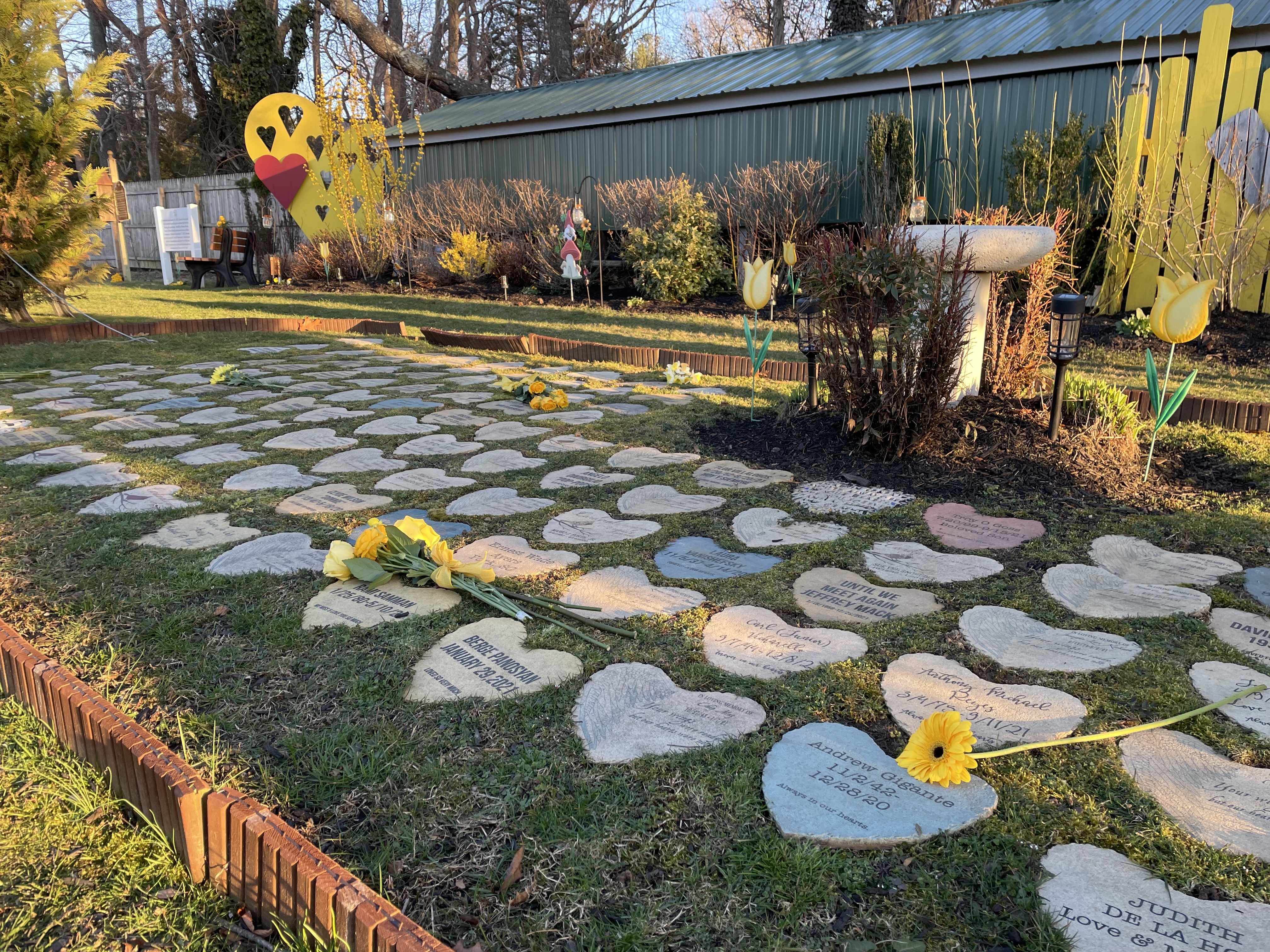
March 28, 2026: In the earnest, warm light of an early spring evening, Rami’s Heart COVID-19 Memorial once again gathered its own to remember their loved ones. Shades of yellow—hearts, shells, stones, candles, ribbons, and flowers—brought the space to life despite (or maybe because of) the setting sun. This year Paige Gavin and I had the honor of joining Rima Samman-Whitaker and the Rami’s Heart community for the occasion, and I write this dispatch with the evening’s sights and sounds still fresh in my mind. The essay combines photos from before and after the ceremony with captions drawn from the different speeches, as well as poetry that I stumbled on in the days since. I’ll start with a collage of photos and two poems that seem especially fitting.
***
Forsythia et al.
For this sixth annual lighting ceremony, Rima urged attendees to bring flowers. And so, gradually, as people arrived, so too did their floral tributes: a vase nested in the dark mulch, its bouquet brimming with shades of bright and pale yellow, pink, and green; clusters of canary-yellow roses tied to a memorial bench; a single stem of gerbera daisy resting atop a heart-shaped stone; florets of golden-yellow ranunculus (Persian Buttercups), tucked between names.
And forsythia, at the entrance and exit, just then in brilliant yellow bloom.
To my delight, I found that two of my favorite poets have written about forsythia:
It caught my eye a while ago, lit up against the gloom of the woods in the corner of a wild field, the pulsing color of caution.
And now that I have spent a little time on this stone wall watching its fire flare out of the earth I begin to think about the long chronicle of forsythia,
how these same flowers have blazed through the centuries, roused from the ground by the churning of spring. I would rather not look around the next
corner of the year to see how this will die, its lights going out, its bare, arcing branches waving like whips in the bitter wind.
So I sit facing the past, letting my feet dangle over the wall, beating time against stone with my heels as the long gray clouds roll over me.
Remember how Arnold by the Channel thought of Sophocles who must have heard the same shore-sounds long ago, walking by the edge of the Aegean?
Well, I am holding in the palm of my thoughts all the others who once were stopped, like me, by this brightness, this sulfuric cry for help:
women in tunics, women gathered by a well, men in feathers, men swimming by a river, all speaking languages I will never know, saying the different words for its color
as I feel the syllables of yellow form in my mouth and hear the sound of yellow fill the morning air.
At the cabin in Snug Hollow near McSwain Branch creek, just spring, all the animals are out, and my beloved and I are lying in bed in a soft silence. We are talking about how we carry so many people with us wherever we go, how even simple living, these unearned moments, are a tribute to the dead. We are both expecting to hear an owl as the night deepens. All afternoon, from the porch, we watched an Eastern towhee furiously build her nest in the untamed forsythia with its yellow spilling out into the horizon. I told him that the way I remember the name forsythia is that when my stepmother, Cynthia, was dying, that last week, she said lucidly, but mysteriously, More yellow. And I thought yes, more yellow and nodded because I agreed. Of course, more yellow. And so now in my head, when I see that yellow tangle, I say, For Cynthia, for Cynthia, forsythia, forsythia, more yellow. It is night now. And the owl never comes, only more of night and what repeats in the night.
***
Scenes from the ceremony: Photo essay
(The captions and quotations that accompany the images are from the ceremony’s speakers: Teresa Dimezza; Dr. Raynard E. Washington; Joann Burney; Sean Burney; and Rima Samman-Whitaker.)
“[COVID] brought a lot of loss and disruption and uncertainty and quarantines and homeschooling and all kinds of home projects and just complete chaos in our lives. And while time has moved forward, the impact of that time certainly hasn’t. In New Jersey alone, we lost more than 35,000 residents to this virus, and while that’s a number, each one of those numbers counts to life, a story, a family that’s forever been changed. . . . So tonight is about honoring those individuals, about saying their names in our hearts, holding space for their stories, and recognizing that though they’re not here with us, the love that we share for them still is here.”
“Every candle we light represents a name, a life, a story and a love that continues to shape us.” – Teresa Dimezza “We [Allaire Community Farm] are a nonprofit that we are honored to host Rami’s Heart, and Rima and Travis have become an extended family to us, and I just want to thank them for all their hard work. I know you all appreciate them very much. They put their heart and soul into this, and without them, it wouldn’t be as beautiful as it is.” – Joann Burney, Allaire Community Farm“I would like to also thank Don Corson. Don’s 91 now, and it was a little too cold for him to be here tonight, but he’s the one who, immediately after seeing the shadow boxes, saw that memorial in his head and put it together, and we had the materials. It was up in less than a week.” – Sean Burney, Allaire Community Farm
To the families I remember with you all this evening, to those that we lost, I honor you all this evening and to all gathered here, may we leave this place, not just with heavy hearts and remembrance of those that have been lost, but with a renewed sense of purpose to continue to act to make health possible for all of our neighbors here in New Jersey.” – Dr. Washington
***
“We also gather in a moment when there are voices who would rather we forget, who would have us move on without reflection and replace our very real, lived experiences with misinformation. But we can’t, and New Jersey won’t. Public health is based depends on trust and on truth and our willingness to learn from what we’ve endured together as communities. Remembering is not about looking backwards. It’s about honoring lives by doing better as we move forward.” – Dr. Washington
***
“But in the six years, each and every year, something happens, something brings us hope, something shows us that there’s still good things out there, like Sean and Joan who gave us the space, like Governor Mikie Sherrill and Dr. Washington for recognizing our grief, the board members that meet with us every month and help us plan everything out, and we all do it on our own time.” – Rima Samman-Whitaker, Founder of Rami’s Heart COVID-19 Memorial
“So it’s another year that we go on grieving as the world moves on. The reality is we’ll never move on from our grief, but we’ll ever, will forever carry their love and their light. So tonight, when we light those candles, just know that we carry their light. And although grief may not be a great thing, it is a part of us. It is a part of who we are now, and it is up to us to keep them in our memory and our lives.”
In the United States, March has become the unofficial month of Covid loss remembrance. For those who lost someone to the virus, those four weeks, when winter pivots to spring, are a time of grief, anger, and often resentment. “There’s a certain Slant of light,” as Emily Dickinson wrote, that can spark and sustain memories, but that “slant” is different for each of those who mourn the more than 1.3 million lives lost to the pandemic.
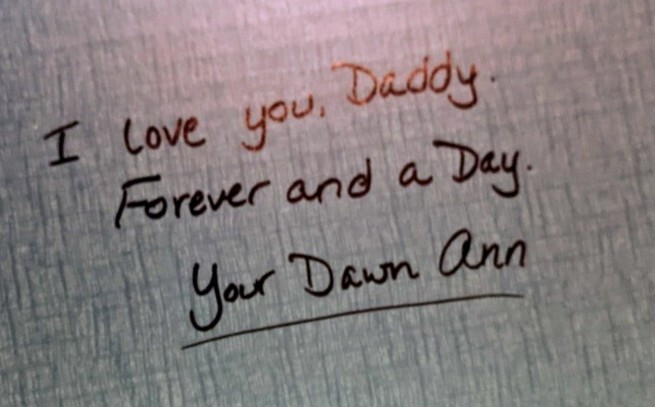
I first met Dawn Hamilton when she sent a story remembering her father to the WhoWeLost website, just after it had become a national project. The piece she wrote wasn’t like anything anyone had yet sent to the site. I recall being struck by the cadences of Dawn’s prose and her nuanced sense of detail. I live in Louisville, just across the bridge from Indiana, where Dawn has lived her whole life, but it felt as if she was writing from far away.
Over the past five years, Dawn has written many stories about her father that I’ve been honored to publish on the WhoWeLost website and her work also appears in our anthology (Who We Lost: A Portable COVID Memorial). When Dawn sent me “The Relentless Bully,” I was certain that it should be included as a Dispatch on the Rituals in the Making project website because it speaks to aspects of the pandemic that RIM is still exploring, specifically the vulnerability of patients with comorbidities and the dignity and empathy shown by the health care workers who cared for them.
Dawn describes herself as a wife, mother, grandmother, and recently retired mail carrier, who “quietly noticed the small details most people miss.” She shares that her father’s death from Covid brought forth memories long “tucked away” which compelled her to write stories about who her father was and what he meant to those around him. In the process of finding her voice as “a writer, observer, critical thinker, resister, and ally,” Dawn is continuing to evolve “as each new story finds its way into existence, continuously changing and transforming.”
I will never tire of reading Dawn Hamilton’s work. Her growth as a writer is inspiring, not just because of her abundant skills but also because she represents an essential voice among those who know that documenting the pandemic is a moral necessity.
There really seems to be no rhyme or reason the way memories process, or when they show up. I mean (as my hands open and raise up together, thinking, for a way to describe the thought) seriously, how does an unhappy memory from five or six years ago push, claw and pull itself through the myriads of everyday normal, happy, and joyous ones that outnumber it. Then it just sits there, demanding to be dealt with. It’s relentless, a bully refusing to go away, until you cry, write about it, or both. So, here we go.
About four and a half years before dad passed away, there was a disagreement with a family member and Dad became uncharacteristically angry, almost aggressive. After that, dad and mom retreated from the usual family get togethers, midweek lunches and Sunday afternoon dinners. Finally, after trying for a couple of years, I was able to get them to slowly start letting us back in. Looking back, I understand why now. My mom, trying to protect the love of her life, was hiding a secret that was just beginning.
I was finally able to convince them to go to lunch with me and my three-and-a-half-year-old grandson. When G saw dad and mom, he was ecstatic and ran to dad. It was wonderful to see dad smile at the joy of holding his great-grandson in his arms. As we walked up to the restaurant, G wanted to hold our hands. When we got to the step, he signaled he wanted to fly. So, dad and I lifted him as he raised his legs in the air, so he could soar above the step. Unbeknownst to me, my mom had been taking pictures of us as we were walking, capturing that precious moment in time. It’s one of my favorite photos. It’s also the one that causes me the most pain. The last photo of my normal.
Everything was going well. We had ordered our food and the conversation was familiar, just as it always had been. The teas were refreshing and cold. We snacked on the warm, soft buttery rolls, waiting on our food. That’s when I heard it. A quiet conversation between mom and dad. Not sure at first what was going on, I listened while keeping G distracted with crayons. Then there it was. Dad—louder, agitated, his voice unrecognizable from the man I knew. His words, even as I write them now, make my breath catch. “It’s poisoned! They put poison in the food.” Mom quietly tried, unsuccessfully, to reassure him. I don’t remember the rest of the conversation. When I run it through my mind, I can’t pull it up. All I remember is them disagreeing and then hurriedly leaving, with G and I sitting there in shock. I was left trying to explain to my grandson why Bubba left. We boxed up the food with the intention of dropping theirs off later. That version of later doesn’t happen. As we were leaving, my mom called.
On the way home, dad had changed. He was angry and the look he gave my mom scared her for the first time since they became one. He didn’t want to go home and was talking about things that weren’t happening. She went to the hospital but the only way they could admit him was if he admitted himself or the police did. While she was there, he took off walking. Mom called the police, following dad in the car. Two officers showed up, one talking to dad, one talking to mom. My mom told the officer dad was not acting like himself and went into everything that had happened. The second officer came over and said he was acting fine and asked mom how many kids she had. She told him three and our names. Apparently, unbeknownst to mom, she had been married to another man and had several more children. After talking to dad again, they understood.
Dad was admitted to the hospital for observation. We were able to see him the next day and visited him over a few days. Medication began to help, but ever so resourceful, he had figured out the entering and exiting routine of the facility. He tried to escape several times and almost made it the first time. Those visits were heartbreaking. He would greet us with hugs and kisses, talking like he was his old self. Then we would sit in the one area where he could see out the window, intently watching like something was going on. Then asking if we see what those men are doing, causing trouble and tearing things up. The neighbors are always throwing their trash on the ground. So, I look and tell him that I do and how awful that is. The window we were peering out of looked out onto the roof of the building. No people, no neighborhood, no cars, just dark shingles. Yet, he was describing it in detail, down to the colors of the cars. I would find out later that this had been going on for a while at home. Waking mom up in the middle of the night to catch the bus, that didn’t exist, at 3 a.m. nightly. The neighbors’ packages were also being brought into their apartment and mom was putting them back. In the hospital at one point, he was yelling at the other patients and staff that everyone had to get out, the Germans were coming. All the while trying to open the Emergency door. In his delusion he was trying to save everyone. When he was calm, he was walking around the unit helping anyone who needed it, especially the ladies. The diagnosis— he presents with Lewy Body Dementia.
The aggression that dad could exhibit was controlled by medication but was more than could be handled at home. We had to place him in a Healthcare Facility. In the beginning mom would visit him three or four times a day, bringing him clean clothes, food, and her love. She washed his clothes, walked him around the hallway, sat with him outside, helped him shower, and sometimes shared a meal with him. There was no cure, but between the medication and mom, he stabilized. Mom continued to believe dad would be able to come home.
Then, in March 2020 everything shut down. The pandemic closed everything. No visits, no touch, no anything. The phone calls didn’t work. It was too distracting and without contact with mom he was deteriorating. This continued for several months, until restrictions were eased but with rules. We got to visit in person for a small amount of time, wore masks, and were supposed to be only in certain areas. In those few months we lost a lot of who dad was. At first, he struggled to recognize her. I’m not sure he remembered her name, but he knew he loved her. On the first visit dad’s clothes were dirty looking, so she took his laundry home to wash. While there, we found a drawer full of the letters, cards and pictures the family had been sending him since the shutdown. All but one or two of the envelopes had never been opened. No one took the time to help him. Each unopened letter, a lost chance to keep him here. We visited as long as we could and then everything shut down again. This time we could visit him through the windows and door. He would light up when he saw mom, motioning for her to go to the door, letting her know he’d open it for her. Of course, they wouldn’t let that happen.
Until December 2020, the facility where dad was had kept Covid out of his unit. The unit had been closed to visitors. Only the residents and staff were allowed in there. Dad was supposed to be safe. He wasn’t. On Christmas day, mom got the call that dad had tested positive for the virus. The exposure to the virus was from the staff. For the next week we received small updates. Each time worse than the last. Dad had a nurse named James. James became an angel. He was taking care of dad, making him as comfortable as he could. Dad wasn’t eating and his breathing was labored. The last two days, James allowed mom, my brother and I to call his personal cell phone to talk to dad. He listened and we told him everything we wanted him to know.
On the morning of January 4, 2021, at my mom’s request, I made a call to the healthcare facility to check on dad. The phone rang and rang. After a bit a man answered, out of breath. I told him I was calling to find out how my dad, Alan Trobe, was doing. There was a long pause, the man sounded rattled. Then he quietly said, “…umm not very well. He just passed away.” I remember asking him to repeat what he said. After pulling myself back together, I called my mom. I had to tell her that the man she had been married to for 57 years, the love of her life, had died. Then I had to call my brother and tell him.
We would not be able to have a funeral service due to Covid, but the immediate family members could say goodbye. My brother, husband, daughter, son-in-law and grandson were at the funeral home. Due to a separate exposure and being positive for Covid, I was unable to be there. While they were there, I was on the phone with my family, listening. My family was at the funeral home mourning together. I was at home alone.
At the funeral home, when my husband went to pick up dad’s ashes, the individual asked if we knew his cause of death. He answered yes and was told that many of the families don’t know cause of death was from Covid. Although dad had dementia at the time of his death, it doesn’t take away the immense loss of his passing. Every person who was lost to Covid mattered. My dad mattered. They were all more than a number or statistic.
On August 27 – 30, 2025, members of the Rituals in the Marking team traveled to Utrecht, Netherlands, to participate in the 17th International Conference on the Social Context of Death, Dying and Disposal, hosted by the Association for the Study of Death & Society and Utrecht University. We presented our research as part of a double panel, “Ordinary necropolitics: Interrogating the state and its absence in everyday death,” organized by RIM research consultant Ruth Toulson, anthropology professor at the Maryland Institute College of Art, and PI Sarah Wagner.
The morning of our presentation began with an auspicious sign (a view from Amsterdam).
The two back-to-back panels were also in celebration of Ruth’s book, published in December 2024, Necropolitics of the Ordinary: Death and Grieving in Contemporary Singapore, which won Honorable Mention for the 2025 Association for Death and Society Book Prize (announced at the conference). Congratulations, Ruth!
Paige Gavin, María José Pelaez, and Avery Nennmann presenting.
During the first panel, four scholars from RIM presented:
Maria Jose Pelaez: “‘Because you have already buried your dead’: Elsa’s dual loss and the politics of waiting in Ecuador’s COVID-19 pandemic.”
Expanding on a previous dispatch, Maria Jose’s paper examined how bureaucracy during Ecuador’s COVID peak transformed routine administration into suffering. Elsa Maldonado’s experience with contradictory claims about her mother’s remains shows how “the politics of waiting” entangle families and bureaucrats in death verification.
Paige Gavin: “Revisionism and social forgetting: Mass death from the 1918 influenza to the COVID-19 pandemic.”
Paige’s talk looked at how the United States memorializes mass death due to disease, examining the historical, political, and social patterns of past disease events in parallel with the COVID-19 pandemic through the lens of revisionism and social forgetting. Among other sources, she drew on ideas that arose in the virtual seminar she hosted in January 2024 with historian Nancy Bristow and epidemiologist Katelyn Jetelina.
Avery Nennmann: “The necropolitical landscape of COVID misinformation in public health”
Avery addressed how misinformation and mistrust in medical authority during the COVID-19 pandemic prompted significant changes to public health in the United States and the ways in which denial undermines and harms healthcare systems and those who work within them. Many of the themes she explored came up in interviews she conducted as part of RIM’s “More Than a Healthcare Hero” project.
Sarah Wagner: “An American state of denial: The unreckoning of pandemic death, five years on.”
Sarah’s paper considered how pandemic denialism has taken new shape in the wake of President Trump’s re-election, forcing COVID bereaved to grapple with the absence of state recognition of mass death and its long-term effects.
Sarah Wagner, Sarah Richardson, and Gorkem Aydemir (who stopped by from KU Leuven)Sarah Richardson and David Henig (with a guest appearance from his pup)Post-panel impromptu lunch organized by Dat Nguyen
***
Throwback photo: Here’s Ruth Toulson at the 14th International Conference DDD conference in Bath, England.
The second panel on “necropolitics of the ordinary” included Ruth Toulson and our very own GW anthropology PhD graduate and professor of anthropology at Washington State University, Sarah Richardson, as well as Sally Raudon (University of Cambridge) and Sasha Kramer (Johns Hopkins University).
Celebrating the end of a successful DDD17 conference.
The two panels were a great success, with questions posed to each presenter and a robust discussion of not only COVID-19 but also the larger topic of state governance of the dead.
***
Next up: Team RIM will be attending and participating in the American Anthropological Association’s annual conference, November 19-23, 2025, in New Orleans. Fittingly, the conference theme this year is “Ghosts.” Paige Gavin and Avery Nennmann will host a roundtable, “Narratives of Care: Medical Professionals and Their Lived Experiences during the COVID-19 Pandemic,” and Joel Kuipers and Richard Grinker have organized a panel, “Scale and Loss: frontiers of care and the ghosts of mediation.” Stay tuned for dispatches on both.
For Page Hawk, 2020 began like any other year, with the exception, she told me, “of massive construction at Ingleside and the rapid spread of COVID-19.” Hawk spent the majority of her life in Washington, DC. She described her decision to move into independent living at Ingleside as a practical one. “We moved here to socialize,” she told me matter-of-factly. “Back in 2020, there was a new director at Ingleside. His name was Felix. He was quite strict with us about social distancing and following the rules.”
Felix was particularly concerned about the committees at Ingleside, small groups that meet and focus on a particular cause. In her 25 years at Ingleside, Hawk belonged to several committees. “It keeps us young. I’m 98 years old, you know.” She chuckled as she registered the shocked look on my face.
“Anyway, we all resented this strict director, but, looking back, we think he did the right thing. We had very little problems with Covid,” she said. “My building has a long history of getting together every night at 5 o’clock for a drink in the lounge, but we couldn’t do that for a time. Later on, someone discovered a mask [for sale] online with a hole in it where we could fit a straw. Felix saw a bunch of us in the lounge with our drinks and our masks, and sighed, “I give up, you win.”
Towards the end of our conversation, I noticed a photograph of a young man standing next to a canoe. My curiosity got the best of me, and I asked her about the man in the picture. She said it was her husband, “a radio operator in the Air Force during the war.” It took me far too long to realize she meant World War II. “He was stationed in London, Paris, and Cairo. Transporting men or Coca-Colas or whatever needed transporting.” Her eyes lingered on the photo, and, for a moment, I realized her mind was elsewhere. I saw the corners of her eyes crinkle in a smile before she turned back to me.
“We had a good, good marriage.” I left Page Hawk’s apartment wondering what it might be like to live through a world war and a global pandemic. What it might be like to experience ten decades of life. I was so wrapped up in my own thoughts, I managed to forget my umbrella in her apartment, oblivious to the never-ending rain that poured outside.
A Guest Dispatch by Ed Koenig Curated and edited by Martha Greenwald
***
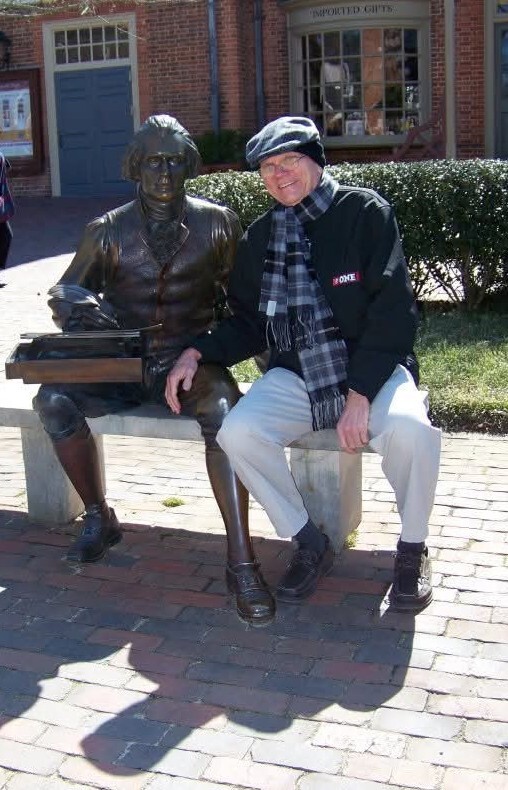
Ed Koenig lives in New York City. Retired from a career in information systems, he is exploring writing and music. His partner of 33 years, Jody Settle, died during the first wave of the COVID-19 pandemic in April 2020. He has found solace in sharing stories on the WhoWeLost website and supporting and participating in other memorial organizations. He’s travelled to Rituals in the Making activities in D.C. several times and participated in the In America: Remember remembrance event, with the Rituals team, in September 2024.
The evening of May 8, 2025, overcast and threatening showers, found me approaching the main entrance of historic Green-Wood Cemetery in Sunset Park, Brooklyn. This was the gathering place for the spring opening night of the “Naming the Lost Memorial,” which runs through June 8, 2025.
“Naming the Lost Memorial” began in May 2020 with a twenty-four hour online vigil where participants could recall the names of family and friends who had died during the first wave of the COVID-19 pandemic. It grew into a public art project offering a space for collective grief with displays appearing throughout the five boroughs of New York City twice each year: in the spring and at the time of El día de los muertos (The Day of the Dead) at the end of October. This year, 2025, is planned to be the last year for this project.
Looking to the left and the right, the cemetery fences were cloaked with very colorful banners created in memory of those who had been lost to the COVID-19 pandemic. Among those lost is my partner of 33 years, Jody Settle, who passed in the first wave of the pandemic in April 2020. I had twenty minutes before the start of the ceremony, so I decided to stroll along the fences to look at as many banners as I could to honor the dead.
Photo by Ed Koenig
I immediately noticed two things that were common to all these artistic remembrances — they were all colorful and full of life. The creators of these banners chose to focus on the life of the loved ones they had lost rather than on how they had died. Five years after the death of my partner, I understood very well their motivations — we choose to remember the lives they led and how they contributed to their families, friends, and community.
Strolling along, I became cognizant that these personal memorials were reflective of the diversity of the people gathered for the memorial. The banners represented people of all races, of various religious and spiritual traditions, drawn from nearly every continent, all who were intertwined together in the great conglomeration called New York City.
All of them reflected the cultural diversity of their creators. Several depicted the simple rituals of daily life like a walk over the Brooklyn Bridge or grandparents sitting on a park bench with their grandchildren.
Photo by Ed Koenig
I was touched to see a large sheet, painted in the colors of the rainbow, that resembled a graffiti tagging, that was made by some young people to honor their friend’s place in the world of hip hop. Their grief led them to create an object of beauty that told the world here is the story of someone who mattered.
Another, created by immigrants from Guyana, was simpler. The country name appeared at the top with five vertical bars of color – red, black, white, yellow, and green – representing the values of their culture.
To my eyes, the most intricate was a depiction of a large compass filled with concentric circles. These were full of names hand sewn into the fabric by the designer. She was nearby and I stopped to inquire about her display. She shared that she hoped to represent that, even as these people are no longer with us physically, they are still important parts of the circles of our lives.
As I walked along, I felt connected to so many more people. One thing I’ve learned over the course of the pandemic is that those who have been impacted by such tragic loss are bound together as one in remembering our loved ones while simultaneously caring for and lifting up one another. I was happy to see that there was a place where I could include my Jody in this memorial. I quickly added his name to a cut-out butterfly, available on a nearby table, and pinned it to the fence, adding him to this pantheon of heroes.
Photo by Ed Koenig
Soon, we gathered at the entrance, ready to walk to the site where the memorial service would take place. A few drops of rain fell — tears from heaven, I suppose — but quickly evaporated. Before proceeding into the cemetery, in a Mexican tradition, incense was burned and sounds were intoned on a conch to call upon the souls of all our ancestors.
We started our serpentine move into the cemetery led by a jazz band consisting of brass instruments. Their song, St. James Infirmary Blues, was doleful and fit the situation perfectly. Several of us remarked that it felt like a funeral procession in New Orleans. Many danced to the melancholy sound of the music in celebration of the lives of our loved ones. I couldn’t help but imaging Jody swaying to the music as we moved forward. We soon reached the entryway to the historic chapel at Green-Wood and molded ourselves into a circle of gathering.
After some opening remarks by the organizers and local political leaders, the program of rituals began. The various presentations came forth from multiple ethnic and religious traditions. The first was a “sound bridge” by Nate Speare. It consists of many sounds that all seemed to come from the depths of his soul. Some were joyous; some filled with mourning; all reflective of the love for those who had passed and the pain of losing them.
A Guyanese tradition followed. As bowls filled with seeds – corn, peas, and other vegetables were passed around for each person to take a handful – the presenter, Winston “Jeggae” Hoppie explained the tradition of sowing seeds in the ground to bring about new life in memory of lost loved ones. All present spread their seeds along the grass in front of the chapel in their honor.
A Mexican purification ritual was next presented by Lucia Ce-Malinalli. As burning incense filled the air, she had us face in different directions: north, south, east, west, toward the ground, and toward the sky. The ritual called upon the sun, the moon, the air, and the water to protect the dead – to look over them by day and night; to help them breathe and be refreshed. The earth was called upon to hold their remains and the sky was implored to accept their souls. After each invocation, there was a beating of drums, shaking of maracas, and the mournful sounding of a conch calling out to our ancestors and loved ones.
This was followed by an explanation and history of the Jewish tradition of laying a rock on the headstone to remember and honor the deceased. The presenter, Sarah Chandler traced the practice back to the story of Cain and Abel, intermingling her commentary with singing the Kaddish prayer. It was a somber moment that left many in tears.
A final speaker was a former prisoner who had been in an upstate New York jail during the pandemic. Willie Kearse, now free and working in creative arts, related the story of how inmates survived and cared for one another in those days. Most troubling to me was that, while given blue surgical masks to wear, they were forced by prison regulations (nothing blue could be worn) to put them on inside out, making them essentially useless. Here was a new level of suffering and neglect that I had never imagined.
Photo by Ed Koenig
The planned rituals completed, it was time to honor the dead. A ceremony of reciting names began. The organizers would pronounce a name and everyone shouted in reply presente! calling them into our presence. The recitation continued with more names spoken a little more quickly each time. The response continued presente! presente! presente! Everyone was asked to recite the names of their loved ones. Of course, I shouted out Jody’s name. I didn’t stop there. I shouted out the names of dozens of others, the loved ones of those who have become my dear friends in grief. The list of names and responses became almost cacophonous, whirling about like a dervish. I couldn’t help but be reminded of the chaos we experienced in those early days of the pandemic.
Feeling overcome with emotion I felt the need to step away. I made my way back to the entrance way. It was dark now. All the banners displayed on the cemetery gates were illuminated with strings of white lights – 46,955 of them, the “official” count of New York City residents who died from COVID-19. As I gazed along the pathway, I couldn’t help but feel sorry that Jody, and all the others were no longer here. But I took consolation in knowing he is among these 46,955 souls beaming down on us.
It’s been five years since COVID-19 was declared a pandemic. The days from March 11-14th, 2020, are etched with individual experiences of the world ending, life coming to a halt, and worry over what comes next. Though the WHO declared the COVID-19 pandemic on March 11th, 2020, it took federal and state governments a few days to catch up. In that confusion, it’s hard to put an official time stamp on the beginning of covid in the collective memory. Still, these vignettes in the moments during the initial chaos can lay the groundwork for remembering those anxiety-ridden days. For Hanaan, COVID began in December when the news began reporting it, working as a volunteer in the ER and seeing people come in droves, fearing they had contracted this virus. But the world officially ‘ended’ when everything in the United States shut down. For Avery, it was a slow trickle, then all at once with her birthday on the 14th of March in Texas – a state that would become contentious in the debate over covid restrictions that came from the community efforts to stop the spread of the virus.
***
Hanaan – It’s December, and COVID is a joke. I’m 16, a volunteer at my local emergency department, and the ED is filled with patients. Every sneeze, every cough, every runny nose and stomach ache is COVID, and it’s funny. The ignorance of patients is funny, a running joke among the nurses in my department. Part of my job is to bring them the questions and concerns of patients, and every question and concern is about this virus. The questions make no sense—I feel insane asking a nurse if you can get COVID from Amazon packages. Every time I repeat these questions and concerns, I’m met with laughter because it’s funny that patients don’t understand. It’s funny that they are so ignorant about how medicine works. It’s funny—until it isn’t.
We got our first confirmed case in late February. A patient was on a boat and later found out that someone on that boat tested positive for COVID. Now, there’s no laughing at symptoms that could be nothing and anything. Now, everything is COVID. Six providers huddle around a single phone, searching for information that doesn’t exist, a test not readily available, a treatment plan that is widely unknown. Now, the ignorance of patients is no longer funny. Now, everything is COVID. Now, that ignorance may actually be fact.
It’s March 7, 2020, and I don’t know it yet, but this is the last time I’ll be in the ED. My birthday is next week, but I don’t plan on coming in, so I bring donuts and coffee. I have been in this ED since October 2019, and at almost 17, I’m realizing that this is exactly what I plan on doing for the rest of my life. My shift is uneventful. It ends with my first experience with blood that isn’t mine. A car accident brings a family to the ED, and I’m wiping the blood off one of the kids’ faces, and that laughter is back. That laughter about COVID because the family appears to be Chinese. At this point, all of us are ignorant. We don’t know that a week from now, the world will end. A month from now, this virus will kill hundreds, if not thousands. A year from now, that joke about China and COVID will lead to unimaginable violence against those who appear Asian. At this point, we’re just as ignorant as the patients we laughed at.
It’s March 13th, and time has stopped. I would liken it to the world ending, and it felt like everything in my life got turned upside down and ripped right out from under my feet, but time has never meant the same thing anymore since 2020.
Avery – It’s March 10th, and I’m standing in a gift shop in the Grand Canyon. A frantic man approached me and my friend, looking to proselytize. Out of breath and standing too close, he begins to explain and show data of a virus coming out of China. Being in my undergrad at the time in Biomedical Sciences, I was aware in December through my infectious disease courses that we were overdue for a bird-like flu and that a new virus was causing rumbles half a world away. The man became more animated, stepping closer to cry out, “We’re all going to die! You need to prepare now! I’m here to get supplies, then I’m getting the hell out of here.” Feeling unnerved from this prophetic interaction, I carried on with my spring break plans. [In hindsight, the WHO declared COVID-19 a pandemic on March 11th, and I believe that is what the man was referencing. I think about him a lot.]
The following days blur together for me; I’m uncertain on when things began and ended, but this is markedly due to Texas’s lack of leadership and mitigations. It’s March 12th, and my university in Texas has moved all classes online for 2 weeks. Panic starts to creep in. How am I going to finish my Organic Chemistry Lab online? Do I need to move back home? How severe is this disease? We cut our time in Santa Fe short, as the day dragged on since the pandemic announcement, it began to feel like a ghost town. The unsettled feeling never leaves my body the whole ride home to Texas.
Paired with the growing social unrest within the country, this time was a breeding ground for growing resentments and misinformation.
Hanaan – It’s now March 13, 2020, and instead of a happy birthday, I wake up to the world ending. President Trump shuts down the country—no domestic or international travel, no non-essential services, no school. The hospital shuts down volunteer services, the speech I was supposed to give is canceled. The day I turned 17 felt like the world had stopped. I get calls, not to wish me a happy birthday, but to ask my opinion as a budding medical professional, and I have nothing to say. I’m not angry or sad; I’m terrified. To me, the world has stopped. Every day, someone is dying from something that was once just a joke. Doctors and nurses are quitting or committing suicide, the death toll and the slowly increasing hatred becoming a burden too much to bear. I’m terrified because this could be me one day. On March 7, I was sure this was what I was going to do for the rest of my life, and now it’s June, and I can’t say that with the same certainty.
Avery – It’s March 14th, my 20th birthday. Texas leadership has not declared quarantine, has not restricted travel, and is keeping businesses open, so my family and I go to dinner in downtown Ft Worth to celebrate my getting older as the world crumbles around me. The restaurant was nearly empty, adding to the unease and my regret and embarrassment at being outside after our government had officially declared a pandemic. Sometimes, it feels like I’m right where COVID left me – blowing out the candles of my 20th birthday. Frozen in time with what could have been.
The rest of 2020 goes by in a blur, filled with medical appointments, online classes, and escaping to the countryside. As the pandemic progressed, I saw the hospital in my small college town fill up to the brim with patients, some on beds in the hallway, and only necessary personnel entering the hospital. I was only allowed in because of the severity of my growing brain tumor, putting me in an immunocompromised state that shifted how I navigated the pandemic. By December 2020, I was the first in line with the geriatrics and immunocompromised to receive the vaccine. I was a huge advocate for protecting ourselves against this disease and led efforts to get all of my close friends vaccinated by March 2021.
For Texas, this is when the timeline splits. The state had reopened by June 2020, so by the beginning of 2021, in many minds, the pandemic was already over – despite the growing number of cases. It became business as usual, despite classes continuing to be online and restaurants and venues still beholden to federal regulations. Paired with the growing social unrest within the country, this time was a breeding ground for growing resentments and misinformation.
Hanaan – It’s 2021, and I’m back, this time as a CNA, and it’s not fun. No one laughs at sneezes, coughs, and runny noses. I wear two masks and a face shield, I change in the garage, and I don’t greet my family until I take a shower. People say it’s over. People say masks are silly and there’s no point in wearing them. People are protesting masks and vaccine mandates because it’s all fear-mongering. But all I can think about is how it used to be funny, and now it’s not. How a cold can now be COVID, and COVID can kill. And how it’s not over.
Avery – From 2022 to now, 2025, I could see these shifts growing larger in its polarization. In early 2022, I lived in Germany, where the lockdowns and precautions were ever-present and akin to the beginning of 2020. For the rest of the world, there were still mitigations to take and apps and new technology that aided in taking those steps. From the outside looking in, America was the Wild West, where covid was able to run amok with no clear leadership from both state and federal governments. This really emphasized the individualism that seeps into every corner of our society.
Hanaan – Today is March 12, 2025, and my birthday is tomorrow, and I still wear a mask because now it’s COVID, the flu, the measles, RSV, and a bunch of other things. Tomorrow is my birthday, and still, no one laughs at sneezes, coughs, and runny noses. It’s been five years, and everything is still not funny.
Avery – Today is March 14th – I’m 25. Covid has taken so much and altered my life’s trajectory in ways I still may not even understand. I feel more cautious now than I was at the beginning of 2020, but now with an unshakable knowledge of the realities of what a pandemic can do and what it did do. My only hope is that we can do better for next time and that I will be released from the shackles of time.
In the spring of 2020, as Ecuador became an epicenter of Latin America’s COVID-19 outbreak, Elsa Maldonado found herself in a situation that recalls Sophocles’ Antigone. Like the Greek character who defied the state to bury her brother, Elsa embarked on a quest to secure a proper burial for her mother, Marina. Her story reflects on the struggle for dignity in death during a time of overwhelming loss and institutional failure.
Photo by: Wladimir Torres for Fund. Periodistas sin Cadenas
When she agreed to meet me virtually – she in Guayaquil, I in Bogotá – I had imagined her as one of the ghostly figures in Mexican writer Juan Rulfo’s stories, speaking with a resigned temporality and an almost dryness. Instead, I encountered a torrent of emotions and memories, a woman who defied easy categorization.
***
Standing amidst the squeezed tulle dresses hanging in her shop – yellow, green, turquoise – Elsa began her story: “First, I would like to tell you that everything you see here was inherited from my mother. Both of us lived off of this business all these years. She was a woman who pushed forward, a strong woman. My mami was not killed by COVID. The hospital killed her.”
With that “first,” I understood that Elsa was not just telling a story of loss but reclaiming a narrative that had been taken from her. She would give me both a beginning and an ending.
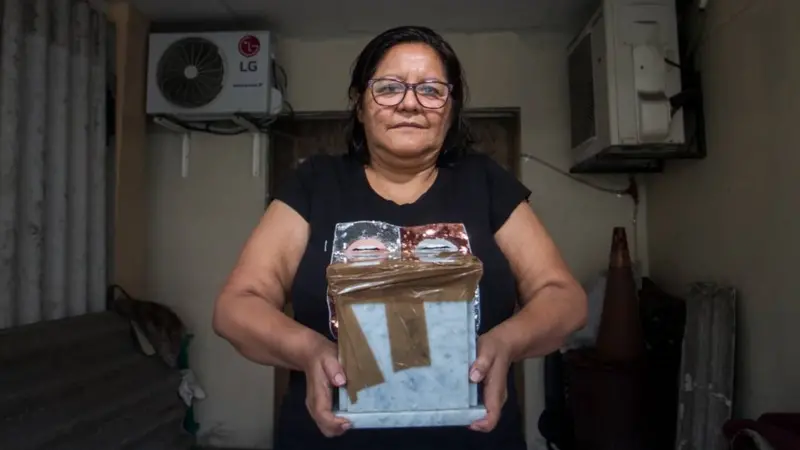
Before delving into the details of her mother’s hospitalization, Elsa paused. “You need to understand,” she said, her voice barely above a whisper, “that for months, I’ve been living with two versions of my mother’s remains. In my garage, there’s a marble urn containing ashes that I was told were hers. But then, they called me about a body in the cemetery. How could I mourn when I didn’t even know which – if either – was truly my mother?”
This uncertainty, this doubling of her loss, formed the core of Elsa’s struggle. It was an illustration of the confusion that reigned in Ecuador during the height of the pandemic, where the dead often became as lost as the living.
***
On March 25, 2020, Elsa took her mother to the hospital to get treatment for a urinary tract infection. By this time, Ecuador reported the second-largest number of deaths on the continent a number exceeded only by the much more populous Brazil. For Elsa, the “plague” or “bug” was a thing that roamed around, killing everyone she knew, fluttering, and frightening. But she was sure her “mami wasn’t infected.”
Elsa, her son Kevin, and her sister spent the entire night driving to every hospital in Guayaquil trying to get her mother admitted. They were all rejecting patients with suspected COVID-19. Elsa insisted her mother did not have “the plague.” With some embarrassment, she confessed, “I went to the private Luis Vernaza hospital in Guayaquil. I knelt to the doorman and said: ‘Here, I give you 100 dollars. Give me a bed, please.’” He refused.
When her mother was finally accepted at Los Ceibos Hospital, Elsa noticed they were understaffed. Her mother would have a bed, but no one would attend to her. Still, she kissed her mother’s forehead and promised everything would be all right, as she rushed to get a wheelchair.
“‘Mother, they’re going to take care of you, calm down, they’ll take care of you, and we’ll return home,’” she told her. “But there were so many people waiting. At that time, they gave you a bracelet, and depending on its color, you got attention. They gave my mother the yellow one. It meant ‘not urgent.’”
The hospital scene Elsa described was nightmarish. The aisles widened and shrank with every step. The rhythmic pumping of ventilators choked her. She came upon a room filled with piled bodies. “No saline, nothing,” Elsa said, just the steady pump.
“There, in the hospital, my mom got it [COVID]… there… She died in the early hours of March 26th. My mami caught it there and died there.”
Cemeteries are made of bones, but also of paper.
What followed was an ordeal of bureaucracy and uncertainty. Elsa’s son, Kevin, was given a death certificate stating that his grandmother “DIED OF PNEUMONIA” and instructions for cremation. But when he returned with an urn of ashes, Elsa knew instinctively – due to her distrust in the way the State managed the pandemic– they weren’t her mother’s. “My son came back half an hour later with a heavy marble urn without a cover. ‘They told me that this is Nana,’ he said. I took out a cover, cleaned it, and put it carefully in the garage, but with the certainty that it was not my mother’s.” Elsa didn’t cry over those ashes. Yet, she couldn’t bring herself to dispose of them, knowing they belonged to someone else’s loved one.
For months, Elsa navigated a labyrinth of institutions, each passing responsibility to another. “Nobody knew anything. They all told me they were doing their part and that I needed to escalate my request,” she recalled. Institutions that had been nonexistent or subtly absent in Ecuador before the pandemic began to multiply: the headquarters of…, the board of…, the commissioner of…, the court of… In the face of the floating bodies and the state’s negligence, a suffocating bureaucracy emerged. Cemeteries are made of bones, but also of paper.
The violence of bureaucracy reached its peak when an official called, saying, “Mrs. Elsa, we are also contacting you to remind you of your payment of $1,300 for the mortuary services, otherwise you will be charged for the delay. Because you – I remember the exact words – BECAUSE YOU HAVE ALREADY BURIED YOUR DEAD.”
These words echo the theme of Gabriel Giorgi’s work on the politics of corpses. The anonymity imposed on the dead during the pandemic created what Giorgi calls “corpses without community, bodies with which the community cannot establish any bond.”2 But Elsa, like many others, resisted this anonymity, insisting on naming and honoring her mother even when faced with unidentified remains.
Elsa’s struggle reveals how language can be weaponized to dehumanize the dead and their grieving families. The shift from “body” to “corpse,” the clinical “DIED OF PNEUMONIA” on a death certificate, the bureaucratic “BECAUSE YOU HAVE ALREADY BURIED YOUR DEAD” – all serve to distance the living from the individual humanity of the deceased.
Perhaps the most poignant aspect of Elsa’s narrative is what remains unsaid. Our interactions became less about what she was communicating and more about what she was refusing to say. Her silences, her inability, and, at moments, her unwillingness, to fully articulate her loss, voice the pain inflicted by many state and institutional responses to the pandemic.
While we often say the dead don’t speak, Elsa’s experience suggests otherwise. The presence of her mother – whether in unidentified ashes or a body in an unmarked grave – becomes a way for death itself to speak. These unclosed presences challenge our understanding of grief and memory in the face of mass casualty events.
After months of fighting, Elsa finally received confirmation that her mother’s body had been identified in a cemetery and the state withdrew the 1,300 charges after her case got notoriety in the media. But even then, her distrust of the state was so profound that she asked for a video call to make sure that, this time, the person in the cemetery was indeed her mom. From the pajamas, the blanket, the raised mole on the right shoulder, and the missing bottom tooth – Elsa knew it was her, it was Marina.
“I was not afraid of her scarred skin. I wanted to see her,” Elsa said, “I would have carried her myself like Michelangelo’s Pieta if I had been allowed to. I was afraid of the lie, of the simulation in which I have been made to live all this time.”
The day Marina died, it is estimated that at least seven hundred people died in Guayaquil. For many, there were no caskets. In a country where one in three people is poor, paying hundreds of dollars for a coffin was not an option. People began to do their private rituals at home. When they could not do it anymore, bodies started appearing here and there, scattered on the pavement.
Mauricio Torres for The New York Times/EPA vía Shutterstock.
At one point, the Mayor’s Office of Guayaquil delivered some cardboard mortuary boxes to avoid exposing the bodies and what Elsa calls “the state’s ineptitude” to the international press. Elsa wanted to know what type of coffin her mother was in. “No, she is not in a coffin,” the coroner told her.
The last time I saw Elsa she was still fighting to give her mother a proper burial and a coffin. The state hadn’t picked up the marble urn with the ashes in her garage. Elsa, as she did since the first day, kept taking care of the urn–cleaning it and waiting for a family to find whoever the person in that urn was.
***
As our conversation ended, Elsa returned to work in her shop. “It’s been dry and scarce,” she said. “Without Marina, things are not the same in the shop.” At that moment, I could almost see Marina moving alongside her daughter through the shimmering, squeezed dresses. Behind every statistic is a deeply personal story of loss, love, and strength to honor those we’ve lost.