Rituals in the Making: a George Washington University research project on memorialization, misinformation, and the consequences of the COVID-19 pandemic

Tag: memorial-day

  • Ritual in motion: Rami’s Heart Covid-19 Memorial 4th Annual 5k “Walk to Remember” 

    Ritual in motion: Rami’s Heart Covid-19 Memorial 4th Annual 5k “Walk to Remember” 

    “’A Walk to Remember’ is more than just a physical journey; it’s a step towards healing, a tribute to resilience, and a celebration of the memories that forever bind us to our loved ones.”

    – Rima Samman-Whitaker 

    By Sarah Wagner

    On April 13, 2024, I drove back up to New Jersey to take part in Rami’s Heart Memorial 4th Annual “Walk to Remember” along the boardwalk at Belmar Beach. Joined by my husband and a close friend from high school, we arrived in time to register, get our pinnies, and catch the opening ceremony. 

    It was a surprisingly chilly day for mid-April, with gusty winds and an overcast sky. But nothing to deter the organizers and participants, most of whom came prepared, dressed in layers and ready to move. Travis Whitaker (co-founder along with Rima Samman Whitaker) made his way through the crowd offering Dunkin Donuts—“you’ll walk it off.”   

    Just stone’s throw from the original site of the memorial, the event formally began at a small staging area off the boardwalk where the crowd of approximately 50 people, ranging in age from little children to seniors, gathered together for opening remarks. In the center was a wire cage with a flouncy yellow bow holding two snow-white doves. 

    The mayor of Belmar, Jerry Buccafusco, welcomed the participants, paying tribute to Rima’s drive and dedication and explaining that there would be an unveiling of a memorial plaque marking the original site of Rami’s Heart Memorial, a few weeks later on May 11. He spoke with ease and without a script, comfortable among this gathering and yet careful with his words. He knows their story and their grief. 

    Then came the releasing of the doves—five in total, two in the cage and three in a nearby crate. A woman in a bright yellow jacket handed the birds over one by one with instructions to the participating family members to hold them tightly around their wings. There was a moment of uncertainty when one of the doves flapped, tufts of feathers sent airborne. The handler explained they would need to give them a push, release them with a thrust upward, because otherwise they would fall to the ground. An unrehearsed moment around a symbolic script (of peace, love, remembrance), there was no explicit ceremonial explanation of the meaning of the doves and their release. Once freed, the birds took flight and were gone in an instant. 

    Rima then gave her own brief remarks, shorter and less formal than the lighting ceremony we attended earlier in March. Just as she had described to me beforehand, this event felt more grounded in the local community and less somber. It was a chance for people to socialize together while also remembering. 

    The ceremonial part complete, we began the walk itself along the boardwalk. People proceeded in informal groupings, presumably as they came to the event. The waves were quite high and so as we walked along the beach we saw scores of surfers—must have been ideal conditions—in wetsuits, riding the waves, the surf crashing against a large outcropping of black rocks.  

    As we neared the finish line, we caught up with Trav and I asked him about the evolution of the hearts, how many and how they grew. He explained that the first day there were about fifty. Rima posted images on social media and the next day 200 people had responded, some asking for her to add a name. The first heart was the largest, he explained, with about 300 stones contained within it. Two months later they had expanded into six hearts. Media attention—coverage from a local newspaper and then an ABC report—meant that, as they walked by the site, people knew what they were seeing. Sometimes they offered encouraging words, “It’s so good, so important what you’re doing.” Others thanked them for including their loved one’s name.  

    After having visited twice the Allaire Community Farm, where the permanent memorial now stands, it was powerful to hear these stories, to take in the sight of the beach, to imagine the stone-filled hearts in their original form, and to see Rami’s Heart—its leaders and dedicated members—gathered in ritual, in motion, and in remembrance.   

  • Observations from the RIM’s 2024 Pandemic Reflections Series finale 

    Observations from the RIM’s 2024 Pandemic Reflections Series finale 

    All the images in this dispatch were taken (and generously shared) by photographer Bruce Guthrie.

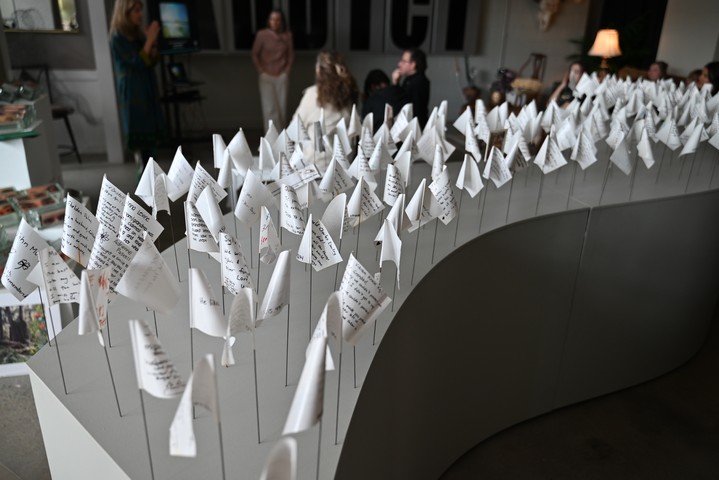
    At the concluding event of Rituals in the Making’s pandemic reflection series on Thursday, March 7, 2024, team members made their way from Foggy Bottom to Bethesda, Maryland. There, we paid a visit to Suzanne Firstenberg’s studio, which houses 20,000 flags from the In America: Remember art installation, each bearing a memorial inscription. 

    In the year since we began to transcribe the thousands of flags with written dedications, we have had to be flexible in our approach to account for the following categories: 

    1. flags from the 2020 installation, In America: How Could This Happen … held at RFK stadium 
    1. In America: Remember (IAR) flags with dedications submitted online, written by volunteers 
    1. IAR flags that were registered and handwritten by loved ones on-site at the installation 
    1. IAR flags that were un-registered and handwritten by loved ones one-site at the installation 

    RIM team members sign up to transcribe the flags when we have the time, locating the photos and correct spreadsheets scattered across our databases. 

    Professor Sarah Wagner, Professor Richard Grinker, Paige Gavin, Maura Kelly-Yuoh, and Emmy Numann were able to meet with the dedicated volunteers who have been heavily involved with cleaning and transcribing the flags (see our previous dispatches on cleaning and storing; and “sleuthing”). It gave us a chance to check back in with the process of transcribing, which had taken a temporary back-seat to our work preparing for the seminar series. 

    During this first publicly accessible visit, the studio opened its space for the volunteers from the installation to gather together during the first week of March, a time that is now held sacred by those who have lost a loved one to the pandemic or who have been diagnosed with Long COVID. The group included individuals who took photographs of each flag for transcriptions and longevity, placed flags onto the National Mall, and handwrote submitted dedications, many among them mourners themselves. 

    As people entered the studio on that day in March 2024, they were immediately greeted by a wooden structure, built in the form of curve or wave, that served as a platform to display approximately 100 of the dedicated flags. Nearby, shelves were stacked with long, white boxes that contained the rest of installation flags—all 20,000 of them. In opening up the studio, Suzanne also wanted people to get a glimpse, a reminder, of the emotional force of the flags with their individual inscriptions. 

    Suzanne showed multiple screenings of Jamie Meltzer’s short, not even for a moment do things stand still, throughout the event. The short featured families who agreed to wear microphones and filmed by the documentary crew as they placed the flag dedicated to their loved one on the National Mall. With no accompanying score, the short featured the families talking and supporting each other and captured the immense sound of hundreds of thousands of flags blowing in the wind during a picturesque autumn in the nation’s capital. The screenings invited studio visitors to reflect on and share their own experiences and impressions at the installation. 

    Listening to the personal connections that the volunteers had to the installation, as well as their anecdotes during their two weeks of work back in 2021, gave our own team members another moment, of which there can never be too many, to reflect on the work of flag transcriptions. The importance of each flag is never lost on us.