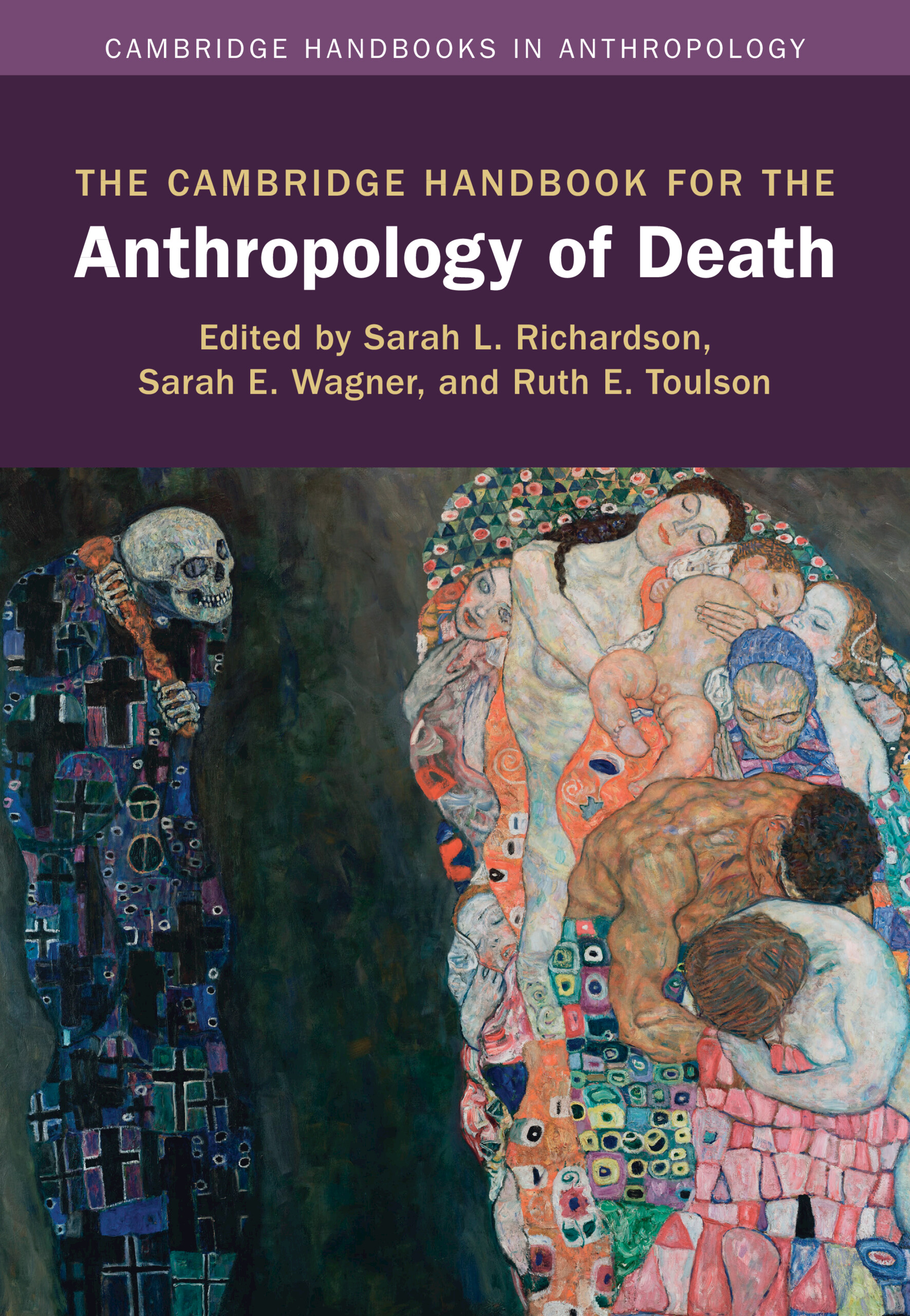
At noon EDT, we gathered—editors, contributors, our website designer, friends and family, students and colleagues—to celebrate the humble but monumental arrival into the world of The Cambridge Handbook for the Anthropology of Death. With five chapters directly addressing COVID-19, including two co-authored by Rituals in the Making team members Richard Grinker and Joel Kuipers, and Martha Greenwald, Maria Jose Pelaez, and Sarah Wagner, the volume is one of RIM’s major academic contributions.
The informal book launch attendees spanned at least three times zones: from Sarah Richardson, Tom Laqueur, and Robin Reineke (among others) on the West Coast and a whole slew of folks from the East, to Tam Ngo in the Netherlands, Graham Denyer Willis from a train in the UK, and Paco Ferrandiz who joined from a concert in Madrid. We convened in joy, levity, and, yes, a measure of relief. At long last, it’s out!!
The three editors, Sarah Richardson, Ruth Toulson, and Sarah Wagner read aloud passages from the conclusion on why the volume was important to each of them on a more personal level. Lorelei O’Reilly walked us through her inspiration and aims in creating the companion website for the volume.
We also seized the opportunity to fete various contributors for recent distinctions:
Ruth Toulson, esteemed co-editor and Chapter 7 author: her book Necropolitics of the Ordinary: Death and Grieving in Contemporary Singapore was selected as the second prize winner of the 2026 Victor Turner Prize for Ethnographic Writing. Previous honorees include volume contributors Sarah Wagner, Casey Golomski, Shannon Dawdy, Robert Desjarlais, and Richard Grinker.
Barbara King, Emerita Professor of Anthropology at William & Mary and author of the volume’s final chapter on animal grief, received the Anthropology in Media Award (AIME), Honorable Mention.
Erica Borgstrom, author of Chapter 5 on end-of-life care, recently edited three books drawing together interdisciplinary perspectives in death studies, all published by Routledge, including one on palliative care and hospice, one on Covid-19, and one featuring interviews with death studies scholars.
Paco Ferrandiz, author of Chapter 16 on Franco’s funerary project at the Valley of the Fallen in Spain, has teamed up with Élisabeth Anstett to edit the Routledge Handbook of Necropolitics (forthcoming next year).
We then heard from two contributors who have books either just out or almost out:
Andreia Vicente’s Death rites in the Covid-19 pandemic: Cut-off rites, abbreviated and mediatized in contemporary Brazil
Though unable to join us that day, Abou Farman also has a new book out, No Silence in the Afterlife, which Ruth Toulson described in brief but beautiful detail:
When, finally, our hour was almost up, each of us raised a glass (Richard Grinker, a proper martini glass nonetheless!) or a mug and—across the sacred pixels of our Zoom gathering—toasted each other and our joint accomplishment.
“Huzzah!!” in the words of Tom Laqueur.
***
Postscript: Martha Greenwald, co-author of Chapter 25 with Maria Jose Pelaez and Sarah Wagner, summed it up in an email afterwards, “I am imagining a perfume named ‘Launch!’ Dunno why. . . . It was genuinely touching and beautiful.”
As one of the over 1.2 million Americans who has lost one or more loved ones to COVID-19 (my partner of 33 years, Jody Settle, died in April 2020,) I was curious to see how the lived experiences of those who were most severely impacted would be represented. Unfortunately, our experiences were either ignored or glossed over during the various presentations.
The symposium instead looked at various aspects of how we coped and lived our lives during the temporary lockdowns that arose around the world to combat the spread of the SARS-CoV-2 virus and how some of those changes have impacted and continue to influence our daily lives.
Sour, Dough
One of the obvious areas that concerned everyone was food, its production, and the related delivery systems. As was sometimes true prior to the lockdowns, comfort food became a source of solace for many who were fearful or, worse, mourning the loss of loved ones to this new virus. I was a bit disillusioned with a reference to a meme that discussed common weight gains during that period as “the COVID nineteen” (much as first year college students are often said to experience a weight gain called the “freshman fifteen.”) Unfortunately, the laughter from the audience that ensued ignored the sentiments of those who were most severely impacted.
One of the activities that seemed to become rampant during the lockdown period was the baking of sourdough bread. Myriads of families ordered bread making machines so they also could join in this activity. Perhaps, it was their way of feeling connected to others. Someone sent me one in the days after my partner died in April 2020. Looking at the box, I wondered what I was supposed to do with a bread making machine. I couldn’t bake a new partner! Sadly, the box sits unopened in the closet six years later.
More interesting, there seems to have been an increased rediscovery of old family recipes for favorite meals that had been stored away unused due to the lack of time in our busy society. Now, staying and/or working at home, there was more time to reconsider these foods and the comforts and memories they provided. This, of course, required ingredients that many did not regularly have at hand.
The food procurement system has been impacted or altered by the pandemic. There was a huge increase in the ordering of groceries on-line which stores then needed to deliver directly to the home. Restaurants, restricted from indoor dining, began relying on services like DoorDash and Grub Hub that came into prominence during this period. People began ordering take-out food from local restaurants if only to support them and help them to survive until the lockdowns were over. The message seemed to be that people wanted to continue enjoying their favorite foods without risk to themselves. Sadly, the risk to those who had to work to survive was only discussed in a passing remark that “comfort for one became discomfort for another.”
Several other observations were made about the impact on food delivery systems. There has been a notable increase in the number of farmers markets around the country. Researchers presume that people felt that shopping at these open-air concessions was safer with less chance of exposure to the virus.
A final thought is that there now seems to be an increased understanding of how the corporate industrial food system works. People have finally acknowledged that our food doesn’t miraculously appear on the shelves in our grocery stores. It requires a great number of human resources to grow, produce and ship products and then to stock the shelves – all of which put people at risk during the pandemic. The question left unsaid is whether people continue to care about those who are part of this important supply chain component.
I would be remiss if I didn’t mention how friends and neighbors stepped up to prepare meals that they shared with me when Jody died. They would call and come over and we would meet outside. Maintaining the recommended social distance, they would place the food nearby and step back. I would then go over and pick it up. After a brief shouted “thank you,’ we would return to our homes. The comfort offered by a homecooked meal and a few minutes of face-to-face contact was not something discussed during this portion of the symposium.
Synchrony/Cacophony
Music and the impact on musicians were the themes of several presentations. Because musicians were unable to perform together in-person, many of them tried to employ new on-line technologies, like Zoom, to continue their collaborations and performances. Because of the nature of internet technology at that time (since improved somewhat,) lags in transmission speeds often made the synchronization of the various musicians difficult, if not, impossible, often leading to cacophony. Musicians experimented, learned and implemented new techniques to overcome these difficulties such as writing compositions and arrangements where one performer’s last notes could be sustained and then the next performer would begin on the same note. Also, visual clues were used for one musician to cue another. These aided the musicians to continue their creative work until they could again work together in-person. An example of these new techniques was shown (performed via Zoom) by the Kronos Quartet performing the musical piece, Marejada (which translates as “surge”) composed during the lockdown.
Other speakers spoke of the means musicians in small or isolated communities used to continue performing for themselves and others. One presenter discussed a group of blue grass musicians in southern Indiana. As they told her, if they were to live the lives they were used to living, they would have to adapt. And, they did. Single performers would play from their front porches while friends and neighbors would sit in their cars listening to the performance. Later, as restrictions eased, some of the groups would gather to perform outdoor concerts. She even showed videos of them precisely measuring out six-foot social distance circles around each performer. They did the same with the folks that came to listen and enjoy. All this helped them to live during the lockdown.
Improvisation was the key to survival for many musicians. A project based in some impoverished neighborhoods of Washington, DC, put into service a rickety old van nicknamed the “COVID Van.” The organizer, from American University, and his wife would meet musicians, usually in their late teens or early twenties, who would perform while they, safely inside the van, recorded videos that, once edited, were shared on platforms like YouTube. This allowed these young musicians to continue creating and sharing new music with their fans even when they couldn’t appear in a public setting. Again, new ways of thinking worked and continue to be used now.
Several researchers who worked in Spanish-speaking Latin American communities discussed the role of music in providing information and solace to people from Mexico to Argentina. One of the interesting things they discovered was that musicians were less concerned about making music during the pandemic, but rather they focused on creating music about the pandemic. As they termed it, the music was about the humanity of surviving.
Much of this music focused on instructing people on how to stay safe — like washing your hands frequently, wearing a face covering, and maintaining social distance – “be a good citizen and we’ll get through this.” The one quirky thing they recognized in each country was that the music was usually upbeat and the videos created for these songs were almost always full of dancing and hope and smiles. They served as cheerleaders in a time of sorrow.
The use of folk art provided some further insights. Some art work served to educate people on how to protect themselves and, in doing so, provided continued economic survival for the creators. Of course, some art work served to memorialize people who died from COVID-19.
A Renaissance of Stitches
In the early stages of the pandemic when there was a lack of personal protective equipment, ethical questions arose about the creation and sale for profit of face masks while people were dying. This included examples where protective face masks were decorated with distinctive patterns and designs and intended to be sold as art work rather than to be used as protection against the virus.
Of interest to me was how seamstresses around the world gathered whatever materials they had at hand and produced many millions of masks for their friends and neighbors and others. Their work was so prolific that there was a run on the elastic materials used to keep the masks properly placed on the face. An interesting anecdote was how seamstresses in Cambodia produced and shipped face masks to underprivileged people in the United Kingdom and Australia.
During the lockdown periods, there was a notable renaissance in the art of quilt making around the world. Many picked up an avocation that they had set aside a long time ago. Many others first came to quilting at that time.
Over time, often influenced by social media posts that referenced the AIDS Memorial Quilt that was begun to memorialize those who had died during the HIV/AIDS epidemic in the 1980s and 1990s, many tried to reproduce the feelings those quilts invoked in them and moved to sew similar quilts for those lost to COVID-19. Examination of many of the quilts produced reflect the social anxiety the creators were feeling whether from being isolated, having to maintain social distance when interacting with others, and, even the simple task of trying to find toilet paper. One other interesting aspect of this work was the number of quilting bees that arose on the internet via apps like Zoom. The people could sew while talking to others doing the same thing. It provided them a chance to share their feelings and their work. It allowed them to practice a tactile art without the need to touch.
Say Their Names
Another use of art serving to memorialize appears in the work of the Naming the Lost Memorial project in New York City. Taking inspiration from the reaction to the murder of George Floyd in Minneapolis in May 2020 and the constant call to “say his name,” this small group formed and reached out to those communities that weren’t able to properly mourn their dead following their own customs and traditions.
After receiving a grant, the group expanded and joined with local artists and musicians from various immigrant communities in New York City to develop memorial artwork and events that gave honor to their cultural ways of mourning. They scheduled two events per year: one at Brooklyn’s Green-wood Cemetery in the spring and the other celebrating the Day of the Dead (el Día de los Muertos) at the Church of St. Marks-in-the-Bowery in Manhattan. I attended both memorials in 2025 where I recall and experienced how the rituals of mourning in various places such as Mexico, Guyana, and West Africa, among others, were performed to honor the members of those communities who had passed on. While loved ones were lost, we continue to remember and learn from each other.
The Naming the Lost Memorial project concluded with the most recent Day of the Dead event in November 2025. But the project will never really end as long as we continue to say their names.
There were other various presentations. Some of them I found interesting. One dealt with the impact of COVID-19 on the Navajo Nation. It was noted that in May 2020, the indigenous peoples of the United States had the highest COVID-19 infection rates. On a brighter note, by February 2021, these same groups had the highest COVID-19 vaccine uptake rates. The primacy of elders in the indigenous populations as repositories of their language, oral and written history, and native learning methods promoted the care of these elders to primary importance in their communities as they struggled against COVID-19. An elderly Navajo woman noted speaking about COVID-19: “I look upon it as a monster that is feeding on us.” The lack of resources for these indigenous communities from the U.S. government (the case before the appearance of COVID-19) accelerated the situation. Sadly, a number of members of the Navajo community were lost.
Others presentations I found disturbing. These made me wonder why anyone would want to characterize this period of history in this way. One of these compared some of the reactions to COVID-19 pandemic to those of the 1918 Influenza Pandemic dubbed the Spanish Flu even though credible scientific evidence shows it most likely originated at a U.S. Army base in Kansas City.
In 2020, early on in the pandemic, the use of the internet and social media platforms led to “ideas” and disinformation such as the belief that 5G cell phone technology or the financier George Soros was the source of the pandemic. The somewhat racist depiction, Kung Flu, was an ad lib from Donald Trump in a speech he delivered during the beginning of the pandemic. Other strange ideas also arose at this time like “vegetarians are safe – only meat eaters get COVID” and “gargling with salt water would dislodge the virus from your throat.” Many of the numerous memes that were shared via social media showed a disconnect between the perceived image and actuality. The hurtfulness of many of these memes to those who lost loved ones to or continue to suffer from the impact of COVID-19 was not mentioned or just ignored. There was no discussion of counteracting the misinformation arising from these memes and other postings.
For me, the most disturbing presentations made during the symposium revolved around the topic of play. One positive presentation in this area of play was an exception. Presented by two young scholar researchers from the United Kingdom who work with young people living with Tourette’s Syndrome. Their organization, Tourette’s Hero, developed several creative projects to help keep these individuals engaged. One they spoke of was named “Digital Heros of Imagination.” Using whatever materials were close at hand, the people worked to create their own superheroes and then to develop backstories surrounding their creations which they told through posters that shared with one another. When the severe lockdowns were lifted, they began a second program called “Journey to a Better World.” Here, they strove to instill and maintain a sense of joy and connection in their clients.
Other presenters discussed games for children like “Coronavirus Tag” in which a designated player who, in theory, carried the coronavirus would run around and tag another player who would become “infected” and would fall down as if dead. This continued until all the players had been “infected.” The game would restart with a different player designated as the one having coronavirus. Parents seemed to find that this game, and others like it, were inventive and catered to the physical and psychological vulnerabilities of the children while including them as historical witnesses to life during the pandemic. As a person who lost someone to COVID-19, I found the idea of this game offensive, particularly because it was presented as a celebration of creativity. If only my loved one could just get up and live again. In Finland, “Korona” was a board game, much like Monopoly, where players moved along the board trying to infect the world with a virus. Players often exhibited joy in watching the virus spread. I tried to ask the presenters if they had considered the impact of these games on children who had lost a parent, sibling, or caretaker to COVID-19. They were adept at ignoring my question.
All this leads to one overarching conclusion about these presentations. All of them, in their own way, were too focused on those who had the most privilege, e.g., those who had the ability to flee large urban areas for vacation homes in rural areas. There was very little note given to the financially challenged people who lived crammed together in urban centers and continued, at much personal risk, to venture out to “essential” jobs to serve the needs of those who were able isolate. In the end, I was disappointed. I think many of the presentations failed to consider the people who were most severely impacted by COVID-19, i.e., those who died and those who loved them.
“We are talking about how we carry so many people with us wherever we go, how even simple living, these unearned moments, are a tribute to the dead.”
– Ada Limón, “Forsythia”
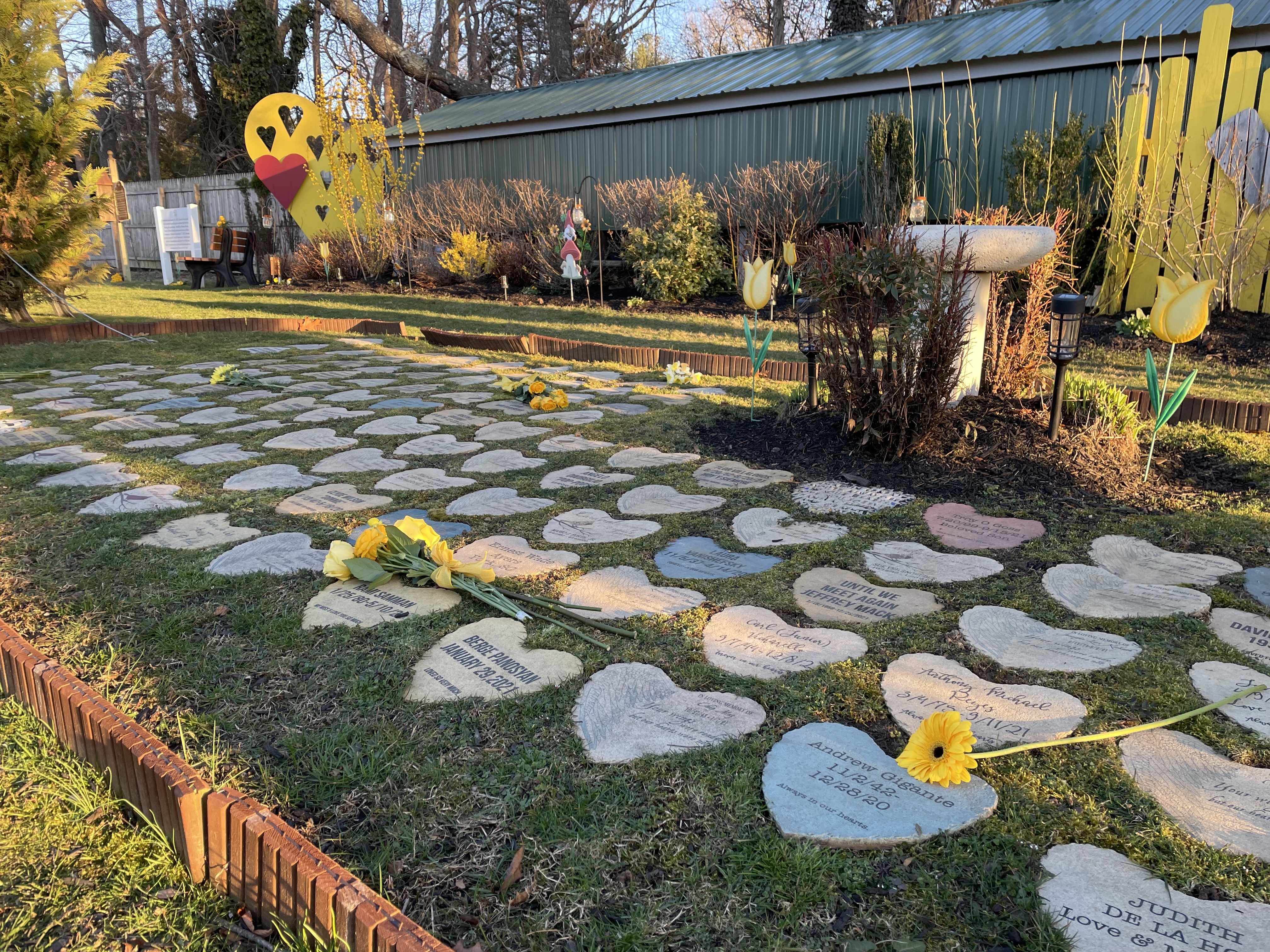
March 28, 2026: In the earnest, warm light of an early spring evening, Rami’s Heart COVID-19 Memorial once again gathered its own to remember their loved ones. Shades of yellow—hearts, shells, stones, candles, ribbons, and flowers—brought the space to life despite (or maybe because of) the setting sun. This year Paige Gavin and I had the honor of joining Rima Samman-Whitaker and the Rami’s Heart community for the occasion, and I write this dispatch with the evening’s sights and sounds still fresh in my mind. The essay combines photos from before and after the ceremony with captions drawn from the different speeches, as well as poetry that I stumbled on in the days since. I’ll start with a collage of photos and two poems that seem especially fitting.
***
Forsythia et al.
For this sixth annual lighting ceremony, Rima urged attendees to bring flowers. And so, gradually, as people arrived, so too did their floral tributes: a vase nested in the dark mulch, its bouquet brimming with shades of bright and pale yellow, pink, and green; clusters of canary-yellow roses tied to a memorial bench; a single stem of gerbera daisy resting atop a heart-shaped stone; florets of golden-yellow ranunculus (Persian Buttercups), tucked between names.
And forsythia, at the entrance and exit, just then in brilliant yellow bloom.
To my delight, I found that two of my favorite poets have written about forsythia:
It caught my eye a while ago, lit up against the gloom of the woods in the corner of a wild field, the pulsing color of caution.
And now that I have spent a little time on this stone wall watching its fire flare out of the earth I begin to think about the long chronicle of forsythia,
how these same flowers have blazed through the centuries, roused from the ground by the churning of spring. I would rather not look around the next
corner of the year to see how this will die, its lights going out, its bare, arcing branches waving like whips in the bitter wind.
So I sit facing the past, letting my feet dangle over the wall, beating time against stone with my heels as the long gray clouds roll over me.
Remember how Arnold by the Channel thought of Sophocles who must have heard the same shore-sounds long ago, walking by the edge of the Aegean?
Well, I am holding in the palm of my thoughts all the others who once were stopped, like me, by this brightness, this sulfuric cry for help:
women in tunics, women gathered by a well, men in feathers, men swimming by a river, all speaking languages I will never know, saying the different words for its color
as I feel the syllables of yellow form in my mouth and hear the sound of yellow fill the morning air.
At the cabin in Snug Hollow near McSwain Branch creek, just spring, all the animals are out, and my beloved and I are lying in bed in a soft silence. We are talking about how we carry so many people with us wherever we go, how even simple living, these unearned moments, are a tribute to the dead. We are both expecting to hear an owl as the night deepens. All afternoon, from the porch, we watched an Eastern towhee furiously build her nest in the untamed forsythia with its yellow spilling out into the horizon. I told him that the way I remember the name forsythia is that when my stepmother, Cynthia, was dying, that last week, she said lucidly, but mysteriously, More yellow. And I thought yes, more yellow and nodded because I agreed. Of course, more yellow. And so now in my head, when I see that yellow tangle, I say, For Cynthia, for Cynthia, forsythia, forsythia, more yellow. It is night now. And the owl never comes, only more of night and what repeats in the night.
***
Scenes from the ceremony: Photo essay
(The captions and quotations that accompany the images are from the ceremony’s speakers: Teresa Dimezza; Dr. Raynard E. Washington; Joann Burney; Sean Burney; and Rima Samman-Whitaker.)
“[COVID] brought a lot of loss and disruption and uncertainty and quarantines and homeschooling and all kinds of home projects and just complete chaos in our lives. And while time has moved forward, the impact of that time certainly hasn’t. In New Jersey alone, we lost more than 35,000 residents to this virus, and while that’s a number, each one of those numbers counts to life, a story, a family that’s forever been changed. . . . So tonight is about honoring those individuals, about saying their names in our hearts, holding space for their stories, and recognizing that though they’re not here with us, the love that we share for them still is here.”
“Every candle we light represents a name, a life, a story and a love that continues to shape us.” – Teresa Dimezza “We [Allaire Community Farm] are a nonprofit that we are honored to host Rami’s Heart, and Rima and Travis have become an extended family to us, and I just want to thank them for all their hard work. I know you all appreciate them very much. They put their heart and soul into this, and without them, it wouldn’t be as beautiful as it is.” – Joann Burney, Allaire Community Farm“I would like to also thank Don Corson. Don’s 91 now, and it was a little too cold for him to be here tonight, but he’s the one who, immediately after seeing the shadow boxes, saw that memorial in his head and put it together, and we had the materials. It was up in less than a week.” – Sean Burney, Allaire Community Farm
To the families I remember with you all this evening, to those that we lost, I honor you all this evening and to all gathered here, may we leave this place, not just with heavy hearts and remembrance of those that have been lost, but with a renewed sense of purpose to continue to act to make health possible for all of our neighbors here in New Jersey.” – Dr. Washington
***
“We also gather in a moment when there are voices who would rather we forget, who would have us move on without reflection and replace our very real, lived experiences with misinformation. But we can’t, and New Jersey won’t. Public health is based depends on trust and on truth and our willingness to learn from what we’ve endured together as communities. Remembering is not about looking backwards. It’s about honoring lives by doing better as we move forward.” – Dr. Washington
***
“But in the six years, each and every year, something happens, something brings us hope, something shows us that there’s still good things out there, like Sean and Joan who gave us the space, like Governor Mikie Sherrill and Dr. Washington for recognizing our grief, the board members that meet with us every month and help us plan everything out, and we all do it on our own time.” – Rima Samman-Whitaker, Founder of Rami’s Heart COVID-19 Memorial
“So it’s another year that we go on grieving as the world moves on. The reality is we’ll never move on from our grief, but we’ll ever, will forever carry their love and their light. So tonight, when we light those candles, just know that we carry their light. And although grief may not be a great thing, it is a part of us. It is a part of who we are now, and it is up to us to keep them in our memory and our lives.”
On August 27 – 30, 2025, members of the Rituals in the Marking team traveled to Utrecht, Netherlands, to participate in the 17th International Conference on the Social Context of Death, Dying and Disposal, hosted by the Association for the Study of Death & Society and Utrecht University. We presented our research as part of a double panel, “Ordinary necropolitics: Interrogating the state and its absence in everyday death,” organized by RIM research consultant Ruth Toulson, anthropology professor at the Maryland Institute College of Art, and PI Sarah Wagner.
The morning of our presentation began with an auspicious sign (a view from Amsterdam).
The two back-to-back panels were also in celebration of Ruth’s book, published in December 2024, Necropolitics of the Ordinary: Death and Grieving in Contemporary Singapore, which won Honorable Mention for the 2025 Association for Death and Society Book Prize (announced at the conference). Congratulations, Ruth!
Paige Gavin, María José Pelaez, and Avery Nennmann presenting.
During the first panel, four scholars from RIM presented:
Maria Jose Pelaez: “‘Because you have already buried your dead’: Elsa’s dual loss and the politics of waiting in Ecuador’s COVID-19 pandemic.”
Expanding on a previous dispatch, Maria Jose’s paper examined how bureaucracy during Ecuador’s COVID peak transformed routine administration into suffering. Elsa Maldonado’s experience with contradictory claims about her mother’s remains shows how “the politics of waiting” entangle families and bureaucrats in death verification.
Paige Gavin: “Revisionism and social forgetting: Mass death from the 1918 influenza to the COVID-19 pandemic.”
Paige’s talk looked at how the United States memorializes mass death due to disease, examining the historical, political, and social patterns of past disease events in parallel with the COVID-19 pandemic through the lens of revisionism and social forgetting. Among other sources, she drew on ideas that arose in the virtual seminar she hosted in January 2024 with historian Nancy Bristow and epidemiologist Katelyn Jetelina.
Avery Nennmann: “The necropolitical landscape of COVID misinformation in public health”
Avery addressed how misinformation and mistrust in medical authority during the COVID-19 pandemic prompted significant changes to public health in the United States and the ways in which denial undermines and harms healthcare systems and those who work within them. Many of the themes she explored came up in interviews she conducted as part of RIM’s “More Than a Healthcare Hero” project.
Sarah Wagner: “An American state of denial: The unreckoning of pandemic death, five years on.”
Sarah’s paper considered how pandemic denialism has taken new shape in the wake of President Trump’s re-election, forcing COVID bereaved to grapple with the absence of state recognition of mass death and its long-term effects.
Sarah Wagner, Sarah Richardson, and Gorkem Aydemir (who stopped by from KU Leuven)Sarah Richardson and David Henig (with a guest appearance from his pup)Post-panel impromptu lunch organized by Dat Nguyen
***
Throwback photo: Here’s Ruth Toulson at the 14th International Conference DDD conference in Bath, England.
The second panel on “necropolitics of the ordinary” included Ruth Toulson and our very own GW anthropology PhD graduate and professor of anthropology at Washington State University, Sarah Richardson, as well as Sally Raudon (University of Cambridge) and Sasha Kramer (Johns Hopkins University).
Celebrating the end of a successful DDD17 conference.
The two panels were a great success, with questions posed to each presenter and a robust discussion of not only COVID-19 but also the larger topic of state governance of the dead.
***
Next up: Team RIM will be attending and participating in the American Anthropological Association’s annual conference, November 19-23, 2025, in New Orleans. Fittingly, the conference theme this year is “Ghosts.” Paige Gavin and Avery Nennmann will host a roundtable, “Narratives of Care: Medical Professionals and Their Lived Experiences during the COVID-19 Pandemic,” and Joel Kuipers and Richard Grinker have organized a panel, “Scale and Loss: frontiers of care and the ghosts of mediation.” Stay tuned for dispatches on both.
A Guest Dispatch by Ed Koenig Curated and edited by Martha Greenwald
***
Ed Koenig lives in New York City. Retired from a career in information systems, he is exploring writing and music. His partner of 33 years, Jody Settle, died during the first wave of the COVID-19 pandemic in April 2020. He has found solace in sharing stories on the WhoWeLost website and supporting and participating in other memorial organizations. He’s travelled to Rituals in the Making activities in D.C. several times and participated in the In America: Remember remembrance event, with the Rituals team, in September 2024.
The evening of May 8, 2025, overcast and threatening showers, found me approaching the main entrance of historic Green-Wood Cemetery in Sunset Park, Brooklyn. This was the gathering place for the spring opening night of the “Naming the Lost Memorial,” which runs through June 8, 2025.
“Naming the Lost Memorial” began in May 2020 with a twenty-four hour online vigil where participants could recall the names of family and friends who had died during the first wave of the COVID-19 pandemic. It grew into a public art project offering a space for collective grief with displays appearing throughout the five boroughs of New York City twice each year: in the spring and at the time of El día de los muertos (The Day of the Dead) at the end of October. This year, 2025, is planned to be the last year for this project.
Looking to the left and the right, the cemetery fences were cloaked with very colorful banners created in memory of those who had been lost to the COVID-19 pandemic. Among those lost is my partner of 33 years, Jody Settle, who passed in the first wave of the pandemic in April 2020. I had twenty minutes before the start of the ceremony, so I decided to stroll along the fences to look at as many banners as I could to honor the dead.
Photo by Ed Koenig
I immediately noticed two things that were common to all these artistic remembrances — they were all colorful and full of life. The creators of these banners chose to focus on the life of the loved ones they had lost rather than on how they had died. Five years after the death of my partner, I understood very well their motivations — we choose to remember the lives they led and how they contributed to their families, friends, and community.
Strolling along, I became cognizant that these personal memorials were reflective of the diversity of the people gathered for the memorial. The banners represented people of all races, of various religious and spiritual traditions, drawn from nearly every continent, all who were intertwined together in the great conglomeration called New York City.
All of them reflected the cultural diversity of their creators. Several depicted the simple rituals of daily life like a walk over the Brooklyn Bridge or grandparents sitting on a park bench with their grandchildren.
Photo by Ed Koenig
I was touched to see a large sheet, painted in the colors of the rainbow, that resembled a graffiti tagging, that was made by some young people to honor their friend’s place in the world of hip hop. Their grief led them to create an object of beauty that told the world here is the story of someone who mattered.
Another, created by immigrants from Guyana, was simpler. The country name appeared at the top with five vertical bars of color – red, black, white, yellow, and green – representing the values of their culture.
To my eyes, the most intricate was a depiction of a large compass filled with concentric circles. These were full of names hand sewn into the fabric by the designer. She was nearby and I stopped to inquire about her display. She shared that she hoped to represent that, even as these people are no longer with us physically, they are still important parts of the circles of our lives.
As I walked along, I felt connected to so many more people. One thing I’ve learned over the course of the pandemic is that those who have been impacted by such tragic loss are bound together as one in remembering our loved ones while simultaneously caring for and lifting up one another. I was happy to see that there was a place where I could include my Jody in this memorial. I quickly added his name to a cut-out butterfly, available on a nearby table, and pinned it to the fence, adding him to this pantheon of heroes.
Photo by Ed Koenig
Soon, we gathered at the entrance, ready to walk to the site where the memorial service would take place. A few drops of rain fell — tears from heaven, I suppose — but quickly evaporated. Before proceeding into the cemetery, in a Mexican tradition, incense was burned and sounds were intoned on a conch to call upon the souls of all our ancestors.
We started our serpentine move into the cemetery led by a jazz band consisting of brass instruments. Their song, St. James Infirmary Blues, was doleful and fit the situation perfectly. Several of us remarked that it felt like a funeral procession in New Orleans. Many danced to the melancholy sound of the music in celebration of the lives of our loved ones. I couldn’t help but imaging Jody swaying to the music as we moved forward. We soon reached the entryway to the historic chapel at Green-Wood and molded ourselves into a circle of gathering.
After some opening remarks by the organizers and local political leaders, the program of rituals began. The various presentations came forth from multiple ethnic and religious traditions. The first was a “sound bridge” by Nate Speare. It consists of many sounds that all seemed to come from the depths of his soul. Some were joyous; some filled with mourning; all reflective of the love for those who had passed and the pain of losing them.
A Guyanese tradition followed. As bowls filled with seeds – corn, peas, and other vegetables were passed around for each person to take a handful – the presenter, Winston “Jeggae” Hoppie explained the tradition of sowing seeds in the ground to bring about new life in memory of lost loved ones. All present spread their seeds along the grass in front of the chapel in their honor.
A Mexican purification ritual was next presented by Lucia Ce-Malinalli. As burning incense filled the air, she had us face in different directions: north, south, east, west, toward the ground, and toward the sky. The ritual called upon the sun, the moon, the air, and the water to protect the dead – to look over them by day and night; to help them breathe and be refreshed. The earth was called upon to hold their remains and the sky was implored to accept their souls. After each invocation, there was a beating of drums, shaking of maracas, and the mournful sounding of a conch calling out to our ancestors and loved ones.
This was followed by an explanation and history of the Jewish tradition of laying a rock on the headstone to remember and honor the deceased. The presenter, Sarah Chandler traced the practice back to the story of Cain and Abel, intermingling her commentary with singing the Kaddish prayer. It was a somber moment that left many in tears.
A final speaker was a former prisoner who had been in an upstate New York jail during the pandemic. Willie Kearse, now free and working in creative arts, related the story of how inmates survived and cared for one another in those days. Most troubling to me was that, while given blue surgical masks to wear, they were forced by prison regulations (nothing blue could be worn) to put them on inside out, making them essentially useless. Here was a new level of suffering and neglect that I had never imagined.
Photo by Ed Koenig
The planned rituals completed, it was time to honor the dead. A ceremony of reciting names began. The organizers would pronounce a name and everyone shouted in reply presente! calling them into our presence. The recitation continued with more names spoken a little more quickly each time. The response continued presente! presente! presente! Everyone was asked to recite the names of their loved ones. Of course, I shouted out Jody’s name. I didn’t stop there. I shouted out the names of dozens of others, the loved ones of those who have become my dear friends in grief. The list of names and responses became almost cacophonous, whirling about like a dervish. I couldn’t help but be reminded of the chaos we experienced in those early days of the pandemic.
Feeling overcome with emotion I felt the need to step away. I made my way back to the entrance way. It was dark now. All the banners displayed on the cemetery gates were illuminated with strings of white lights – 46,955 of them, the “official” count of New York City residents who died from COVID-19. As I gazed along the pathway, I couldn’t help but feel sorry that Jody, and all the others were no longer here. But I took consolation in knowing he is among these 46,955 souls beaming down on us.
Trinity Eimer graduated from Rice University in 2024 with a major in cell biology and genetics, a minor in medical humanities, and a certificate in Spanish. During the acute phase of the COVID-19 pandemic, she was inspired by watching her mom, an intensivist, work through the many challenges and griefs the pandemic brought. Trinity also experienced the deaths of several family members, and wondered why the grief she felt–and saw around her–during the pandemic felt so different from grief during “normal” times. This question led her to travel the globe for a year as a Watson Fellow, exploring the pandemic’s effects in other countries. Thus far, she has visited Mexico, Chile, the UK, Ireland, the Netherlands, and Japan, and will return to the US in 2025. Upon her return, she plans to apply to medical school.
In July of 2024, I traveled to Mexico to explore the impact of COVID. I was particularly interested in exploring how healthcare workers and laypeople experienced pandemic-resultant grief. In order to better understand the pandemic’s accompanying sorrows, I sought to understand general sentiments and practices regarding death and grief in Mexico, both in the present day and throughout the country’s storied past.
As I traveled through Mexico, I became deeply interested in how often I encountered themes of death and grief within Mexican art. I visited Frida Kahlo’s historic Casa Azul and discovered that in her still life paintings, she hinted at deeper themes of death and pain. I toured the Casa Estudio Luis Barragán and noted how the famed architect worked symbolic reminders of mortality into the building itself. Reminders of mortality presented themselves in every museum and artistic space I entered.
I began to actively explore how death and grieving are portrayed in Mexican art. In fact, the theme of death is so prevalent in Mexican art that an entire museum is dedicated to the topic. The Museo Nacional de la Muerte in Aguascalientes houses artifacts and artworks related to funerary practices and death in Mexico throughout its history.
The museum itself is enormous and unforgettable. The exhibits are varied: the first room contains a replica of northern and western pre-Hispanic tombs, while later rooms explore the connection between political cartoons and skeletal imagery. Still further on, a collection of modern art related to death is on display. One memorable painting, titled “Catrina con celular” by Erandini Figueroa, depicts a skeleton in a revealing tank top talking on her mobile phone while wearing the catrina’s classic fancy hat. In other words, depictions of death-related imagery span the gamut from the solemn and religious to the irreverent and playful.
One of my favorite works in the museum is Francisco Toledo’s “La muerte caga I.” The print depicts a skeleton squatting down and releasing a billowing stream of ink from its backside.
My initial reaction to the piece — giggly shock — gave way, upon further contemplation, to a deep appreciation for its layered, complex meaning. Death and excrement are both shunned as polite topics of conversation. Yet death, like excretion, is an inevitable part of life. Both death and excretion work in cycles: you die and your nutrients are absorbed by the earth — you consume the nutrients of the earth and excrete them again.
By explicitly connecting the themes of death and excretion, Toledo powerfully demonstrates the natural inevitability of death while also forcing the viewer to contemplate why the bodily processes of death and excretion are so distinctly compartmentalized. Moreover, “La muerte caga I” calls to mind pre-Hispanic beliefs regarding the cyclical nature of death and life. Many different ethnic groups in Mexico shared some variety of beliefs in this cycle.
The popularity of the skull and skeleton in modern-day death-related art in Mexico is a direct result of this historically significant cycle, according to the museum’s accompanying text.
In many cultures across Mexico, the skeleton became not a symbol of death, but of eternal life; by representing skeletons as living beings, doing such things as talking on phones or using the bathroom, the phenomenon of life after death is made visible.
The ability of art to communicate healing and comforting ideas about death, or at least to introduce the necessity of considering death to the viewer, struck me as powerful. During the pandemic itself, art became a tool that many in the US used to cope with the painful reality of grieving in isolation. People wrote poetry reminding themselves and their communities of the power in solidarity and in friendship across distance. Others picked up long-forgotten paintbrushes and instruments, escaping the sad present into the arms of artistry.
Pandemic-era art serves to memorialize the events of the pandemic and commemorate those who died from COVID. Books such as “Our Evenings” by Alan Hollinghurst incorporate elements of the pandemic into the plot. Songs like “Supalonely” by Benee became popular during the pandemic, forever bearing an association between their lyrics (“I’m a sad girl, in this big world / It’s a mad world / … I’ve been lonely”) and lockdowns. Purposeful artistic memorials communicate the grief of the COVID-bereaved to future generations, communicating the importance of preparing appropriately for potential future pandemics and the impossible enormity of the many griefs left behind.
My exploration of death-related art in Mexico and its relationship to pandemic-era art led me to conclude that death and art are inescapably intertwined. Whether art is used as an outlet to express grief or as a medium through which to convey messages about death, it allows humanity to express the inexpressible and the unknowable: the vastness of grief, the mystery of death.
“We’re literally the first permanent national memorial, which I can’t believe we’ve accomplished that because back then [in January 2021] we were so deep in our grief that we didn’t even realize what we were doing. So the fact that we did it and we continue to maintain it is really amazing.”
– Rima Samman-Whitaker in a video interview for Asbury Park Press, March 13, 2025
“There was and still is just a profound sense of emptiness, regret, blame, and longing. It’s drowning over and over again without ever catching your breath.”
– Michelle Digangi, mother of Jonathan Digangi, who died of COVID at the age of 26.
Members of the RIM team drove from Washington, DC, to the Allaire Community Farm in Wall, NJ, on March 15, 2025, to join Rami’s Heart, its community of mourners and supporters, in their efforts to mark five years since the start of the pandemic. This year’s fifth annual lighting ceremony began slightly later than in the past, at 6:00 pm, just as dusk was starting to settle over the farm and the memorial. Those who arrived early were immediately drawn toward a series of memorial signs (“In loving remembrance”) placed on either side of the stretch of lawn that leads to the covered memorial space of Rami’s Heart. Some lingered to study the faces; others took photographs of their loved one’s sign.
The memorial itself also had a new feature: a printed directory at the entrance that allowed visitors to look up individual names and locate the memorial stone in the corresponding “”heart”—the display case that houses one of the twelve clamshell-bordered hearts.
Visitors took their time walking through the memorial illuminated by lights strung above and lines of mason jars filled with tea lights below. Gestures of tender recollection, fingertips kissed and traced over names; cameras zoomed into focus; words shared in hushed tones—all combined to reinforce an aura of sacral remembrance. Shells, stones, memories, and the people who treasure them.
Alongside these images and descriptions of memorial, its attendees, and the atmosphere of the day, in this dispatch we want to give space to a tribute of mourning shared by one of the ceremony’s speakers, Michelle Digangi, mother of Jonathan Digangi. Her words brought us, the audience, to tears, both in recounting the loss of her son and how the knowledge of his suffering and pain of his absence have forever changed her and her family:
“Just over four years ago we lost our son Jonathan on January 3, 2021 after he fought relentlessly for 18 long days by himself with no one by his side. During those 18 days, he never allowed me or his father to know how sick he really was. It wasn’t till the day before he left us that we realized when he texted us both saying he was in too much pain he couldn’t fight anymore and he asked to be put on a ventilator. His words to his ICU nurse was just “Tell my mom I will be ok.”
The hospital would not allow us to be by him even when they knew he was never coming home. There were no last goodbyes, no ‘I love you so much and I am proud to be your mom.‘
There was and still is just a profound sense of emptiness, regret, blame, and longing. It’s drowning over and over again without ever catching your breath.
As a family, we not only lost a son and brother, we lost our futures together. We have three boys and all their lives we did everything together, even as they became adults. We embodied a true sense of family in every way. From celebrating all holidays, birthdays and special events with each other. So to say we only lost a son would be a lie; we lost our family. There are no more happy holidays decorating the tree or dying Easter eggs. No longer do we look forward to our annual apple picking and hayrides. Where there was once so much love, happiness and joy, what has been left behind is sadness, and loss so profound the devil himself would be brought to his knees. We all lost so much the day JonJon was taken from us. The world lost a light so bright even the stars themselves would be jealous of him.
Living without a child rips at not only [your] heart but your soul. It changes you in ways that you don’t even recognize yourself most days. It puts a stain on all your relationships because the person you were before is truly not the person you are today. Hell, somedays I don’t even like myself. I’ve lost the me that I was and do not know how to cope with the person I was forced to become.
Our two other boys have been our reason to continue on. They are our life and without them not sure where we would be today. I wish I had some words to tell you it gets better or easier, but I would be lying to you all. For me the pain and longing are just as bad today as the day Jonathan left us. Nothing makes that broken shattered piece of your heart and soul stop aching and hoping that each morning you will wake up and it was all just a nightmare.
I am grateful to Rami’s Heart for being a driving force in memorializing our loved ones because whether it’s a son, daughter, mother, father or any person you love, they all deserve to be remembered, loved, and honored for as long as we live.
Thank you for taking the time to listen about the loss of our son Jonathan Digangi, forever 26.”
In our own remarks, presented by RIM team member Paige Gavin, we sought to recognize the lasting imprint of losses such as Michelle’s, alongside the powerful, enduring work of Rami’s Heart Memorial. Paige explained:
“We’ve learned that the work of remembrance happens through grand acts and small gestures. It’s with that in mind and on an occasion like today, that we as researchers can say to you, this vast but tightly knit community of mourners, that what you do will live on – for years and decades to come. Your memories will be this nation’s memories. Maybe they don’t know it yet, but the bright yellow shells and hand-painted rocks are laying the cornerstones of collective memory that no attempts at pandemic revisionism or social forgetting can brush away.”
To Rima and Trav, to Michelle Digangi, her husband and her two other boys, to all of the Rami’s Heart community: thank you for allowing us to stand with you in this beautiful event of remembrance and solidarity.
“All beginnings contain an element of recollection.” When the late British anthropologist Paul Connerton wrote these words (1989: 6), he had in mind a specific kind of memory: social memory that generates and is revitalized in commemorative practices (like rituals, holidays, and parades) as well as in material culture (like monuments, museums, and sacred texts). But there is an even more general point to be made: when we remember, and perhaps especially when the memories cause us pain, we try to find meaning in the pain; and when we search for meaning, we are engaged in creative and imaginative acts.
To illustrate our capacity for creativity, one need only look at two of the subjects covered in our dispatches: “In America: Remember” and “Rami’s Heart.” Both efforts came from mourning losses to COVID-19 – “In America: Remember” from artist Suzanne Brennan Firstenberg’s desire to mourn and honor the enormous number of people in the US who died from the virus, and “Rami’s Heart” from Rima Samman-Whitaker’s desire to mourn and honor her brother, and to invite us to join her and extend that honor to others. Importantly, the projects continue to grow, even in a divisive political climate in which many in the US deny the realities of the pandemic and urge us to forget. As we will see below, when Freud wrote during WWI about the positive effects of mourning, he was so critical of those who reacted to loss with apathy and dejection rather than with a therapeutic grieving process that he suggested they were engaged in a “revolt” against mourning. To the extent that Firstenberg and Samman-Whitaker’s projects seek to embrace rather than to revolt against mourning, they are counter-revolutionary.
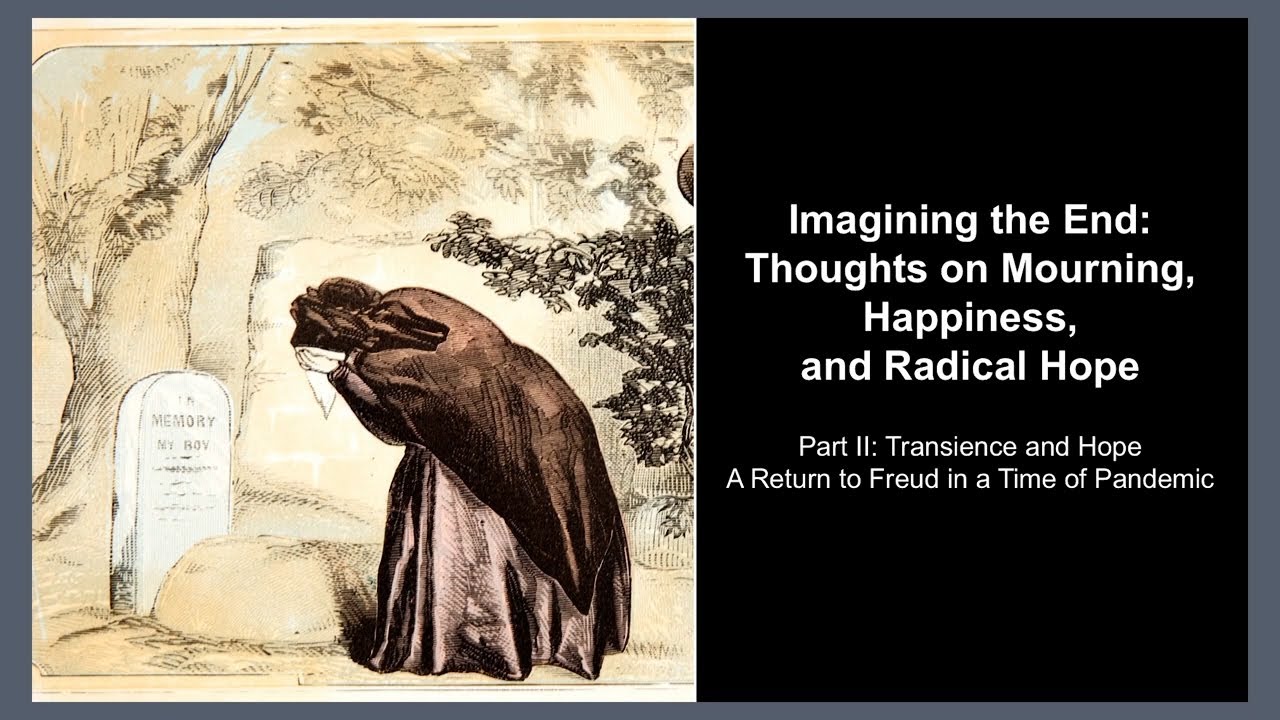
I recently came across a fascinating short article by the philosopher and psychoanalyst Jonathan Lear, “Transience and Hope: A Return to Freud in a Time of Pandemic” (2021), that might help us understand the value of mourning we see in phenomena like “In America: Remember” and “Rami’s Heart.” I also bring it up for a simple academic reason: it is a relatively unknown work that may be of interest to many scholars who, if they are anything like me, had never even heard of it.
Given the title of his essay, I assumed Lear’s article would be about Freud’s 1917 “Mourning and Melancholia,” since so many scholarly works on the COVID-19 pandemic draw on this classic. Writers in numerous academic disciplines have argued that the pandemic and the restrictions on social interaction that followed (including mortuary rites) complicated the experience of loss, making it hard for survivors to move from what Freud considered pathological grief or melancholia (the unconscious experience of loss as grief of a part of one’s self) to “normal” mourning (the conscious experience of grief as the loss of someone outside of ourselves).
But Lear surprises us. Instead, he discusses Freud’s little-known 1916 piece “On Transience,” a short 2 ½ page reflection. The seeds of “Mourning and Melancholia” are there, but they are symbolized, as in a dream or a parable.
In “On Transience,” Freud reflects on a vacation in 1913, just one year before the onset of WWI, when war, in his words, “robbed us of very much that we had loved, and showed us how ephemeral were many things that we had regarded as changeless” (1957 [1916]: 307). He recounts a summer walk in the countryside (likely the Dolomite mountains in northeastern Italy) – with an unnamed “taciturn friend” and an unnamed “famous poet.” We learn almost nothing about the views of the taciturn friend, who remained taciturn; other than that, he did not enjoy the walk. The poet, however, expresses his displeasure. He becomes despondent when he considers that the beauty around him and indeed “all human beauty” will one day disappear. Freud cannot argue with the fact that many beautiful things perish; but he does dispute the idea that transience should get in the way of enjoying what is currently in front of us. In fact, transience should make that which is beautiful even more beautiful. As Freud puts it, “A flower that blossoms only for a single night does not seem to us on that account less lovely” (1957 [1916]: 306). Why, then, was the friend unhappy and the poet so disturbed?
Freud writes, “What spoilt their enjoyment of beauty must have been a revolt against mourning,” and more specifically the pain of mourning, even if they were unaware of the reason for their melancholy. For Freud, mourning is therapeutic; unlike melancholia, personified by his companions, mourning allows us to appreciate what we love, even if it perishes, while at the same time, it liberates us to attach ourselves to other new objects of love. Mourning doesn’t eliminate the loss—in fact, it transforms the natural phenomenon of death into an experienced loss, an absence in our lives to which we give a psychological meaning, and in so doing provides us with relief. This is the point Lear wishes to make: melancholia fixes us in one place; it is unproductive and can lead to depression, while mourning is creative. What’s more, the pain of mourning—at least one’s socially recognized withdrawal or the impairments in one’s everyday life—eventually wanes.
Lear tells us that he read “On Transience” differently before and during the pandemic. Before the pandemic, he considered it merely a poignant meditation on ephemeral beauty, and the imagined losses of the impending war. After the pandemic, he read it as an allegory of Freud’s own process of mourning. Despite Freud’s insistence that he is different from the poet, having worked through the problem of how to sustain an appreciation of beauty in a chaotic and ephemeral world, there is evidence that Freud on the walk in the Dolomites is also melancholic, grieving a part of himself. Freud writes almost apocalyptically. He says that the war “tarnished the lofty impartiality of our science,” “let loose the evil spirits within us,” “made our country small again,” and “shattered our pride in the achievements of our civilization, our admiration for many philosophers and artists and our hopes of a final triumph over the differences between nations and races” (307). The losses of pride, admiration, faith in science, the nation, etc. are pieces of Freud, losses of his ideals. He does not sound like someone in “normal” mourning; he sounds like someone who needs to mourn.
Lear is thus convinced that the essay, read as a whole, is an allegory for Freud’s own mourning process. “On Transience,” Lear concludes, is “a performance of psychic repair in the midst of world catastrophe” (2021: 13, emphasis in original). First, Lear suspects no such trip or conversation ever took place. The event is likely a fictional attempt to make a philosophical and psychological argument, and to illustrate a journey into mourning. Second, the two companions are part of Freud’s own mind, as he debates valuing and despairing that which is transient, an internal debate Lear considers to be both something personal for Freud, as well as a general, human, psychological process. By identifying melancholia in his fellow travelers and mourning in his own “working through” of transience, I even wondered if there was some attempt here to symbolize the taciturn traveler as the self-centered Id, the poet as the guilt-ridden superego, and Freud himself as the mediating ego. What’s more, the three individuals may also represent Freud’s reading audience, living in war and ambivalent about the future.
Even those who did not lose friends or family from COVID-19 suffered, as Freud did in WWI, as we witnessed the loss of faith in science, the loss of pride in our leaders, the loss of national unity in the face of a tragedy that, under different historical conditions, might have brought us together. If readers, Lear says, “can use [Freud’s] essay to make a similar journey” it might help them deal with the pain of their losses.
Even within the war, Freud remained optimistic about the possibilities of mourning. He writes that mourning is itself transient, and perhaps even evil is transient: “Once the mourning is over, it will be found that our high opinion of the riches of civilization has lost nothing from our discover of their fragility. We shall build up again all that war has destroyed, and perhaps on firmer ground and more lastingly than before.”
References Cited
Connerton, Paul. 1989. How Societies Remember. Cambridge: Cambridge University Press.
Freud, Sigmund. 1957 [1916]. “On Transience.” The Standard Edition of the Complete Psychological Works of Sigmund Freud. James Strachey, trans. London: Hogarth.
Lear, Jonathan. 2021. “Transience and Hope: A Return to Freud in a Time of Pandemic.” International Journal of Psychoanalysis, 102 (1): 3-15.
Lear, Jonathan. 2022. Imagining the End: Mourning and Ethical Life. Cambridge, MA and London: Belknap Press of Harvard University Press.
Acknowledgments: Many thanks to Paige Gavin for comments on a draft of this dispatch.
An Interview with Dr. Eileen Gavin on Serving Native Communities During the COVID-19 Pandemic.
By: Avery Nennmann
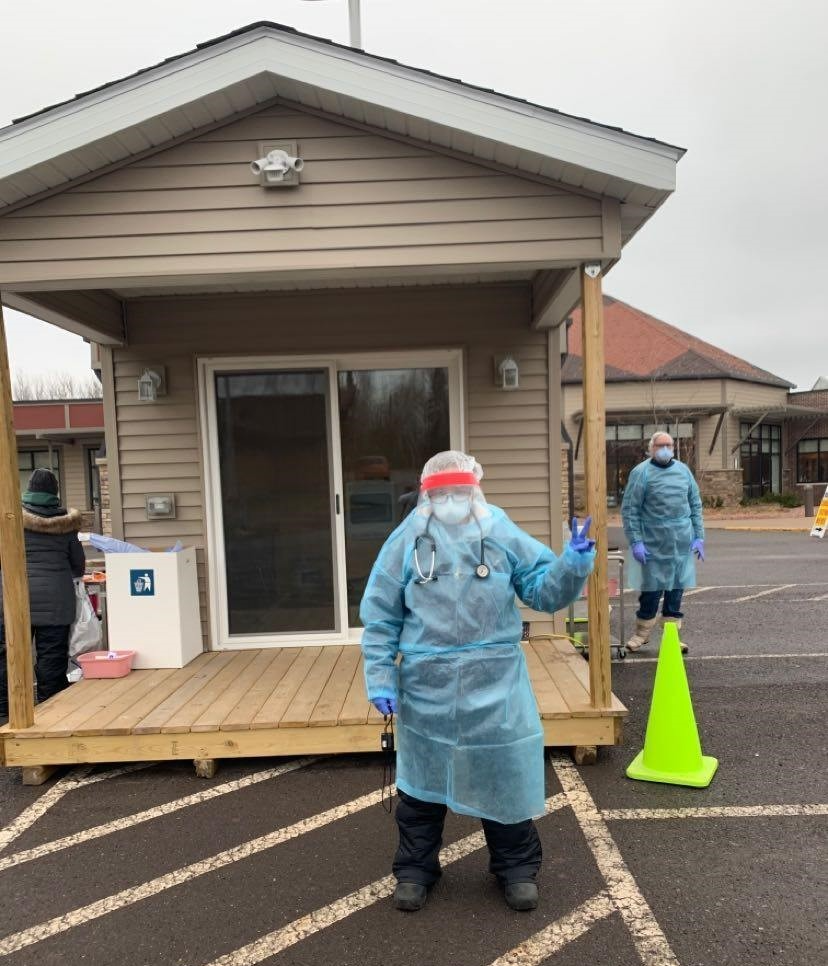
On June 19, 2024, Avery Nennmann, Paige Gavin, Daria Dzen, and Martha Greenwald interviewed Dr. Eileen Gavin on her experiences during 2020-2021 of the pandemic for the More Than a Healthcare Hero Initiative. Dr. Gavin currently works as a travel doctor, going where the people need her, with short stints throughout the year in various indigenous reservations across the Upper Midwest. During the first year of the pandemic in 2020, Dr. Gavin was working on the Bad River Reservation in the northernmost part of Wisconsin on Lake Superior. The reservation had one clinic that serviced the entire tribal territory causing most tribal members to travel 30-40 minutes from their residence to receive any sort of medical care. The closest tertiary care hospital was in Duluth, MN, a car ride an hour and forty minutes away.
Dr. Gavin flashing a peace sign in full PPE gear outside of a drive-through clinic on the Bad River Reservation, November 2020.
Dr. Gavin, an outsider to the Bad River Tribe, relied heavily on building doctor/patient relationships with community members who were suspicious of Western medicine. To do this she acknowledged traditional medicine as a healing tool alongside her Western approach to medicine. She contended that she didn’t “have anything [better] to offer them and [was] not going to argue with a 1000+ year practice” during a time filled with such uncertainty and fear. Dr. Gavin also noted that no one was well prepared to deal with a pandemic, especially when it came to tribal governments that are often the last to receive care and feel the effects of policy changes from the federal government. She waited for the Centers for Disease Control and Prevention and the federal government to step in and bring resources, but nothing came. With no one but herself and one other nurse practitioner, Dr. Gavin resolved to creating a system of care to mitigate the weight of the pandemic felt by the community. She anticipated what was coming early in February of 2020 and took it upon herself as an independent contractor to tell the clinic director to close the casino. She began holding meetings to brace for the imminent pandemic. At first, everyone thought she was blowing circumstances out of proportions, but her fail safes became safety rafts in the months to come.
Dr. Gavin likened the initial year of the pandemic as “kind of like being a firefighter” with her gear and respirator on for protection – she saw the fire coming but only had a fire hose to put it out. She stated her “biggest concern was the feeling of helplessness. There was nothing to do, there were no treatments, there was no vaccines, there was just supportive care, even if we hospitalized them.” Since COVID-19 was a novel virus, Dr. Gavin had no idea how it worked or mutated but thankfully Indian Health Services kept the clinic stocked on the necessary PPE to stave off the disease as much as they could. The Native community wanted to protect their elders by keeping them separated and prioritizing their care – a difficult feat as many households were multigenerational.
Alongside the Nurse Practitioner, Dr. Gavin treated all sick patients outdoors, with one day of the week dedicated to only seeing respiratory patients to screen them for COVID or other infectious diseases and diagnose treatment. During the interview, Dr. Gavin mentioned multiple times how overwhelmed and hopeless she was throughout that first year. She was working four-five days a week, with ten-twelve-hour days, and an additional two-three-hour commute from home and loved ones. Despite the medical necessity of the pandemic, Dr. Gavin continued to care for everyday health matters as “we still had to practice medicine. People still got pregnant, people still got pneumonia, people still had diabetes.”
Dr. Gavin disclosed that at the beginning of the pandemic, it was “a lot easier for me to manage it mentally, physically, spiritually, psychologically because I just had that education and pandemics and how they work, and knowing that lots of people are going to die. And I was much more comfortable with that, than a lot of most of the other people that I worked with. Having worked in hospice and palliative medicine, I mean, that’s what you do all day long is death and dying, and you just become used to it just as a natural state of life ending and not as a horrific event, it’s not a failure.” Despite this sentiment, Dr. Gavin was not immune to infection or her own impending burnout.
As the pandemic wore on, she became more depleted and fatigued as the commute and futility of care took its toll on her body and mind. As she dedicated her life to her oath of care, she was not able to be with her aging parents, nor her husband and daughters, which made it more difficult to persevere through the initial year of the pandemic. She said she wished she would have known we would have gotten the vaccine so quickly because she would have had more hope and wouldn’t have been in such a panic during that time. Dr. Gavin reiterated that it “was the most stressful year of my career. Hands down. I can’t stress that enough.” In December of 2020, COVID caught up to Dr. Gavin despite her precautions, leading her to take a year-long break from medicine. Dr. Gavins’s story is reminiscent of the moral injury and fatigue faced by physicians with little resources and an inability to save everyone from a devastating disease.
On the Zoom calls, we are flailing, unprepared, uninformed on practical things. It is also an emotional floundering. . . . I come to dread the Zoom calls, shrouded in shadow. The family shape is changed forever, and nothing makes it more poignant than to slide on my phone screen and no longer see the square with the word ‘Dad.’
In the summer of 2020, as the COVID-19 pandemic raged in the USA, the father of award-winning Nigerian-American author Chimamanda Ngozi Adichie passed away in Africa due to kidney failure. Adichie, confined in Maryland, found herself struggling to respond to the shocking death of a man who was so central to her emotional life. In her book, Notes on Grief, she writes, “On the Zoom calls, we are flailing, unprepared, uninformed on practical things. It is also an emotional floundering. . . . I come to dread the Zoom calls, shrouded in shadow. The family shape is changed forever, and nothing makes it more poignant than to slide on my phone screen and no longer see the square with the word ‘Dad.’ “
How do people manage when they are unable to properly bury and mourn the dead? And how do they manage when they must communicate using technology such as phone calls and Zoom? Adichie’s case is of course not unique: literature abounds with depictions of mourning “gone wrong.” In Shakespeare’s “Hamlet,” the play confronts a dilemma at the core of the disjunction between our normative expectations and our actual practices after death: when things go wrong, how do we try to make them right?
Adichie wrote about “how much grief is about language, the failure of language and the grasping for language.” She echoes countless writers in the past, most famously Virginia Woolf, who wrote that the essence of pain is its inability to be communicated. In a commentary on Woolf, the scholar Elaine Scarry thus says of physical pain: “Whatever pain achieves, it achieves in part through its unsharability, and it ensures this unsharability through its resistance to language. . . . Physical pain does not simply resist language but actively destroys it, bringing about an immediate reversion to a state anterior to language, to the sounds and cries a human being makes before language is learned.” But did language really fail Adichie? Despite her struggle to express her emotional pain, she nonetheless managed to communicate effectively in a magazine essay, subsequently published as a book, that does much of what might expect from an effective funeral: it outlines the processes of grief and mourning while informing the reader about her father as a professional, a spouse, a father, his philosophy of life, his hobbies, etc. There is thus both rupture and continuity in the use of language. Perhaps language always fails us when we struggle to communicate surfeits of meaning, as anyone who has ever given a eulogy or written a condolence letters knows well.
We analyzed the transcripts of 15 recordings of US-based Zoom-mediated funerals to explore the role of language in that technological space (note: we employ pseudonyms to protect the identities of the deceased and their families). We focus on how participants talk about the performance of the funeral itself, using a variety of verbal strategies to adapt to the new circumstances. In these cases, a specific kind of language that linguists call metacommunication successfully provided the participants with the tools to adapt to rapidly changing expectations.
One way that mourners and officiants addressed the inability of people to gather at funerals was to explicitly acknowledge the newness, indeed the strangeness, of holding a funeral over Zoom. Phrased differently, people engaged in metacommunication: they talked about the medium of communication itself. In communicating about communication, one minister began a funeral service in the US for a woman we call Agnes Roberts (note: we use pseudonyms throughout this dispatch): “Today . . . we gather virtually in a way that you probably never imagined that you would need together. . . . We gather online rather than in person.” But instead of immediately conceptualizing the online gathering as inadequate, the minister points out its positive attributes, adding, “and that act itself is an act of communal care staying apart in order that the more vulnerable among us may stay safer.”Only after he stated those words did he point out the problems of an on-line ritual, noting that it is “hard to be together virtually, unable to hug or hold each other. . . . And it will probably be awkward at times glitches might happen screens might freeze up.”
“But still we gather knowing that saying goodbye is all part of the already messy process of grief and loss . . . your love for Agnes will come through across the pixels and Wi-Fi connections and the space between us . . . is sacred ground” – Minister at a Zoom Funeral during the Pandemic
If mourners typically think of funerals held in a solemn and religious setting as to some extent sacred – a set of words and behaviors that are set apart from everyday life and treated with respect and devotion – might they think of a funeral held on Zoom as profane? Although many mourners we have interviewed in recent years have expressed a disdain for rituals mediated by technology, the minister running Agnes’s service noted first, that all grief is, in his words, “messy,” no matter how or where it takes place and second, that even Zoom can be sacred if we want it to be: “But still we gather knowing that saying goodbye is all part of the already messy process of grief and loss . . . your love for Agnes will come through across the pixels and Wi-Fi connections and the space between us . . . is sacred ground.” By re-framing the electronic media as the “space between us” that helped communicate the funeral event as “sacred ground,” rather than as just another COVID-related indignity, the minister implicitly proposed that we view this new experience of ritual in a more positive light. Rather than dwelling on its “messiness,” he highlighted how this medium afforded the opportunity for far flung and vulnerable relatives to participate. While mourners may not be able to “hug or hold each other,” the zoom funeral widened the community of grief and support for the bereaved.
Given the legal restrictions on the number of people who could attend a funeral in the early days of the pandemic, Esther Klein’s daughter Deborah enacted for the mourners a process which many of them could not have experienced without Zoom: Esther’s actual interment and shoveling of dirt onto her lowered casket. Deborah emceed a synchronous video event from a car in the parking lot of a cemetery just before the interment. After acknowledging the unusual circumstances for the more than 100 people on the call, a rabbi led a 20-minute service, followed by short remembrances. As the small traditional synchronous service drew to a close, Deborah noted: “When we get out there we’re gonna use the uh laptop to uh I’ll reverse the camera . . . to give you all a view of the burial . . . I’m gonna turn this around so people can se. . . . We have shovels we brought. . . . You brought your own shovels so you can start shoveling . . . so I’d like to show you what the grave looks like. . . . It’s going to be a little bit of a lag because of the bandwidth but we’ll try to do this as much in sync as possible with the mourners.”
The three and one-half-hour long service for Edith Brown, an elderly Black-American woman who was a prominent member of her community, was a striking mix of synchronous and asynchronous content. The funeral managers made frequent reference to the co-presence of mourners from all over the world. “Today we are joined by the Edith Brown family and friends from across the globe. We have family members from Ghana, Australia, Paris, London, Canada, Maryland. . . . Please ensure your cameras are on.”
Like the Esther Klein memorial, there was a narrative component, essentially a dashcam video recording the drive to the cemetery and the placing of flowers on the grave. This latter journey to the graveside was depicted as part of an exhortation to safety: “Just be careful in the mud. It’s very slippery.” The ritual act of laying the flowers on the grave was itself part of a journey that, while carrying some imagined risk (slipping in the mud), created a diagram of efficacy for the participants: by risking one’s personal safety while succeeding in placing flowers, those witnessing the act are also insinuated into the process of participating in the interment.
Zoom funerals certainly caused tensions and frustrations for officiants and families who had to navigate new kinds of interactions, and new meanings. Some viewed the experience as impoverished, even insulting, due to its lack of tactile experience. Yet others viewed the act of connecting with far-flung relatives, the creation of a safe and sanitary screen for protecting the health of others and the invitations to engage in joint ceremonial actions to be powerful acts of participation and care. Still others valued the ways digital technology paradoxically allowed proximity, close-up visual participation in otherwise inaccessible narrative journeys. What first appears as a failure of appropriate communication compels repair. Then, as participants talk about their acts of communication, they create new meanings. Talk about talk can make people who feel isolated or marginalized part of a moral community; it can make events that are unpracticed and unorganized a part of a new tradition; it can even turn the profane into the sacred.