
Rituals in the Making: a George Washington University research project on memorialization, misinformation, and the consequences of the COVID-19 pandemic

Tag: Funeral

  • Because You Have Already Buried Your Dead 

    Because You Have Already Buried Your Dead 

    Elsa’s Dual Loss in Ecuador’s COVID Crisis1  

    By María José Peláez 


    In the spring of 2020, as Ecuador became an epicenter of Latin America’s COVID-19 outbreak, Elsa Maldonado found herself in a situation that recalls Sophocles’ Antigone. Like the Greek character who defied the state to bury her brother, Elsa embarked on a quest to secure a proper burial for her mother, Marina. Her story reflects on the struggle for dignity in death during a time of overwhelming loss and institutional failure.  


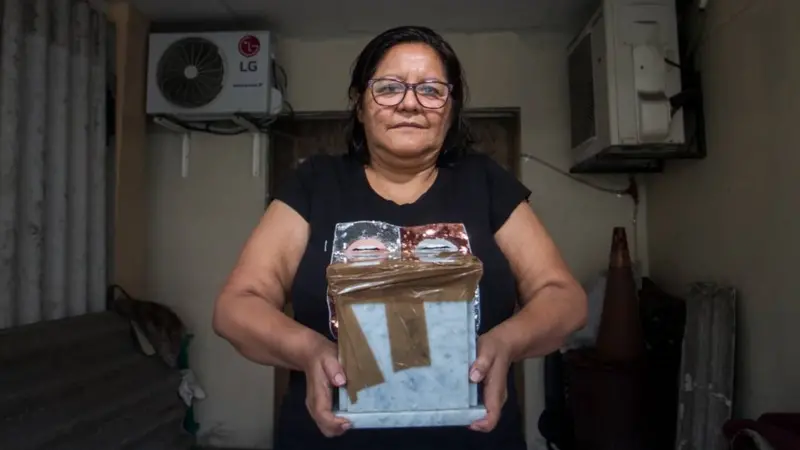
    Photo by: Wladimir Torres for Fund. Periodistas sin Cadenas

    I first learned of Elsa through the Ecuadorian and international news headlines: “Some ashes and a corpse”; “Ten months with the ashes of a stranger in her garage“; “The two bereavements of Elsa Maldonado.”   

    When she agreed to meet me virtually – she in Guayaquil, I in Bogotá – I had imagined her as one of the ghostly figures in Mexican writer Juan Rulfo’s stories, speaking with a resigned temporality and an almost dryness. Instead, I encountered a torrent of emotions and memories, a woman who defied easy categorization.  

    *** 

    Standing amidst the squeezed tulle dresses hanging in her shop – yellow, green, turquoise – Elsa began her story: “First, I would like to tell you that everything you see here was inherited from my mother. Both of us lived off of this business all these years. She was a woman who pushed forward, a strong woman. My mami was not killed by COVID. The hospital killed her.”  

    With that “first,” I understood that Elsa was not just telling a story of loss but reclaiming a narrative that had been taken from her. She would give me both a beginning and an ending.  

    Before delving into the details of her mother’s hospitalization, Elsa paused. “You need to understand,” she said, her voice barely above a whisper, “that for months, I’ve been living with two versions of my mother’s remains. In my garage, there’s a marble urn containing ashes that I was told were hers. But then, they called me about a body in the cemetery. How could I mourn when I didn’t even know which – if either – was truly my mother?”  

    This uncertainty, this doubling of her loss, formed the core of Elsa’s struggle. It was an illustration of the confusion that reigned in Ecuador during the height of the pandemic, where the dead often became as lost as the living.  

    *** 

    On March 25, 2020, Elsa took her mother to the hospital to get treatment for a urinary tract infection. By this time, Ecuador reported the second-largest number of deaths on the continent a number exceeded only by the much more populous Brazil. For Elsa, the “plague” or “bug” was a thing that roamed around, killing everyone she knew, fluttering, and frightening. But she was sure her “mami wasn’t infected.”  

    Elsa, her son Kevin, and her sister spent the entire night driving to every hospital in Guayaquil trying to get her mother admitted. They were all rejecting patients with suspected COVID-19. Elsa insisted her mother did not have “the plague.” With some embarrassment, she confessed, “I went to the private Luis Vernaza hospital in Guayaquil. I knelt to the doorman and said: ‘Here, I give you 100 dollars. Give me a bed, please.’” He refused.  

    When her mother was finally accepted at Los Ceibos Hospital, Elsa noticed they were understaffed. Her mother would have a bed, but no one would attend to her. Still, she kissed her mother’s forehead and promised everything would be all right, as she rushed to get a wheelchair.  

    “‘Mother, they’re going to take care of you, calm down, they’ll take care of you, and we’ll return home,’” she told her. “But there were so many people waiting. At that time, they gave you a bracelet, and depending on its color, you got attention. They gave my mother the yellow one. It meant ‘not urgent.’”  

    The hospital scene Elsa described was nightmarish. The aisles widened and shrank with every step. The rhythmic pumping of ventilators choked her. She came upon a room filled with piled bodies. “No saline, nothing,” Elsa said, just the steady pump.  

    “There, in the hospital, my mom got it [COVID]… there… She died in the early hours of March 26th. My mami caught it there and died there.”  

    Cemeteries are made of bones, but also of paper.  

    What followed was an ordeal of bureaucracy and uncertainty. Elsa’s son, Kevin, was given a death certificate stating that his grandmother “DIED OF PNEUMONIA” and instructions for cremation. But when he returned with an urn of ashes, Elsa knew instinctively – due to her distrust in the way the State managed the pandemic– they weren’t her mother’s. “My son came back half an hour later with a heavy marble urn without a cover. ‘They told me that this is Nana,’ he said. I took out a cover, cleaned it, and put it carefully in the garage, but with the certainty that it was not my mother’s.” Elsa didn’t cry over those ashes. Yet, she couldn’t bring herself to dispose of them, knowing they belonged to someone else’s loved one.   

    For months, Elsa navigated a labyrinth of institutions, each passing responsibility to another. “Nobody knew anything. They all told me they were doing their part and that I needed to escalate my request,” she recalled. Institutions that had been nonexistent or subtly absent in Ecuador before the pandemic began to multiply: the headquarters of…, the board of…, the commissioner of…, the court of… In the face of the floating bodies and the state’s negligence, a suffocating bureaucracy emerged. Cemeteries are made of bones, but also of paper.  

    The violence of bureaucracy reached its peak when an official called, saying, “Mrs. Elsa, we are also contacting you to remind you of your payment of $1,300 for the mortuary services, otherwise you will be charged for the delay. Because you – I remember the exact words – BECAUSE YOU HAVE ALREADY BURIED YOUR DEAD.”  

    These words echo the theme of Gabriel Giorgi’s work on the politics of corpses. The anonymity imposed on the dead during the pandemic created what Giorgi calls “corpses without community, bodies with which the community cannot establish any bond.”2 But Elsa, like many others, resisted this anonymity, insisting on naming and honoring her mother even when faced with unidentified remains.  

    Elsa’s struggle reveals how language can be weaponized to dehumanize the dead and their grieving families. The shift from “body” to “corpse,” the clinical “DIED OF PNEUMONIA” on a death certificate, the bureaucratic “BECAUSE YOU HAVE ALREADY BURIED YOUR DEAD” – all serve to distance the living from the individual humanity of the deceased.  

    Perhaps the most poignant aspect of Elsa’s narrative is what remains unsaid. Our interactions became less about what she was communicating and more about what she was refusing to say. Her silences, her inability, and, at moments, her unwillingness, to fully articulate her loss, voice the pain inflicted by many state and institutional responses to the pandemic.  

    While we often say the dead don’t speak, Elsa’s experience suggests otherwise. The presence of her mother – whether in unidentified ashes or a body in an unmarked grave – becomes a way for death itself to speak. These unclosed presences challenge our understanding of grief and memory in the face of mass casualty events.  

    After months of fighting, Elsa finally received confirmation that her mother’s body had been identified in a cemetery and the state withdrew the 1,300 charges after her case got notoriety in the media. But even then, her distrust of the state was so profound that she asked for a video call to make sure that, this time, the person in the cemetery was indeed her mom. From the pajamas, the blanket, the raised mole on the right shoulder, and the missing bottom tooth – Elsa knew it was her, it was Marina.   

    “I was not afraid of her scarred skin. I wanted to see her,” Elsa said, “I would have carried her myself like Michelangelo’s Pieta if I had been allowed to. I was afraid of the lie, of the simulation in which I have been made to live all this time.”  

    The day Marina died, it is estimated that at least seven hundred people died in Guayaquil. For many, there were no caskets. In a country where one in three people is poor, paying hundreds of dollars for a coffin was not an option. People began to do their private rituals at home. When they could not do it anymore, bodies started appearing here and there, scattered on the pavement.  

    Mauricio Torres for The New York Times/EPA vía Shutterstock.

    At one point, the Mayor’s Office of Guayaquil delivered some cardboard mortuary boxes to avoid exposing the bodies and what Elsa calls “the state’s ineptitude” to the international press. Elsa wanted to know what type of coffin her mother was in. “No, she is not in a coffin,” the coroner told her.  

    The last time I saw Elsa she was still fighting to give her mother a proper burial and a coffin. The state hadn’t picked up the marble urn with the ashes in her garage. Elsa, as she did since the first day, kept taking care of the urn–cleaning it and waiting for a family to find whoever the person in that urn was.   

    ***

    As our conversation ended, Elsa returned to work in her shop. “It’s been dry and scarce,” she said. “Without Marina, things are not the same in the shop.” At that moment, I could almost see Marina moving alongside her daughter through the shimmering, squeezed dresses. Behind every statistic is a deeply personal story of loss, love, and strength to honor those we’ve lost. 


    Endnotes

    1  A longer version of this article was originally published in Spanish by the author at: https://issuu.com/gestiondeproyectos/docs/la_mucura_10

    2 Giorgi, G. (2014) Formas Comunes: Animalidad, Cultura, Biopolítica. Buenos Aires: Eterna Cadencia.

  • Across Pixels and Wi-Fi Connections: Making Zoom Funerals Sacred

    Across Pixels and Wi-Fi Connections: Making Zoom Funerals Sacred

    By Joel Kuipers and Roy Richard Grinker

    Graphic credit: Derek Abella, New York Times

    On the Zoom calls, we are flailing, unprepared, uninformed on practical things. It is also an emotional floundering. . . . I come to dread the Zoom calls, shrouded in shadow. The family shape is changed forever, and nothing makes it more poignant than to slide on my phone screen and no longer see the square with the word ‘Dad.’ 

    In the summer of 2020, as the COVID-19 pandemic raged in the USA, the father of award-winning Nigerian-American author Chimamanda Ngozi Adichie passed away in Africa due to kidney failure.  Adichie, confined in Maryland, found herself struggling to respond to the shocking death of a man who was so central to her emotional life. In her book, Notes on Grief, she writes, “On the Zoom calls, we are flailing, unprepared, uninformed on practical things. It is also an emotional floundering. . . . I come to dread the Zoom calls, shrouded in shadow. The family shape is changed forever, and nothing makes it more poignant than to slide on my phone screen and no longer see the square with the word ‘Dad.’ “

    How do people manage when they are unable to properly bury and mourn the dead?  And how do they manage when they must communicate using technology such as phone calls and Zoom? Adichie’s case is of course not unique: literature abounds with depictions of mourning “gone wrong.” In Shakespeare’s “Hamlet,” the play confronts a dilemma at the core of the disjunction between our normative expectations and our actual practices after death: when things go wrong, how do we try to make them right?

    Adichie wrote about “how much grief is about language, the failure of language and the grasping for language.” She echoes countless writers in the past, most famously Virginia Woolf, who wrote that the essence of pain is its inability to be communicated. In a commentary on Woolf, the scholar Elaine Scarry thus says of physical pain: “Whatever pain achieves, it achieves in part through its unsharability, and it ensures this unsharability through its resistance to language. . . . Physical pain does not simply resist language but actively destroys it, bringing about an immediate reversion to a state anterior to language, to the sounds and cries a human being makes before language is learned.” But did language really fail Adichie? Despite her struggle to express her emotional pain, she nonetheless managed ​​to communicate effectively in a magazine essay, subsequently published as a book, that does much of what might expect from an effective funeral: it outlines the processes of grief and mourning while informing the reader about her father as a professional, a spouse, a father, his philosophy of life, his hobbies, etc. There is thus both rupture and continuity in the use of language. Perhaps language always fails us when we struggle to communicate surfeits of meaning, as anyone who has ever given a eulogy or written a condolence letters knows well.

    We analyzed the transcripts of 15 recordings of US-based Zoom-mediated funerals to explore the role of language in that technological space (note: we employ pseudonyms to protect the identities of the deceased and their families). We focus on how participants talk about the performance of the funeral itself, using a variety of verbal strategies to adapt to the new circumstances. In these cases, a specific kind of language that linguists call metacommunication successfully provided the participants with the tools to adapt to rapidly changing expectations.

    One way that mourners and officiants addressed the inability of people to gather at funerals was to explicitly acknowledge the newness, indeed the strangeness, of holding a funeral over Zoom. Phrased differently, people engaged in metacommunication: they talked about the medium of communication itself. In communicating about communication, one minister began a funeral service in the US for a woman we call Agnes Roberts (note: we use pseudonyms throughout this dispatch): “Today . . . we gather virtually in a way that you probably never imagined that you would need together. . . . We gather online rather than in person.” But instead of immediately conceptualizing the online gathering as inadequate, the minister points out its positive attributes, adding, “and that act itself is an act of communal care staying apart in order that the more vulnerable among us may stay safer.” Only after he stated those words did he point out the problems of an on-line ritual, noting that it is “hard to be together virtually, unable to hug or hold each other. . . . And it will probably be awkward at times glitches might happen screens might freeze up.”

    “But still we gather knowing that saying goodbye is all part of the already messy process of grief and loss . . . your love for Agnes will come through  across the pixels and Wi-Fi connections and the space between us . . . is sacred ground” – Minister at a Zoom Funeral during the Pandemic

    If mourners typically think of funerals held in a solemn and religious setting as to some extent sacred – a set of words and behaviors that are set apart from everyday life and treated with respect and devotion – might they think of a funeral held on Zoom as profane? Although many mourners we have interviewed in recent years have expressed a disdain for rituals mediated by technology, the minister running Agnes’s service noted first, that all grief is, in his words, “messy,” no matter how or where it takes place and second, that even Zoom can be sacred if we want it to be: “But still we gather knowing that saying goodbye is all part of the already messy process of grief and loss . . . your love for Agnes will come through  across the pixels and Wi-Fi connections and the space between us . . . is sacred ground.” By re-framing the electronic media as the “space between us” that helped communicate the funeral event as “sacred ground,” rather than as just another COVID-related indignity, the minister implicitly proposed that we view this new experience of ritual in a more positive light. Rather than dwelling on its “messiness,” he highlighted how this medium afforded the opportunity for far flung and vulnerable relatives to participate. While mourners may not be able to “hug or hold each other,” the zoom funeral widened the community of grief and support for the bereaved.

    Given the legal restrictions on the number of people who could attend a funeral in the early days of the pandemic, Esther Klein’s daughter Deborah enacted for the mourners a process which many of them could not have experienced without Zoom: Esther’s actual interment and shoveling of dirt onto her lowered casket. Deborah emceed a synchronous video event from a car in the parking lot of a cemetery just before the interment.  After acknowledging the unusual circumstances for the more than 100 people on the call, a rabbi led a 20-minute service, followed by short remembrances. As the small traditional synchronous service drew to a close, Deborah noted: “When we get out there we’re gonna use the uh laptop to uh I’ll reverse the camera . . . to give you all a view of the burial . . . I’m gonna turn this around so people can se. . . . We have shovels we brought. . . . You brought your own shovels so you can start shoveling . . . so I’d like to show you what the grave looks like. . . . It’s going to be a little bit of a lag because of the bandwidth but we’ll try to do this as much in sync as possible with the mourners.”

    The three and one-half-hour long service for Edith Brown, an elderly Black-American woman who was a prominent member of her community, was a striking mix of synchronous and asynchronous content. The funeral managers made frequent reference to the co-presence of mourners from all over the world.  “Today we are joined by the Edith Brown family and friends from across the globe. We have family members from Ghana, Australia, Paris, London, Canada, Maryland. . . . Please ensure your cameras are on.”

    Like the Esther Klein memorial, there was a narrative component, essentially a dashcam video recording the drive to the cemetery and the placing of flowers on the grave. This latter journey to the graveside was depicted as part of an exhortation to safety: “Just be careful in the mud. It’s very slippery.” The ritual act of laying the flowers on the grave was itself part of a journey that, while carrying some imagined risk (slipping in the mud), created a diagram of efficacy for the participants: by risking one’s personal safety while succeeding in placing flowers, those witnessing the act are also insinuated into the process of participating in the interment. 

    Zoom funerals certainly caused tensions and frustrations for officiants and families who had to navigate new kinds of interactions, and new meanings. Some viewed the experience as impoverished, even insulting, due to its lack of tactile experience. Yet others viewed the act of connecting with far-flung relatives, the creation of a safe and sanitary screen for protecting the health of others and the invitations to engage in joint ceremonial actions to be powerful acts of participation and care. Still others valued the ways digital technology paradoxically allowed proximity, close-up visual participation in otherwise inaccessible narrative journeys. What first appears as a failure of appropriate communication compels repair. Then, as participants talk about their acts of communication, they create new meanings. Talk about talk can make people who feel isolated or marginalized part of a moral community; it can make events that are unpracticed and unorganized a part of a new tradition; it can even turn the profane into the sacred.

  • ‘When Everything is Stripped Away, What is Left is All We Really Need’

    We approached grief counselors in the greater Washington, D.C. area, to find out how their clients were managing during the pandemic.

    Bunny, a counselor who works at a hospice in Maryland, has been impressed by the creativity and resourcefulness of her clients, clients like Patty. After her mother died of COVID, Patty wanted to give her the same kind of funeral she’d given to her father many years earlier. But there was no gathering, and most hurtful, no flowers. Her mother loved flowers. Before the burial, Patty went to her mother’s house and picked the few azaleas that remained in the yard.

    “I cut sprigs and then tucked them in the grave by the coffin. I think these were more meaningful than store-bought flowers because they were her flowers. Her azaleas.”

    Patty reflected, “I don’t know who said it, but when everything is stripped away, what is left is all we really need.”