Mayar Ibrahim
My grandmother was a dentist and a respected member of the Egyptian syndicate. Everywhere she would go, there was a familiar face. Her network was huge as she made sure to attend every occasion she was invited to. But she rarely went alone; I was always by her side.
Since it was deemed too somber to bring a seven-year-old to funerals and eulogies, together we attended the weddings of people I had never seen before and probably will never see again. I couldn’t care less. It was my time to pursue my favorite hobby, dancing. I danced on top of tables, with guests, with brides and grooms, on my own – you name it – and each time, my grandma was there clapping and smiling.
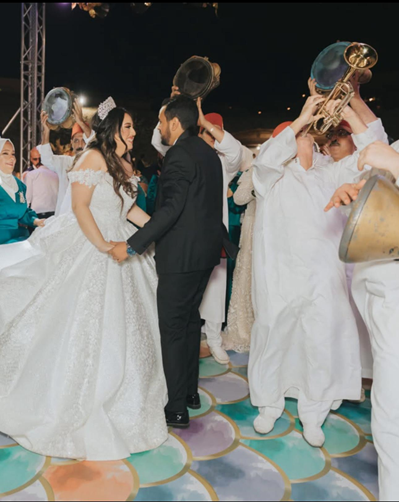
Given the plethora of weddings I have attended, I naively thought that weddings were a fixed ceremony, a ritual with a durable sequence that brings two people together. It used to start with the bride and her father going down the stairs of a hotel as the groom awaits the bride. He then meets them on the way, shakes the father’s hand, and kisses the bride’s forehead. Then, El-Zaffa –the wedding procession–begins. During El-Zaffa, the couple is accompanied by a band, playing festive instruments such as the Riqq, a tambourine-like drum with jingles, the Daff, a larger frame drum without jingles often used in folk music, and a mizmar, a traditional flute usually associated with upper Egypt and folk songs. All the while, the guests walk alongside the couple, clapping and swaying until they enter the wedding hall. This is usually the cue for the recitation of the Asma’ Allah al-Husna (the beautiful names of God derived from the Quran), followed by a love song for the couple’s slow dance, in which guests and couples usually join halfway through the song. [See notes below, for examples]
But a few years back, a few alterations took place and became more visible. It was no longer customary for the bride and her father to take the stairs. They stand on a stage in the wedding hall, arm in arm, as the groom goes up to them, greets the father, who gives him his blessing, and hands him his daughter. Egyptian Zaffa is now replaced by El-Debakkah, a traditional folk dance from the Levant—even if no one from the attendees is from there. The slow dance is no longer shared with other guest couples. Cutting a huge multi-level cake after witnessing a beautiful, usually dramatic entrance is no longer the norm. Now, the newlyweds, usually affluent, spread strawberries and berries on a single-level cake with frosting on it.
Some of these changes took place almost three years ago, especially with the newfound obsession with “following the trend.” It became a good enough reason to adopt a certain practice and incorporate/insert it at your wedding because X or Y influencers have done it before. They set up the bar, and those who can afford it follow. The newlyweds’ spreading of strawberries and berries, for example, comes from the traditional Italian Millefoglie wedding cake that was originally made from layers of puff pastry, cream, and fresh strawberries but was morphed into a sponge cake to cater to a wider audience. Social media platforms, specifically Instagram and TikTok, popularized this trend among many and categorized it as the desired aesthetic to follow.
But there was a time when TikTok did not set extravagant or peculiar trends, an algorithmic time still, but limited to a reel-free Instagram, since the reel feature was launched in August 2020. Before the pandemic, introducing new currents in the wedding industry was confined, to a huge extent, to Instagram. Procured mainly by bloggers and influencers, Instagram’s content defined different wedding aesthetics from those we are used to. Though this visual platform still provides some archetypal visual narrative of what a wedding should be, TikTok now accelerates the circulation of these trends through constant repetition.
TikTok was used extensively during the pandemic as a coping mechanism for isolation or a venue for laughter and short-form humor. Now, it is also used as a search engine, a trend setter, and a news hub.
***
Right before the TikTok craze took momentum, I had yet to be invited to another wedding in which I knew neither the bride nor the groom very well. It started as a joke. A mutual friend introduced us, and Rahma, the bride-to-be back then, invited me, hoping that one day her wedding would materialize. A few months later, specifically in October 2020, the wedding was held in Ain EL-Sokhna, a tiny town southeast of Cairo on the Red Sea. I took the bouquet that day, and I vividly remember the happy event.

The precarity caused by the pandemic shaped Rahma’s wedding preparations. Suddenly, it became more pronounced that this supposedly predictable ceremony, the one imagined to be encrusted in ritual and tradition, showed some signs of ephemerality. Familiar rituals and established patterns were hoping to survive and provide comfort. But everything was pushed aside or paused till further notice. The predictability of the wedding industry, like everything else, has shifted.
Rahma’s wedding was postponed many times. It was supposed to be held in April 2020, but COVID started in late March. The Egyptian government closed schools, universities, restaurants, churches, mosques, and other public spaces, including wedding halls. Consequently, another date was set in July 2020, but still, the halls were closed, and the gatherings were banned. The couple set yet another date in September 2020, which was also postponed. “Finally,” Rahma recalls, “I said: No more postponements—it’s losing its meaning.”
“I postponed it many times, and every time it was canceled because of the curfew and COVID. But the positive thing for me was that my whole life, I had always imagined my wedding by the sea, and I was 100% sure that my parents would not come. I knew they would think it was too far. Then, when all the wedding halls closed because of COVID, I suggested doing it in Sokhna, and people had no other option but to come. This culture of “it’s too far” was always there—my dad even told me, “How will people come? Where will they sit? It’s far.” Even though Sokhna is just an hour and a half away, it was the same as if it were in October (another area on Cairo’s outskirts). I had always wanted this, but I thought Khaled’s family would also say it’s too far since most of them live in Giza and Haram, on the opposite side of Cairo. But when I suggested it, Khaled was supportive—he said, “It’s already a crazy time, let’s do what we want.”

Because it was located 75 miles southeast of Cairo, and it was an hour and a half drive, guests who would normally drop by out of social obligation did not make it. “They could not just pass by for half an hour, like some people would normally do if it were in Cairo, and just leave. Even the people I invited just out of formality didn’t bother, which was a good thing. Whoever came made the effort and showed they cared, and it made Khaled and me feel like we’ll go to these people’s weddings! No matter where, we’ll go.”
Rahma asked her guests not to come if they showed any signs of COVID. Yet, she remained concerned for those who made it for two or three weeks after the wedding. “Four of my close very friends I invited were sick, and some tested positive. I respected that they didn’t come, even though I was upset.” She also, out of sheer concern, asked her father to go upstairs to rest and stay away from people after he witnessed the most important events of the wedding. Unfortunately, this was not the case at many other weddings, including one that was held in September of the same year. It resulted in the death of an entire family in Damietta, 124 miles northeast of Cairo. Another was held in July 2020, despite the official ban, where the guests were wearing medical gowns in solidarity with healthcare workers.

This tension highlights the ethical dilemma of celebrating life events in the shadow of a global health crisis: how do young couples balance the cultural weight of weddings with the medical risks of gathering? In Rahma’s case, precautions were taken, but the anxiety lingered. Her story, however, is not an isolated case, as many families across Egypt faced the same choice: postpone indefinitely or proceed with altered, sometimes covert, celebrations. Others were relieved to be spared the enormous costs of putting on a huge event and settled for a small gathering with their loved ones.

Rituals in Time: Two Dresses, One Bride

The wedding costs were one among many issues that the couple faced. Time constraints were another. Everything was compressed. Canceled once and postponed twice, the wedding began in the afternoon, starting from Katb El-Kitab—the Islamic marriage contract ceremony—to the party at night. “We knew the curfew would close things early, so everything was rushed. We had a guest book, but because we knew that the security would close the place down at 9:30 pm, before I couldn’t even pick it up. Khaled and I didn’t eat, even though there was plenty of food. I barely greeted most people. They closed the lights… before that, you know, most of our weddings end at 3:00 am, like when people actually get bored. But I guess since we started really early, people did not feel that the wedding ended early.” Like many brides, Rahma wore two dresses in her wedding: one for the Kitab Ketab—the ceremony in which the bride and the groom sign the marriage contract—and one for the wedding party. “Because there was no time, there were no professional photos of the dress I wore at night.”
A recent trend that many brides in Egypt follow, including Rahma, is to wear two dresses on the day of their wedding. But because of the time constraints, there were no professional photos taken of the party dress—just quick phone photos. “We are used to weddings ending at 3:00 am, like when people actually get bored at the end.”
Despite all these challenges, Rahma remembers how happy her guests were to go to a wedding after all such a long time and how energized the staff were following stagnation and uncertainty. “The DJ, for instance, hadn’t worked in a long time, so you could see how happy he was. Even a friend of mine, who’s a doctor, is usually very reserved—at the wedding video, she’s dancing freely. Normally, she would just clap politely. But everyone was suffocated after months of lockdown, so they were ready to let go. Everyone actually came, which was surprising. Even people who might not have made it in Cairo came to Sokhna, maybe because no one had been to a wedding for such a long time, and mine was the first one after many months.” In mid-September, the government announced that wedding ceremonies and cultural events were allowed to be held in open-air venues starting from September 21 after banning them for months. It was allowed that open-air weddings of a maximum of 300 people, but Rahma was told otherwise.
Surveillance
Throughout the wedding, local coastguards and other guards from the armed forces were going around and counting guests. “They told me and Khaled that we had three more people than the 120 limit, and they wanted to close it down because the rules were strict: only 120 guests allowed, since it was COVID, and we were too many for a small space. It was similar in Cairo as well—if you exceeded the limit, they would shut the wedding down, but we managed.”

It might be counterintuitive to think that the pandemic had a positive impact, but in Rahma’s case, it allowed her to have the wedding of her dreams with her loved ones. “I would never have had my wedding in Sokhna if it hadn’t been for COVID. No one would have agreed. But the halls were closed, and I said: Guys, we’re doing it there—whoever wants to come, comes.”
The pandemic also allowed Rahma and Khaled to explore Egypt in a different way. Because the airports were shut, the couple spent 21 days traveling around and rediscovering parts of Egypt. “Yes, we spent enough money to go to Bali, and I had always dreamed of going abroad like everyone else. But I was so happy in Egypt. This completely changed how I see my country. I always imagined the sea abroad was cleaner, better. But the entertainment and quality in Hurghada and Sahl Hasheesh was actually very high—clean, fun, world-class, and still your own country where people know how to host you. The views of the sea are unlike anywhere else. I never once thought: “This is just like abroad.” No—Marsa Alam’s Sea is unique. Maldives? The weather there isn’t always good, always raining, and you have to go at a specific season. Bali? I was scared of the insects anyway.”
References
Arab News. “Egyptian Family of Five Dies of COVID-19 after Attending Wedding.” Arab News, September 24, 2020. https://www.arabnews.com/node/1739631/middle-east.
Kershner, Isabel. “Virus Weddings in the Arab World: Love and Celebration Amid the Pandemic.” The New York Times, April 25, 2020. https://www.nytimes.com/2020/04/25/world/middleeast/virus-weddings-arab.html
Ramadan Al Sherbini. “COVID-19: Guests in Medical Gowns at Egyptian Wedding.” Gulf News, June 12, 2021. https://gulfnews.com/world/mena/covid-19-guests-in-medical-gowns-at-egyptian-wedding-1.79862820
Reuters. 2020. “Egypt to Allow Wedding Ceremonies, Cultural Events in Open-Air Venues.” Reuters, September 14, 2020. https://www.reuters.com/article/world/egypt-to-allow-wedding-ceremonies-cultural-events-in-open-air-venues-idUSKBN2652JQ/
United Nations Office on Drugs and Crime (UNODC). COVID-19 and the Impact on Prisons in Egypt. Cairo: United Nations Office on Drugs and Crime, Regional Office for the Middle East and North Africa, 2020. https://www.unodc.org/documents/middleeastandnorthafrica/2020/COVID19/COVID_19_Egypt_Final.pdf.
Notes
- Example of “caking up” trend. Spreading of strawberries: https://www.tiktok.com/@cake_up_egypt/video/7515519604953746706
- Example of the “stage phenomenon”: https://www.youtube.com/watch?v=ZW9JNem-G08&list=RDTNpREhGVq_w&index=12
- The bride goes down the stairs with her father (example): https://www.youtube.com/watch?v=sTZhdlrHIpw&list=RDTNpREhGVq_w&index=4
- Wedding procession example: https://www.youtube.com/watch?v=oLdROw7vIc0